
Homework Answers

Add Answer to:
The diagram below shows several points along the path of a hypothetical planet as it orbits...
The diagram below shows several points along the path of a hypothetical planet as it orbits...
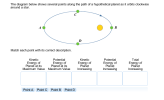 The diagram below shows several points along the path of a hypothetical planet as it orbits clockwise around a star. Match each point with its correct description.
Problem 1 Planetary Orbits Consider the two-body problem for a planet-star system. The planet, of mass...
 Problem 1 Planetary Orbits Consider the two-body problem for a planet-star system. The planet, of mass m, is initially in a circular orbit of radius r and angular speed w about the star, of mass M. (i) What is the gravitational potential energy of the system, U? What is the kinetic energy of the planet, K? What is the total energy of the system, E = K +U? (ii) The star suddenly loses half of its mass, M + M/2....
An object moves counter-clockwise along the circular path shown below. As it moves along the path...
 An object moves counter-clockwise along the circular path shown below. As it moves along the path its acceleration vector continuously points toward point S. The object speeds up at P, Q, and R. slows down at P, Q, and R. speeds up at P and slows down at R. slows down at P and speeds up at R. speeds up at Q. slows down at Q. No object can execute such a motion. An object moves counter-clockwise along the circular...
The diagram below shows an ADIAS model for a hypothetical economy which is initially in a...
 The diagram below shows an ADIAS model for a hypothetical economy which is initially in a short-run equilibrium at point A Price Level O A. implementing an expansionary fiscal policy OB. increasing government purchases. OC. decreasing government transfer payments. OD. increasing the net tax rate OE decreasing the net tax rate
2) The figure shows the potential energy diagram of a particle oscillating on a spring. a)...
 2) The figure shows the potential energy diagram of a particle oscillating on a spring. a) What is the spring's equilibrium length? b) The particle's turning points are at 16 cm and 24 cm. Draw the total energy line and label it Kinetic Energy (J) Potential Energy (J) 16 20 12 24 28 x(cm) Stuttga yom 1620 c) What is the particle's maximum kinetic energy? d) Sketch the particle's kinetic energy as a function of position. e) What will be...
(Figure 1) shows the potential-energy diagram and the total energy line of a particle oscillating on a spring
 (Figure 1) shows the potential-energy diagram and the total energy line of a particle oscillating on a spring. where r represents the length of the spring. Part C What is the particle's maximum kinetic energy? Part D What will be the turning points if the particle's total energy is doubled?
Each diagram below shows the location of two or more wires and several points in space...
 Each diagram below shows the location of two or more wires and
several points in space labeled A, B,
C, etc. In each diagram, the magnetic field at one or more of
the points is zero. For each diagram: A, B, C, D
Determine the point or points where the magnetic field is
zero.
Determine the direction of the magnetic field at each of the
other points.
Write an expression for the magnitude of the magnetic field at
each point....
Each diagram below shows the location of two or more wires and
several points in space labeled A, B,
C, etc. In each diagram, the magnetic field at one or more of
the points is zero. For each diagram: A, B, C, D
Determine the point or points where the magnetic field is
zero.
Determine the direction of the magnetic field at each of the
other points.
Write an expression for the magnitude of the magnetic field at
each point....
The diagram below shows an ADIAS model for a hypothetical economy which is initially in a...
 The diagram below shows an ADIAS model for a hypothetical economy which is initially in a short-run equilibrium at point A Y AS 120 B Price Level A 90 D 70 AD OOO A. decreasing government transfer payments. B. decreasing the net tax rate. C. implementing an expansionary fiscal policy. O D. increasing government purchases. 40 of 40 (32 complete) 120 90 D 70 E AD 400 600 700 750 Real GDP FIGURE 24-7 Refer to Figure 24-7. The government...
this is one question with many parts, thanks for the help! A Imagine a negatively charged...
 this is one question with many parts, thanks for the
help!
A Imagine a negatively charged particle, A approaching another negatively charged particle, B, along the path shown in the diagram. A moves from point X to point Y. These two particles form an isolated system, which means no work is done by external forces; therefore, the system's total energy does not change. A foelsan clectrical force (an repelling force) from B while it approaches B. Therefore, work is done...
this is one question with many parts, thanks for the
help!
A Imagine a negatively charged particle, A approaching another negatively charged particle, B, along the path shown in the diagram. A moves from point X to point Y. These two particles form an isolated system, which means no work is done by external forces; therefore, the system's total energy does not change. A foelsan clectrical force (an repelling force) from B while it approaches B. Therefore, work is done...
1. The diagram below shows an AD/AS model for a hypothetical economy. The economy begins in...
 1. The diagram below shows an AD/AS model for a hypothetical economy. The economy begins in long-run equilibrium at point A. Price Level - AD, -t-AD₂ 1250 700 800 900 1000 Real GDP C. Describe a plausible economic event (ie. Shock) that could have shifted the AD curve from AD1 to AD2? D. Please describe the adjustment process that would return the economy to its long-run equilibrium following the negative aggregate demand shock shown in the diagram.
 The diagram below shows several points along the path of a hypothetical planet as it orbits clockwise around a star. Match each point with its correct description.
 Problem 1 Planetary Orbits Consider the two-body problem for a planet-star system. The planet, of mass m, is initially in a circular orbit of radius r and angular speed w about the star, of mass M. (i) What is the gravitational potential energy of the system, U? What is the kinetic energy of the planet, K? What is the total energy of the system, E = K +U? (ii) The star suddenly loses half of its mass, M + M/2....
 An object moves counter-clockwise along the circular path shown below. As it moves along the path its acceleration vector continuously points toward point S. The object speeds up at P, Q, and R. slows down at P, Q, and R. speeds up at P and slows down at R. slows down at P and speeds up at R. speeds up at Q. slows down at Q. No object can execute such a motion. An object moves counter-clockwise along the circular...
 The diagram below shows an ADIAS model for a hypothetical economy which is initially in a short-run equilibrium at point A Price Level O A. implementing an expansionary fiscal policy OB. increasing government purchases. OC. decreasing government transfer payments. OD. increasing the net tax rate OE decreasing the net tax rate
 2) The figure shows the potential energy diagram of a particle oscillating on a spring. a) What is the spring's equilibrium length? b) The particle's turning points are at 16 cm and 24 cm. Draw the total energy line and label it Kinetic Energy (J) Potential Energy (J) 16 20 12 24 28 x(cm) Stuttga yom 1620 c) What is the particle's maximum kinetic energy? d) Sketch the particle's kinetic energy as a function of position. e) What will be...
 Each diagram below shows the location of two or more wires and
several points in space labeled A, B,
C, etc. In each diagram, the magnetic field at one or more of
the points is zero. For each diagram: A, B, C, D
Determine the point or points where the magnetic field is
zero.
Determine the direction of the magnetic field at each of the
other points.
Write an expression for the magnitude of the magnetic field at
each point....
Each diagram below shows the location of two or more wires and
several points in space labeled A, B,
C, etc. In each diagram, the magnetic field at one or more of
the points is zero. For each diagram: A, B, C, D
Determine the point or points where the magnetic field is
zero.
Determine the direction of the magnetic field at each of the
other points.
Write an expression for the magnitude of the magnetic field at
each point....
 The diagram below shows an ADIAS model for a hypothetical economy which is initially in a short-run equilibrium at point A Y AS 120 B Price Level A 90 D 70 AD OOO A. decreasing government transfer payments. B. decreasing the net tax rate. C. implementing an expansionary fiscal policy. O D. increasing government purchases. 40 of 40 (32 complete) 120 90 D 70 E AD 400 600 700 750 Real GDP FIGURE 24-7 Refer to Figure 24-7. The government...
 this is one question with many parts, thanks for the
help!
A Imagine a negatively charged particle, A approaching another negatively charged particle, B, along the path shown in the diagram. A moves from point X to point Y. These two particles form an isolated system, which means no work is done by external forces; therefore, the system's total energy does not change. A foelsan clectrical force (an repelling force) from B while it approaches B. Therefore, work is done...
this is one question with many parts, thanks for the
help!
A Imagine a negatively charged particle, A approaching another negatively charged particle, B, along the path shown in the diagram. A moves from point X to point Y. These two particles form an isolated system, which means no work is done by external forces; therefore, the system's total energy does not change. A foelsan clectrical force (an repelling force) from B while it approaches B. Therefore, work is done...
 1. The diagram below shows an AD/AS model for a hypothetical economy. The economy begins in long-run equilibrium at point A. Price Level - AD, -t-AD₂ 1250 700 800 900 1000 Real GDP C. Describe a plausible economic event (ie. Shock) that could have shifted the AD curve from AD1 to AD2? D. Please describe the adjustment process that would return the economy to its long-run equilibrium following the negative aggregate demand shock shown in the diagram.
Most questions answered within 3 hours.
-
Where is the error in this code sequence?
String s1 = "Hello";
String s2 = "ello";...
asked 10 months ago -
Financial data for Joel de Paris, Inc., for last year
follow:
Joel de Paris, Inc.
Balance...
asked 10 months ago -
Consider this reaction:
Al2(SO4)3 (aq)+ BaCl3
(aq) Al2Cl6 (aq)- +
3BaSO4(s) . What is the...
asked 10 months ago -
Suppose that Savneet is considering increasing her
recent random sample from 20 car rentals to 40...
asked 10 months ago -
Trucks arrive at an unloading terminal at an average rate of 120
per hour.
Trucks arrive...
asked 10 months ago -
Why are methanol and ethanol completely soluble in water while
octanol is not very little soluble....
asked 10 months ago -
A facilities manager at a university reads in a research report
that the mean amount of...
asked 10 months ago -
When the CuSO4 is rehydrated by adding water to the anhydrous
compound, is this an endothermic...
asked 10 months ago -
A ray of sunlight is passing from diamond into crown glass; the
angle of incidence is...
asked 10 months ago -
A block of mass 0.249 kg is placed on top of a light, vertical
spring of...
asked 10 months ago -
how do the kidneys compensate in the presences of acidosis
a) trigger hyperventilate
b) reserve acid...
asked 10 months ago -
Question 501 pts
The rental rate of capital to the firm increases. Which of the
following...
asked 10 months ago