
Homework Answers
The correct answer is OPTION A i.e the central nervous system.
Explanation
Mind and body are two very different concepts. These are affected by each other and studies have shown that there are various psychological explanations which shows how the mind affects the body.
The only explanation given by the René Descartes is that the mind affects the body through the central nervous system.
Their are are also various other explanations given by Descartes which shows that the mind and body are separated from each other and it is still an issue of debate that what is the relationship between the thought and consciousness in the human mind, even though the mind is connected or effects the body through the central nervous system.
The central nervous system of human body is responsible for controlling the most functions of mind and body. It consists of brain and spinal cord and all the parts of the body are connected through peripheral nervous system. So the obivious result is that every part of our body is connected through central nervous system and it can also be said that the mind affects the body through the central nervous system.
Add Answer to:
According to Descartes, the mind affects the body through the central nervous system. the heart. the...
5.1. What are the two main divisions of the vertebrate nervous system? A) parasympathetic and sympathetic...
 5.1. What are the two main divisions of the vertebrate nervous system? A) parasympathetic and sympathetic B) autonomic and sympathetic nervous system C) Brain and Spinal Cord D) Central Nervous System and Peripheral Nervous System 5.2. What are the three major structures that make up the diencephalon? A) The medulla, the pituitary gland, and the hindbrain B) The thalamus, hypothalamus and pituitary gland c) The pons, the hypothalamus, and the optic tract D) The motor cortex, the occipital lobe, and...
Descartes considers reality to be comprised of two substances body and mind. True or False
Descartes considers reality to be comprised of two substances body and mind. True or False
Answer with 3 paragraphs and please no plagiarizing. What is Descartes Mind-Body Problem? (i.e. hint –...
Answer with 3 paragraphs and please no plagiarizing. What is Descartes Mind-Body Problem? (i.e. hint – how many substances exist in the universe for Descartes).
Lead is a toxic metal that affects the central nervous system. A Pb-contaminated water sample contains...
Lead is a toxic metal that affects the central nervous system. A Pb-contaminated water sample contains 0.0012 % Pb by mass. What volume of the water in milliliters contains 155 mg of Pb? (Assume that the density of the solution is 1.0 g/mL.) Express your answer using two significant figures.
1)Lipid-soluble hormones move easily through the body attached to a carrier protein to reach their destination;...
1)Lipid-soluble hormones move easily through the body attached to a carrier protein to reach their destination; they also bind to receptors within the cell to activate them. Which of the following fits this description a- carbohydrate hormones b-Most biogenic amines c-Steroid hormones d-Peptide and polypeptide hormones 2) Which of the following are stimulation mechanisms that cause a gland to secrete a hormone? A) nervous system, hormonal, humoral B) enzymatic, nervous system, humoral C) nervous system, enzymatic, hormonal D) enzymatic, hormonal,...
Uppers stimulate which system of the body? central nervous system O digestive system circulatory system O...
 Uppers stimulate which system of the body? central nervous system O digestive system circulatory system O endocrine system Question 15 5 pts Which of the following are appropriate first aid measures for a coral snakebite? Owash the wound with soap and water apply a mild pressure bandage keep the victim calm all of these answers are correct
Descartes believes that there exists both 'mind' and 'matter' (or 'body' - same thing). Smart believes...
Descartes believes that there exists both 'mind' and 'matter' (or 'body' - same thing). Smart believes that there is only 'matter', or the material/physical world, and everything else, including thoughts, sensations and other apparently 'mental' processes are really just physical processes at the bottom. Which view do you find more plausible? Explain why.
b.Describe the effect of metabolic acidosis on respiration and on the central nervous system. c.In an...
b.Describe the effect of metabolic acidosis on respiration and on the central nervous system. c.In an elderly person with respiratory acidosis due to chronic respiratory congestion, why would decreased kidney function be so dangerous? d.If serum pH decreases to 7.1 because of severe renal disease, explain the change that has occurred in the buffer pair and the effect of this change on the central nervous system. E.Explain why sublingual administration is faster than oral administration. F.How would severe kidney or...
A major distinction between the central nervous system and the peripheral nervous system is that in...
A major distinction between the central nervous system and the peripheral nervous system is that in the peripheral nervous system, there are no neurons, only glial cells. there are no nerves, only individual neurons. neurons and parts of neurons are inside the brain and spinal cord. neurons and parts of neurons are outside the brain and spinal cord.
Adrenaline, also called epinephrine, is produced in the body and circulates in the blood. It affects...
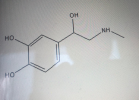 Adrenaline, also called epinephrine, is produced in the body and
circulates in the blood. It affects the autonomic nervous system
(nerves that are not under voluntary control) such as the force of
contractions by the heart or the dilation of the pupils in the eye.
Indicate the number of chiral centres in the adrenaline
molecule.
OH NH Ho Ho
Adrenaline, also called epinephrine, is produced in the body and
circulates in the blood. It affects the autonomic nervous system
(nerves that are not under voluntary control) such as the force of
contractions by the heart or the dilation of the pupils in the eye.
Indicate the number of chiral centres in the adrenaline
molecule.
OH NH Ho Ho
 5.1. What are the two main divisions of the vertebrate nervous system? A) parasympathetic and sympathetic B) autonomic and sympathetic nervous system C) Brain and Spinal Cord D) Central Nervous System and Peripheral Nervous System 5.2. What are the three major structures that make up the diencephalon? A) The medulla, the pituitary gland, and the hindbrain B) The thalamus, hypothalamus and pituitary gland c) The pons, the hypothalamus, and the optic tract D) The motor cortex, the occipital lobe, and...
 Uppers stimulate which system of the body? central nervous system O digestive system circulatory system O endocrine system Question 15 5 pts Which of the following are appropriate first aid measures for a coral snakebite? Owash the wound with soap and water apply a mild pressure bandage keep the victim calm all of these answers are correct
 Adrenaline, also called epinephrine, is produced in the body and
circulates in the blood. It affects the autonomic nervous system
(nerves that are not under voluntary control) such as the force of
contractions by the heart or the dilation of the pupils in the eye.
Indicate the number of chiral centres in the adrenaline
molecule.
OH NH Ho Ho
Adrenaline, also called epinephrine, is produced in the body and
circulates in the blood. It affects the autonomic nervous system
(nerves that are not under voluntary control) such as the force of
contractions by the heart or the dilation of the pupils in the eye.
Indicate the number of chiral centres in the adrenaline
molecule.
OH NH Ho Ho
Most questions answered within 3 hours.
-
Where is the error in this code sequence?
String s1 = "Hello";
String s2 = "ello";...
asked 10 months ago -
Financial data for Joel de Paris, Inc., for last year
follow:
Joel de Paris, Inc.
Balance...
asked 10 months ago -
Consider this reaction:
Al2(SO4)3 (aq)+ BaCl3
(aq) Al2Cl6 (aq)- +
3BaSO4(s) . What is the...
asked 10 months ago -
Suppose that Savneet is considering increasing her
recent random sample from 20 car rentals to 40...
asked 10 months ago -
Trucks arrive at an unloading terminal at an average rate of 120
per hour.
Trucks arrive...
asked 10 months ago -
Why are methanol and ethanol completely soluble in water while
octanol is not very little soluble....
asked 10 months ago -
A facilities manager at a university reads in a research report
that the mean amount of...
asked 10 months ago -
When the CuSO4 is rehydrated by adding water to the anhydrous
compound, is this an endothermic...
asked 10 months ago -
A ray of sunlight is passing from diamond into crown glass; the
angle of incidence is...
asked 10 months ago -
A block of mass 0.249 kg is placed on top of a light, vertical
spring of...
asked 10 months ago -
how do the kidneys compensate in the presences of acidosis
a) trigger hyperventilate
b) reserve acid...
asked 10 months ago -
Question 501 pts
The rental rate of capital to the firm increases. Which of the
following...
asked 10 months ago