![The following is an equation used to calculate the pH of a solution: pH = log10 H ion concentration] This calculation doesnt](http://img.homeworklib.com/questions/1c1647b0-5d13-11ea-972c-4bbff7051e1c.png?x-oss-process=image/resize,w_560)
Homework Answers
![pH = -log (H30t] pH = -log ( 2x16*4] pha 5.69897] <1 As pH <7, the water is acidic.](http://img.homeworklib.com/questions/1cde3e70-5d13-11ea-be4f-95c5597816d6.png?x-oss-process=image/resize,w_560)
Add Answer to:
What is The pH of the water source ?
The following is an equation used to...
A. What is the pH of an aqueous solution with a hydrogen ion concentration of H...
 A. What is the pH of an aqueous solution with a hydrogen ion concentration of H 20 x 10-'M? pH = B. What is the hydroxide ion concentration, OH"), in an aqueous solution with a hydrogen ion concentration of (H) = 2.0 x 10-'M? [OH-] = C. A monoprotic weak acid, HA, dissociates in water according to the reaction HA(aq) H(aq) + A+ (aq) 3.00 x 10-M, and The equilibrium concentrations of the reactants and products are (HA) = 0.140...
(6) Let's see how the spectator" ions present in solution affect the pH of a weak...
 (6) Let's see how the spectator" ions present in solution affect the pH of a weak acid (a) What is the pH of a 0.0200 M benzoic acid (Ka = 6.28 x 10) solution in water? (b) What is the % dissociation of the benzoic acid in pure water? Now we'll add some "spectator" ions to the solution. If the benzoic acid is dissolved in 0.10 M CaCl2 instead of pure water: (c) Calculate the ionic strength of the solution...
art 4: The pH of Salts Equation for ion reaction with H20 (if any) pH salt...
 art 4: The pH of Salts Equation for ion reaction with H20 (if any) pH salt NaCl NH4Cl I 2.75 Pack + H2O P90 Hast HCLG) I 3.06 Phacot Ha Ou Phat cost a laq) 10.80 K COT H2 Ou HR2CO3 OHT 3.33 KPO₃ + H₂O HKPO+CH K2CO3 KNO Student Name: Instructor Name: EXP #8: POST-LAB (THERE ARE QUESTIONS ON BOTH SIDES!) 1. If a buffer solution comprised of 0.10 M acetic acid and 0.10 M sodium acetate was diluted...
At 25° C the thermodynamic activity product (Kw) for the autopyrolysis of water 21,0 H,0+1 +...
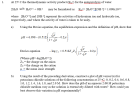 At 25° C the thermodynamic activity product (Kw) for the autopyrolysis of water 21,0 H,0+1 + OH-1 may be formulated as Ku= [H3O+][OH-] = 1.008x10⁻¹⁴ where [H3O+1] and [OH-] represent the activities of hydronium ion and hydroxide ion, respectively, and where the activity of water is taken to be unity. a) Using the Davies equation, the equilibrium expression and the definition of pH, show that pH = 6.998-(0.512 -0.2u 1+ Ju pH = 6.998–(0.512 -0.24 Davies equation -log7: = 0.51227...
1. Write the balanced equation for the reaction between calcium carbonate and hydrochloric acid in water,...
 1. Write the balanced equation for the reaction between calcium carbonate and hydrochloric acid in water, generating aqueous calcium chloride and liberating carbon dioxide gas. (You will need this for Part 1 of the experiment!) 2. Calculate the concentration of one liter of the resulting calcium chloride solution (assuming you started with 102.7 mg of calcium carbonate) in units of molar and millimolar. Also calculate the concentration in "parts-per-million as CaCO3". (Refer to section 13.5 of your textbook, if needed.)...
Calculate the hardness of water in units of mg/L of Caco3 (see equation 15-7) if your titration a...
 Calculate the hardness of water in units of mg/L of Caco3 (see equation 15-7) if your titration at pH 10 resulted in a concentration of 15 mmol/L. Round your answer to the nearest whole number and enter only the numerical answer into the box. In most natural waters, some magnesium ion is present, so expressing water hardness in units of mg/L of CaCO3 is an arbitrary convention that has been adopted for the sake of convenience (or tradition). The conversion...
REPOSTING: observing pH changes in Water and Buffer solutions. the amount added of HCl and NaOH...
 REPOSTING: observing pH changes in Water and Buffer
solutions.
the amount added of HCl and NaOH are both 25mL.
the buffer solution is made of 2grams of NaC2H3O2 and
4 mL of 6M HC2H3O2 in a 50 mL solution (46mL of water). the
solution will contain 2.4x10^-2 mol each of NaC2H3O2 a d
HC2H3O2.
question:
how to answer it (I'm not sure I'm doing it right and
want an expert to double check):
I need help calculating the theoretical and...
REPOSTING: observing pH changes in Water and Buffer
solutions.
the amount added of HCl and NaOH are both 25mL.
the buffer solution is made of 2grams of NaC2H3O2 and
4 mL of 6M HC2H3O2 in a 50 mL solution (46mL of water). the
solution will contain 2.4x10^-2 mol each of NaC2H3O2 a d
HC2H3O2.
question:
how to answer it (I'm not sure I'm doing it right and
want an expert to double check):
I need help calculating the theoretical and...
Part B: pH vs Concentration of Acetic Acid a) Write a chemical equation that shows what...
 Part B: pH vs Concentration of Acetic Acid a) Write a chemical equation that shows what happens when acetic acid is dissolved in water. Be sure to use a double arrow since this is a weak acid) b) Using the measured pH in Part B, calculate the concentrations of all species in the reaction. When finished, enter the results into a table like the following: Concentration pH [H,o ] 2.H7 2. 86 3.18 Acetic Acid [C,H,o2 1 [HC2H 021 1.00...
2. The following question is mostly a review of General Chemistry. You may need to consult...
 2. The following question is mostly a review of General Chemistry. You may need to consult your old chemistry texts or notes from other classes to refresh your memory on some of these things. If you aren't having much success with questions 1-3, at least do question 4, which doesn't really depend on your answer to 1-3. Consider the following balanced equation for the hydrolysis of hydrated metal ions of a. Write the equilibrium constant expression for this dissociation. (The...
all 5&6 5.) Solid silver bromide , AgBr, can be dissolved by adding concentrated aqueous ammonia to give the water- soluble silver-ammonia complex ion. AgBr(s) + 2NH,(aq) U Ag(NH), (aq) + Br(a...
 all 5&6
5.) Solid silver bromide , AgBr, can be dissolved by adding concentrated aqueous ammonia to give the water- soluble silver-ammonia complex ion. AgBr(s) + 2NH,(aq) U Ag(NH), (aq) + Br(aq) (a) Show that this equation is the sum of two other equations, one representing the dissolution of AgBr into its component ions and the other representing the formation of the silver-ammonium complex from silver ion and ammonia (b) Calculate the equilibrium constant for the above reaction K,(AgBr) =...
all 5&6
5.) Solid silver bromide , AgBr, can be dissolved by adding concentrated aqueous ammonia to give the water- soluble silver-ammonia complex ion. AgBr(s) + 2NH,(aq) U Ag(NH), (aq) + Br(aq) (a) Show that this equation is the sum of two other equations, one representing the dissolution of AgBr into its component ions and the other representing the formation of the silver-ammonium complex from silver ion and ammonia (b) Calculate the equilibrium constant for the above reaction K,(AgBr) =...
 A. What is the pH of an aqueous solution with a hydrogen ion concentration of H 20 x 10-'M? pH = B. What is the hydroxide ion concentration, OH"), in an aqueous solution with a hydrogen ion concentration of (H) = 2.0 x 10-'M? [OH-] = C. A monoprotic weak acid, HA, dissociates in water according to the reaction HA(aq) H(aq) + A+ (aq) 3.00 x 10-M, and The equilibrium concentrations of the reactants and products are (HA) = 0.140...
 (6) Let's see how the spectator" ions present in solution affect the pH of a weak acid (a) What is the pH of a 0.0200 M benzoic acid (Ka = 6.28 x 10) solution in water? (b) What is the % dissociation of the benzoic acid in pure water? Now we'll add some "spectator" ions to the solution. If the benzoic acid is dissolved in 0.10 M CaCl2 instead of pure water: (c) Calculate the ionic strength of the solution...
 art 4: The pH of Salts Equation for ion reaction with H20 (if any) pH salt NaCl NH4Cl I 2.75 Pack + H2O P90 Hast HCLG) I 3.06 Phacot Ha Ou Phat cost a laq) 10.80 K COT H2 Ou HR2CO3 OHT 3.33 KPO₃ + H₂O HKPO+CH K2CO3 KNO Student Name: Instructor Name: EXP #8: POST-LAB (THERE ARE QUESTIONS ON BOTH SIDES!) 1. If a buffer solution comprised of 0.10 M acetic acid and 0.10 M sodium acetate was diluted...
 At 25° C the thermodynamic activity product (Kw) for the autopyrolysis of water 21,0 H,0+1 + OH-1 may be formulated as Ku= [H3O+][OH-] = 1.008x10⁻¹⁴ where [H3O+1] and [OH-] represent the activities of hydronium ion and hydroxide ion, respectively, and where the activity of water is taken to be unity. a) Using the Davies equation, the equilibrium expression and the definition of pH, show that pH = 6.998-(0.512 -0.2u 1+ Ju pH = 6.998–(0.512 -0.24 Davies equation -log7: = 0.51227...
 1. Write the balanced equation for the reaction between calcium carbonate and hydrochloric acid in water, generating aqueous calcium chloride and liberating carbon dioxide gas. (You will need this for Part 1 of the experiment!) 2. Calculate the concentration of one liter of the resulting calcium chloride solution (assuming you started with 102.7 mg of calcium carbonate) in units of molar and millimolar. Also calculate the concentration in "parts-per-million as CaCO3". (Refer to section 13.5 of your textbook, if needed.)...
 Calculate the hardness of water in units of mg/L of Caco3 (see equation 15-7) if your titration at pH 10 resulted in a concentration of 15 mmol/L. Round your answer to the nearest whole number and enter only the numerical answer into the box. In most natural waters, some magnesium ion is present, so expressing water hardness in units of mg/L of CaCO3 is an arbitrary convention that has been adopted for the sake of convenience (or tradition). The conversion...
 REPOSTING: observing pH changes in Water and Buffer
solutions.
the amount added of HCl and NaOH are both 25mL.
the buffer solution is made of 2grams of NaC2H3O2 and
4 mL of 6M HC2H3O2 in a 50 mL solution (46mL of water). the
solution will contain 2.4x10^-2 mol each of NaC2H3O2 a d
HC2H3O2.
question:
how to answer it (I'm not sure I'm doing it right and
want an expert to double check):
I need help calculating the theoretical and...
REPOSTING: observing pH changes in Water and Buffer
solutions.
the amount added of HCl and NaOH are both 25mL.
the buffer solution is made of 2grams of NaC2H3O2 and
4 mL of 6M HC2H3O2 in a 50 mL solution (46mL of water). the
solution will contain 2.4x10^-2 mol each of NaC2H3O2 a d
HC2H3O2.
question:
how to answer it (I'm not sure I'm doing it right and
want an expert to double check):
I need help calculating the theoretical and...
 Part B: pH vs Concentration of Acetic Acid a) Write a chemical equation that shows what happens when acetic acid is dissolved in water. Be sure to use a double arrow since this is a weak acid) b) Using the measured pH in Part B, calculate the concentrations of all species in the reaction. When finished, enter the results into a table like the following: Concentration pH [H,o ] 2.H7 2. 86 3.18 Acetic Acid [C,H,o2 1 [HC2H 021 1.00...
 2. The following question is mostly a review of General Chemistry. You may need to consult your old chemistry texts or notes from other classes to refresh your memory on some of these things. If you aren't having much success with questions 1-3, at least do question 4, which doesn't really depend on your answer to 1-3. Consider the following balanced equation for the hydrolysis of hydrated metal ions of a. Write the equilibrium constant expression for this dissociation. (The...
 all 5&6
5.) Solid silver bromide , AgBr, can be dissolved by adding concentrated aqueous ammonia to give the water- soluble silver-ammonia complex ion. AgBr(s) + 2NH,(aq) U Ag(NH), (aq) + Br(aq) (a) Show that this equation is the sum of two other equations, one representing the dissolution of AgBr into its component ions and the other representing the formation of the silver-ammonium complex from silver ion and ammonia (b) Calculate the equilibrium constant for the above reaction K,(AgBr) =...
all 5&6
5.) Solid silver bromide , AgBr, can be dissolved by adding concentrated aqueous ammonia to give the water- soluble silver-ammonia complex ion. AgBr(s) + 2NH,(aq) U Ag(NH), (aq) + Br(aq) (a) Show that this equation is the sum of two other equations, one representing the dissolution of AgBr into its component ions and the other representing the formation of the silver-ammonium complex from silver ion and ammonia (b) Calculate the equilibrium constant for the above reaction K,(AgBr) =...
Most questions answered within 3 hours.
-
Where is the error in this code sequence?
String s1 = "Hello";
String s2 = "ello";...
asked 11 months ago -
Financial data for Joel de Paris, Inc., for last year
follow:
Joel de Paris, Inc.
Balance...
asked 11 months ago -
Consider this reaction:
Al2(SO4)3 (aq)+ BaCl3
(aq) Al2Cl6 (aq)- +
3BaSO4(s) . What is the...
asked 11 months ago -
Suppose that Savneet is considering increasing her
recent random sample from 20 car rentals to 40...
asked 11 months ago -
Trucks arrive at an unloading terminal at an average rate of 120
per hour.
Trucks arrive...
asked 11 months ago -
Why are methanol and ethanol completely soluble in water while
octanol is not very little soluble....
asked 11 months ago -
A facilities manager at a university reads in a research report
that the mean amount of...
asked 11 months ago -
When the CuSO4 is rehydrated by adding water to the anhydrous
compound, is this an endothermic...
asked 11 months ago -
A ray of sunlight is passing from diamond into crown glass; the
angle of incidence is...
asked 11 months ago -
A block of mass 0.249 kg is placed on top of a light, vertical
spring of...
asked 11 months ago -
how do the kidneys compensate in the presences of acidosis
a) trigger hyperventilate
b) reserve acid...
asked 11 months ago -
Question 501 pts
The rental rate of capital to the firm increases. Which of the
following...
asked 11 months ago