The famous Gateway Arch in St. Louis, Missouri, is approximately an inverted catenary. A s...
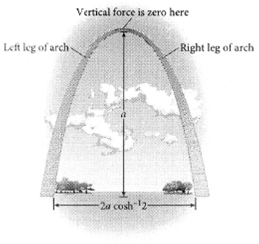
The famous Gateway Arch in St. Louis, Missouri, is approximately an inverted catenary. A simple example of such a curve is given by y(x) = 2a − a cosh (x/a), where y is vertical height and x is horizontal distance, measured from directly under the top of the curve; thus, x varies from −a cosh−1 2 to +a cosh−12, with a the height of the top of the curve (see the figure). Suppose an arch of uniform cross section and density, with total weight W, has this shape. The two legs of the arch exert only horizontal forces on each other at the top; ideally, the stress there should be uniform compression across the cross section.
a) Calculate the vertical and horizontal force components that are acting at the base of each leg of this arch.
b) At what angle should the bottom face of the legs be oriented?
Step-by-Step Solution
THINK: The arch has a functional form that is described by  , where
  is the maximum height and x varies from –acosh-1(2) to +acosh-1(2). We can find the force on the legs of the arch using the fact that the forces must sum to zero and that the sum of the torques must be zero. The arch has a uniform density and cross section, so we can treat the mass in one dimension,
SKETCH:
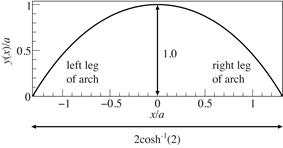
RESEARCH: For static equilibrium, and  To find the vertical forces on the legs, balance all the forces in that direction,
  . The horizontal forces on the legs can be found by considering the torque of the weight of one leg and the horizontal force on the bottom of the leg. The x-coordinate of the center of mass of the left leg is given by
  . To find
  consider
SIMPLIFY: From  .
.  (for each leg). For one leg,
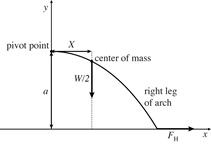
Then  For uniform density, and considering the bridge as a two dimensional object,
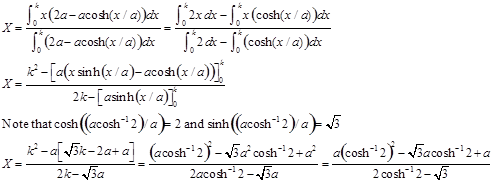
With  known,
  Then,
Then, 
CALCULATE: 

Then,  and
and  so
so 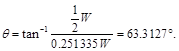
ROUND: We report our answer to three significant digits, This force points down and to the right as shown below.
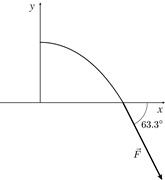
So the bottom face of each leg should make an angle of  with respect to the ground.
DOUBLE-CHECK: An angle of  for an inverse catenary curve arch seems reasonable according to our sketch. Note that the Gateway Arch in Saint Louis is a flattened inverse catenary and does not have a uniform cross section or density.
Most questions answered within 3 hours.
-
Calculating the space time for parallel reactions. m-Xylene is reacted over a ZSM-5 zeolit...
-
Determine Vo and ID for the networks of Fig. 2.160.FIG. 2.160
-
The truck travels along a circular road that has a radius of 50 m at a speed of 4 m/s. F...
-
A state legislature enacted a statute that required any motorcycle operator or passenger...
-
A 1024 × 1024 8-bit image with 5.3 bits/pixel entropy [computed from its histogram using E...
-
In Problem 3.3, we estimated the equationwhere we now report standard errors along with th...
-
In each of the following cases, deduce the nature of the light that is consistent with the...
-
Solve Example 20.5 such that the x, y, z axes move with curvilinear translation, Ω = 0 in...
-
In Fig. 6.43, if i = cos 4t and v = sin 4t, the element is:(a)a resistor(b) a capacitor(c)...
-
Sketch vo for each network of Fig. 2.181 for the input shown.FIG. 2.181
-
(Supplement B) Computing and Reporting Cash Flow Effectsof Sale of Plant and EquipmentDuri...
-
A 350-mL spherical flask contains 0.075 mol of an ideal gas at a temperature of 293 K. Wha...