Using techniques similar to those that were originally developed for miniaturized semicond...
Using techniques similar to those that were originally developed for miniaturized semiconductor electronics, scientists and engineers are creating Micro-Electro-Mechanical Systems (MEMS). An example is an electrothermal actuator that is driven by heating its different parts using an electrical current. The device is used to position 125-µm-diameter optical fibers with submicron resolution and consists of thin and thick silicon arms connected in the shape of a U, as shown in the figure. The arms are not attached to the
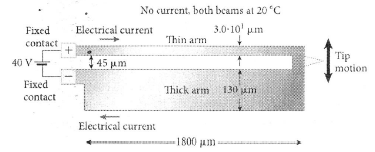
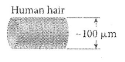
Substrate under the device but are free to move, whereas the electrical contacts (marked + and ‒ in the figure) are attached to the substrate and cannot move. The thin arm is 3.0 ∙101 µm wide, and the thick arm is 130 µ.m wide. Both arms are 1800 µ.m long. Electrical current flows through the arms, causing them to heat up. Although the same current flows through both arms, the thin arm has a greater electrical resistance than the thick arm and therefore dissipates more electrical power and gets substantially hotter. When current is made to flow through the beams, the thin beam reaches a temperature of4.0∙102 °C, and the thick beam reaches a temperature of 2.0∙102 °C. Assume that the temperature in each beam is constant along the entire length of that beam (strictly speaking, this is not the case) and that the two arms remain parallel and bend only in the plane of the paper at higher temperatures. How much and in which direction will the tip move? The linear expansion coefficient for silicon is 3.2∙10‒6 °C‒1 .
Step-by-Step Solution
Request Solution!
We need at least 10 more requests to produce the solution.
0 / 10 have requested this problem solution
The more requests, the faster the answer.
Most questions answered within 3 hours.
-
Calculating the space time for parallel reactions. m-Xylene is reacted over a ZSM-5 zeolit...
-
Determine Vo and ID for the networks of Fig. 2.160.FIG. 2.160
-
The truck travels along a circular road that has a radius of 50 m at a speed of 4 m/s. F...
-
A state legislature enacted a statute that required any motorcycle operator or passenger...
-
A 1024 × 1024 8-bit image with 5.3 bits/pixel entropy [computed from its histogram using E...
-
In Problem 3.3, we estimated the equationwhere we now report standard errors along with th...
-
In each of the following cases, deduce the nature of the light that is consistent with the...
-
Solve Example 20.5 such that the x, y, z axes move with curvilinear translation, Ω = 0 in...
-
In Fig. 6.43, if i = cos 4t and v = sin 4t, the element is:(a)a resistor(b) a capacitor(c)...
-
Sketch vo for each network of Fig. 2.181 for the input shown.FIG. 2.181
-
(Supplement B) Computing and Reporting Cash Flow Effectsof Sale of Plant and EquipmentDuri...
-
A 350-mL spherical flask contains 0.075 mol of an ideal gas at a temperature of 293 K. Wha...