The damping ratio for a critical damped system is:
The damping ratio for a critical damped system is:
1.0
0.5
0
1.05
Homework Answers
 .
.When parts of a vibrating system slide on a dry surface, the damping is:
Question 1 A vibratory system in a vehicle is to be designed with the following parameters: k= 177 N/m, C =2 N-s/m, m=23 kg. Calculate the natural frequency of damped vibration. Quèstion 2 The damping ratio for a critical damped system is: 1.0 0.5 0 1.05 Question 3 A vibratory system is defined by the following parameters: m=2 kg, k = 100N/m, C =4 N-s/m. Determine the damping factor (ε) Question 5 When parts of a vibrating system slide on a dry surface, the damping is: Viscous Coulomb Hyntoretio None of above
A damped system consists of a mass (m = 30kg) supported on a spring and a...
 A damped system consists of a mass (m = 30kg) supported on a spring and a damper in parallel. In an experiment, the period of vibration of this system was measured to be 0.5 seconds, and the ratio of maximum displacement between two successive cycles was determined from the experimental data to be 20. Determine: a. The logarithmic decrement. [2] Q4a. Answer: b. The damping ratio, commenting if this is over-damped, critically damped, or under-damped. [4] Q4b. Answer: c. The...
For the system shown, (a) Determine the damping ratio (b) State whether the system is underdamped,...
 For the system shown, (a) Determine the damping ratio (b) State whether the system is underdamped, critically damped, or overdamped (c) Determine x(t) or 0(t) for the given initial conditions 4 x 10⁴ N/m 3 x 10⁴ N/m 12.5 kg man | C 750 Ns/m x(0) = 3 cm x(O) = 0
A 2nd order dynamic system has a damping ratio, ζ = 0.5 andnatural frequency, ωn...
 A 2nd order dynamic system has a damping ratio, ζ = 0.5 and
natural frequency, ωn = 8 rad/s. The transfer
gain is K = 2. There are no zeros of the system. If the
general response to an impulse input has the form:h(t) =e(–ωnζt)[Asin(ωdt)
+ Bcos(ωdt)]; whereωd is the damped frequency. Find damped natural
frequency (ωd), value of constants A and B. Hint: To find A and B, find h(t) using “Transfer Function Property” and
compare it with the given expression...
A 2nd order dynamic system has a damping ratio, ζ = 0.5 and
natural frequency, ωn = 8 rad/s. The transfer
gain is K = 2. There are no zeros of the system. If the
general response to an impulse input has the form:h(t) =e(–ωnζt)[Asin(ωdt)
+ Bcos(ωdt)]; whereωd is the damped frequency. Find damped natural
frequency (ωd), value of constants A and B. Hint: To find A and B, find h(t) using “Transfer Function Property” and
compare it with the given expression...
Question 3 1 pts If the damping ratio of a second-order system is equal to 0,...
 Question 3 1 pts If the damping ratio of a second-order system is equal to 0, what would you expect the time response of the system to look like? The system will oscillate indefinitely The system will exponentially decay to the steady state value with no oscillations The response will be a damped sinusoid, which decays to the final step value None of the above are correct
Determine the value of the damping coefficient c for which the system is critically damped if...
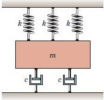 Determine the value of the damping coefficient c for which the system is critically damped if k = 50 kN/m and m = 97 kg.
1. Figure 1 plots a two-order system frequency response at five different damping ratios. The damping...
 1. Figure 1 plots a two-order system frequency response at five different damping ratios. The damping ratios are 0.0.25, 0.5, 1.0, and 2.0, respectively. [5 marks] Output signal y(t) yo) - > (a) Identify the corresponding damping ratio of each curve (A1, A2, A3, A4, AS) tttt (b) If the natural frequency of this two-order system is 100 Hz and its damping ratio is A3, roughly estimate the response time for the system to reach the final stable state. tttttttt
[1] 25 pts. A damped single degree of freedom system without applied forces is oscillating due to...
 solve for #2
[1] 25 pts. A damped single degree of freedom system without applied forces is oscillating due to a certain unknown initial conditions. Derive a response equation x(t) for the following four cases. a. 5 pts. 0 (no damping) b. 10 pts. 0<1 (underdamped) c. 5 pts. >1 (overdamped) d. 5 pts. ๕-1 (critically damped) Here the is the damping ratio of the oscillating system. [2] 5 pts. For the same system of underdamped case with initial conditions...
solve for #2
[1] 25 pts. A damped single degree of freedom system without applied forces is oscillating due to a certain unknown initial conditions. Derive a response equation x(t) for the following four cases. a. 5 pts. 0 (no damping) b. 10 pts. 0<1 (underdamped) c. 5 pts. >1 (overdamped) d. 5 pts. ๕-1 (critically damped) Here the is the damping ratio of the oscillating system. [2] 5 pts. For the same system of underdamped case with initial conditions...
The system parameters of a freely-vibrating damped SDOF system are as follows: Mass, m= 100 kg...
 The system parameters of a freely-vibrating damped SDOF system are as follows: Mass, m= 100 kg Damping Factor, c = 200 kg/s Spring Stiffness, k = 3000 N/m Initial Position, x, = 1 m Initial Velocity, v,= 0 m/s a) Create a MATLAB code and using the specified system parameters compute (using the correct units) the system characteristics: 1) natural (circular) frequency on; 2) cyclic frequency fn; 3) cyclic period p; 4) damped natural (circular) frequency 0g, and 5) damping...
Please solve all parts. Thanks! (4) What is the damping ratio fof the system? (expressed using...
 Please solve all parts. Thanks!
(4) What is the damping ratio fof the system? (expressed using the parameters given) (3 pts) (5) Given m1 = 1, m2-0, c1 = 1, c2-1, ki = 3.k2-3, calculate Wn and( (3 pts) (6) Based on the ζ in (5), this is a system (1 pt) A. Overdamped B. Underdamped C. Critically damped
Please solve all parts. Thanks!
(4) What is the damping ratio fof the system? (expressed using the parameters given) (3 pts) (5) Given m1 = 1, m2-0, c1 = 1, c2-1, ki = 3.k2-3, calculate Wn and( (3 pts) (6) Based on the ζ in (5), this is a system (1 pt) A. Overdamped B. Underdamped C. Critically damped
 A damped system consists of a mass (m = 30kg) supported on a spring and a damper in parallel. In an experiment, the period of vibration of this system was measured to be 0.5 seconds, and the ratio of maximum displacement between two successive cycles was determined from the experimental data to be 20. Determine: a. The logarithmic decrement. [2] Q4a. Answer: b. The damping ratio, commenting if this is over-damped, critically damped, or under-damped. [4] Q4b. Answer: c. The...
 For the system shown, (a) Determine the damping ratio (b) State whether the system is underdamped, critically damped, or overdamped (c) Determine x(t) or 0(t) for the given initial conditions 4 x 10⁴ N/m 3 x 10⁴ N/m 12.5 kg man | C 750 Ns/m x(0) = 3 cm x(O) = 0
 A 2nd order dynamic system has a damping ratio, ζ = 0.5 and
natural frequency, ωn = 8 rad/s. The transfer
gain is K = 2. There are no zeros of the system. If the
general response to an impulse input has the form:h(t) =e(–ωnζt)[Asin(ωdt)
+ Bcos(ωdt)]; whereωd is the damped frequency. Find damped natural
frequency (ωd), value of constants A and B. Hint: To find A and B, find h(t) using “Transfer Function Property” and
compare it with the given expression...
A 2nd order dynamic system has a damping ratio, ζ = 0.5 and
natural frequency, ωn = 8 rad/s. The transfer
gain is K = 2. There are no zeros of the system. If the
general response to an impulse input has the form:h(t) =e(–ωnζt)[Asin(ωdt)
+ Bcos(ωdt)]; whereωd is the damped frequency. Find damped natural
frequency (ωd), value of constants A and B. Hint: To find A and B, find h(t) using “Transfer Function Property” and
compare it with the given expression...
 Question 3 1 pts If the damping ratio of a second-order system is equal to 0, what would you expect the time response of the system to look like? The system will oscillate indefinitely The system will exponentially decay to the steady state value with no oscillations The response will be a damped sinusoid, which decays to the final step value None of the above are correct
 1. Figure 1 plots a two-order system frequency response at five different damping ratios. The damping ratios are 0.0.25, 0.5, 1.0, and 2.0, respectively. [5 marks] Output signal y(t) yo) - > (a) Identify the corresponding damping ratio of each curve (A1, A2, A3, A4, AS) tttt (b) If the natural frequency of this two-order system is 100 Hz and its damping ratio is A3, roughly estimate the response time for the system to reach the final stable state. tttttttt
 solve for #2
[1] 25 pts. A damped single degree of freedom system without applied forces is oscillating due to a certain unknown initial conditions. Derive a response equation x(t) for the following four cases. a. 5 pts. 0 (no damping) b. 10 pts. 0<1 (underdamped) c. 5 pts. >1 (overdamped) d. 5 pts. ๕-1 (critically damped) Here the is the damping ratio of the oscillating system. [2] 5 pts. For the same system of underdamped case with initial conditions...
solve for #2
[1] 25 pts. A damped single degree of freedom system without applied forces is oscillating due to a certain unknown initial conditions. Derive a response equation x(t) for the following four cases. a. 5 pts. 0 (no damping) b. 10 pts. 0<1 (underdamped) c. 5 pts. >1 (overdamped) d. 5 pts. ๕-1 (critically damped) Here the is the damping ratio of the oscillating system. [2] 5 pts. For the same system of underdamped case with initial conditions...
 The system parameters of a freely-vibrating damped SDOF system are as follows: Mass, m= 100 kg Damping Factor, c = 200 kg/s Spring Stiffness, k = 3000 N/m Initial Position, x, = 1 m Initial Velocity, v,= 0 m/s a) Create a MATLAB code and using the specified system parameters compute (using the correct units) the system characteristics: 1) natural (circular) frequency on; 2) cyclic frequency fn; 3) cyclic period p; 4) damped natural (circular) frequency 0g, and 5) damping...
 Please solve all parts. Thanks!
(4) What is the damping ratio fof the system? (expressed using the parameters given) (3 pts) (5) Given m1 = 1, m2-0, c1 = 1, c2-1, ki = 3.k2-3, calculate Wn and( (3 pts) (6) Based on the ζ in (5), this is a system (1 pt) A. Overdamped B. Underdamped C. Critically damped
Please solve all parts. Thanks!
(4) What is the damping ratio fof the system? (expressed using the parameters given) (3 pts) (5) Given m1 = 1, m2-0, c1 = 1, c2-1, ki = 3.k2-3, calculate Wn and( (3 pts) (6) Based on the ζ in (5), this is a system (1 pt) A. Overdamped B. Underdamped C. Critically damped
Most questions answered within 3 hours.
-
Where is the error in this code sequence?
String s1 = "Hello";
String s2 = "ello";...
asked 10 months ago -
Financial data for Joel de Paris, Inc., for last year
follow:
Joel de Paris, Inc.
Balance...
asked 10 months ago -
Consider this reaction:
Al2(SO4)3 (aq)+ BaCl3
(aq) Al2Cl6 (aq)- +
3BaSO4(s) . What is the...
asked 10 months ago -
Suppose that Savneet is considering increasing her
recent random sample from 20 car rentals to 40...
asked 10 months ago -
Trucks arrive at an unloading terminal at an average rate of 120
per hour.
Trucks arrive...
asked 10 months ago -
Why are methanol and ethanol completely soluble in water while
octanol is not very little soluble....
asked 10 months ago -
A facilities manager at a university reads in a research report
that the mean amount of...
asked 10 months ago -
When the CuSO4 is rehydrated by adding water to the anhydrous
compound, is this an endothermic...
asked 10 months ago -
A ray of sunlight is passing from diamond into crown glass; the
angle of incidence is...
asked 10 months ago -
A block of mass 0.249 kg is placed on top of a light, vertical
spring of...
asked 10 months ago -
how do the kidneys compensate in the presences of acidosis
a) trigger hyperventilate
b) reserve acid...
asked 10 months ago -
Question 501 pts
The rental rate of capital to the firm increases. Which of the
following...
asked 10 months ago