
Homework Answers
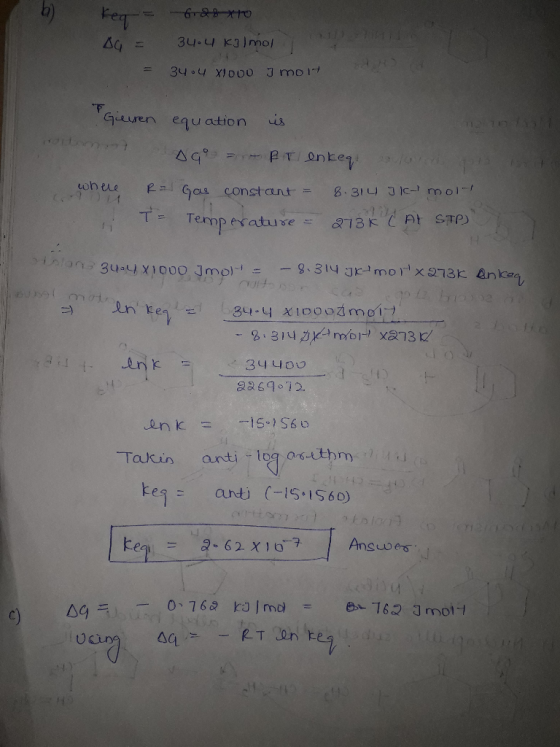
![keq = antilog E7 762 Jmolt --8-314 X 273k IMOINE keq - antio 4.762-12] keq = antilog Co-33573 [keq = 1.398] since keq = [prod](http://img.homeworklib.com/questions/adc036d0-6e56-11ea-a3be-494ac373d58c.png?x-oss-process=image/resize,w_560)
Add Answer to:
I cannot seem to figure it out.
The standard Gibbs-free energy of a system is related...
3. + 2.5/10 points Previous Answers McM8 6.P.012. The standard Gibbs-free energy of a system is related to its equilibr...
 3. + 2.5/10 points Previous Answers McM8 6.P.012. The standard Gibbs-free energy of a system is related to its equilibrium constant through the following equation. AG° = -R·T· In(K) In this equation R is the gas constant, T is the temperature, and the ° next to AG defines the conditions as standard ambient temperature and pressure, i.e. "SATP". (Answer the following questions to three significant figures.) (a) Given an equilibrium constant of 4.53 x 10⁻⁶, what is its standard Gibbs-free...
Calculate the standard change in Gibbs free energy, AGixn , for the given reaction at 25.0...
 Calculate the standard change in Gibbs free energy, AGixn , for the given reaction at 25.0 °C. Consult the table of thermodynamic properties for standard Gibbs free energy of formation values. NH,CI() = NH(aq) + Cl(aq) AGxn = -7.7 kJ/mol Determine the concentration of NH(aq) if the change in Gibbs free energy, AGrxn , for the reaction is –9.53 kJ/mol. [NH] = 0.72 Consider a general reaction enzyme A(aq) = B(aq) The AG® of the reaction is -4.880 kJ mol-....
For a certain chemical reaction, the standard Gibbs free energy of reaction is −141. kJ. Calculate...
For a certain chemical reaction, the standard Gibbs free energy of reaction is −141. kJ. Calculate the temperature at which the equilibrium constant K=3.6 x 10^25.
Calculate the standard change in Gibbs free energy of the following reactions at Standard Ambient Temperature...
 Calculate the standard change in Gibbs free energy of the
following reactions at Standard Ambient Temperature and Pressure
(SATP where T = 25°C and P = 1 atm) and label them as spontaneous
or nonspontaneous.
(a) 2 SO2(g) + O2(g) 2 SO3(g): ΔΗ.-197.8 k , dS.-188.0 J/K kJ, and the reaction is Selectv (b) 2 C6H6(/) + 15 O2(g) 12 CO2(g) + 6 H2O(/); ΔΗ.-6535.0 kJ, S.-439.2 J/K kJ, and the reaction is Select (c) C(diamond); C(graphite); ΔΗ--19 ki, as...
Calculate the standard change in Gibbs free energy of the
following reactions at Standard Ambient Temperature and Pressure
(SATP where T = 25°C and P = 1 atm) and label them as spontaneous
or nonspontaneous.
(a) 2 SO2(g) + O2(g) 2 SO3(g): ΔΗ.-197.8 k , dS.-188.0 J/K kJ, and the reaction is Selectv (b) 2 C6H6(/) + 15 O2(g) 12 CO2(g) + 6 H2O(/); ΔΗ.-6535.0 kJ, S.-439.2 J/K kJ, and the reaction is Select (c) C(diamond); C(graphite); ΔΗ--19 ki, as...
In Class Exercise - The Gibbs Free Energy Change, AG 1) Determining the Standard Gibbs Free...
 In Class Exercise - The Gibbs Free Energy Change, AG 1) Determining the Standard Gibbs Free Energy Change (AGⓇ) for a Chemical Reaction 2) Using AGº to Determine Spontaneity Name: Date: Lab section: Show your work when there are calculations, write units, and use correct significant figures. Consider the following reaction (balanced as written) and thermodynamic data from tables in your book: CO(NH2)2(aq) + H2O(1) ► CO2(g) + 2NH3(g) Substance CO(NH3)2(aq) H00 AH(kJ/mol) 1-391.2 -285.9 -3935 -46.19 S'J/mol K) 173.8...
In Class Exercise - The Gibbs Free Energy Change, AG 1) Determining the Standard Gibbs Free...
 In Class Exercise - The Gibbs Free Energy Change, AG 1) Determining the Standard Gibbs Free Energy Change (AGⓇ) for a Chemical Reaction 2) Using AGº to Determine Spontaneity Name: Date: Lab section: Show your work when there are calculations, write units, and use correct significant figures. Consider the following reaction (balanced as written) and thermodynamic data from tables in your book: CO(NH2)2(aq) + H2O(l) → CO2(g) + 2NH3(g) Substance CO(NH2)2(aq) H2O(1) CO2(g) NH AH° (kJ/mol) -391.2 -285.9 -393.5 -46.19...
A reaction is at equilibrium at 298 K. At 310 K, the Gibbs free energy for the reaction is –12.6 ...
A reaction is at equilibrium at 298 K. At 310 K, the Gibbs free energy for the reaction is –12.6 kJ/mol. Assuming that both entropy and enthalpy are independent of temperature, what are the values of the entropy and enthalpy for this reaction?
Need help with the second part please Calculate the standard change in Gibbs free energy, AGan,...
 Need help with the second part please
Calculate the standard change in Gibbs free energy, AGan, for the given reaction at 25.0 °C. Consult the table of thermodynamic properties for standard Gibbs free energy of formation values. NH CI(s) NH(aq) + CI (aq) kJ/mol -7.67 AGa Determine the concentration of NHt (aq) if the change in Gibbs free energy, AG. for the -9.61 kJ/mol. м INH 676 Enter numeric value
Need help with the second part please
Calculate the standard change in Gibbs free energy, AGan, for the given reaction at 25.0 °C. Consult the table of thermodynamic properties for standard Gibbs free energy of formation values. NH CI(s) NH(aq) + CI (aq) kJ/mol -7.67 AGa Determine the concentration of NHt (aq) if the change in Gibbs free energy, AG. for the -9.61 kJ/mol. м INH 676 Enter numeric value
Calculate the standard Gibbs free energy changes at 25 °C for each of the reactions shown...
 Calculate the standard Gibbs free energy changes at 25 °C for each of the reactions shown below using the Eº values given. Select whether each of these reactions is nonspontaneous, at equilibrium, or spontaneous under standard conditions. (a) 2 Lit(aq) + 2 I'(aq) = 2 Li(s) + 1 12(5) ° = -3.586 V AGC= X kJ/mol nonspontaneous at equilibrium spontaneous (b) 2 CO3+ (aq) + 1 Hg(0) = 2 Co2+ (aq) + 1 Hg2+(aq) ° = 0.988 V AGº =...
What is the standard Gibbs free energy of the reaction, H(aq) - H(aq)+F(aq), if its equilibrium...
 What is the standard Gibbs free energy of the reaction, H(aq) - H(aq)+F(aq), if its equilibrium constant at 298 Kis 7.2 10 A 177 kJfmol O B 17.9 kJ/mol O C -17.9 kJ/mol O D 584 l/mol
 3. + 2.5/10 points Previous Answers McM8 6.P.012. The standard Gibbs-free energy of a system is related to its equilibrium constant through the following equation. AG° = -R·T· In(K) In this equation R is the gas constant, T is the temperature, and the ° next to AG defines the conditions as standard ambient temperature and pressure, i.e. "SATP". (Answer the following questions to three significant figures.) (a) Given an equilibrium constant of 4.53 x 10⁻⁶, what is its standard Gibbs-free...
 Calculate the standard change in Gibbs free energy, AGixn , for the given reaction at 25.0 °C. Consult the table of thermodynamic properties for standard Gibbs free energy of formation values. NH,CI() = NH(aq) + Cl(aq) AGxn = -7.7 kJ/mol Determine the concentration of NH(aq) if the change in Gibbs free energy, AGrxn , for the reaction is –9.53 kJ/mol. [NH] = 0.72 Consider a general reaction enzyme A(aq) = B(aq) The AG® of the reaction is -4.880 kJ mol-....
 Calculate the standard change in Gibbs free energy of the
following reactions at Standard Ambient Temperature and Pressure
(SATP where T = 25°C and P = 1 atm) and label them as spontaneous
or nonspontaneous.
(a) 2 SO2(g) + O2(g) 2 SO3(g): ΔΗ.-197.8 k , dS.-188.0 J/K kJ, and the reaction is Selectv (b) 2 C6H6(/) + 15 O2(g) 12 CO2(g) + 6 H2O(/); ΔΗ.-6535.0 kJ, S.-439.2 J/K kJ, and the reaction is Select (c) C(diamond); C(graphite); ΔΗ--19 ki, as...
Calculate the standard change in Gibbs free energy of the
following reactions at Standard Ambient Temperature and Pressure
(SATP where T = 25°C and P = 1 atm) and label them as spontaneous
or nonspontaneous.
(a) 2 SO2(g) + O2(g) 2 SO3(g): ΔΗ.-197.8 k , dS.-188.0 J/K kJ, and the reaction is Selectv (b) 2 C6H6(/) + 15 O2(g) 12 CO2(g) + 6 H2O(/); ΔΗ.-6535.0 kJ, S.-439.2 J/K kJ, and the reaction is Select (c) C(diamond); C(graphite); ΔΗ--19 ki, as...
 In Class Exercise - The Gibbs Free Energy Change, AG 1) Determining the Standard Gibbs Free Energy Change (AGⓇ) for a Chemical Reaction 2) Using AGº to Determine Spontaneity Name: Date: Lab section: Show your work when there are calculations, write units, and use correct significant figures. Consider the following reaction (balanced as written) and thermodynamic data from tables in your book: CO(NH2)2(aq) + H2O(1) ► CO2(g) + 2NH3(g) Substance CO(NH3)2(aq) H00 AH(kJ/mol) 1-391.2 -285.9 -3935 -46.19 S'J/mol K) 173.8...
 In Class Exercise - The Gibbs Free Energy Change, AG 1) Determining the Standard Gibbs Free Energy Change (AGⓇ) for a Chemical Reaction 2) Using AGº to Determine Spontaneity Name: Date: Lab section: Show your work when there are calculations, write units, and use correct significant figures. Consider the following reaction (balanced as written) and thermodynamic data from tables in your book: CO(NH2)2(aq) + H2O(l) → CO2(g) + 2NH3(g) Substance CO(NH2)2(aq) H2O(1) CO2(g) NH AH° (kJ/mol) -391.2 -285.9 -393.5 -46.19...
 Need help with the second part please
Calculate the standard change in Gibbs free energy, AGan, for the given reaction at 25.0 °C. Consult the table of thermodynamic properties for standard Gibbs free energy of formation values. NH CI(s) NH(aq) + CI (aq) kJ/mol -7.67 AGa Determine the concentration of NHt (aq) if the change in Gibbs free energy, AG. for the -9.61 kJ/mol. м INH 676 Enter numeric value
Need help with the second part please
Calculate the standard change in Gibbs free energy, AGan, for the given reaction at 25.0 °C. Consult the table of thermodynamic properties for standard Gibbs free energy of formation values. NH CI(s) NH(aq) + CI (aq) kJ/mol -7.67 AGa Determine the concentration of NHt (aq) if the change in Gibbs free energy, AG. for the -9.61 kJ/mol. м INH 676 Enter numeric value
 Calculate the standard Gibbs free energy changes at 25 °C for each of the reactions shown below using the Eº values given. Select whether each of these reactions is nonspontaneous, at equilibrium, or spontaneous under standard conditions. (a) 2 Lit(aq) + 2 I'(aq) = 2 Li(s) + 1 12(5) ° = -3.586 V AGC= X kJ/mol nonspontaneous at equilibrium spontaneous (b) 2 CO3+ (aq) + 1 Hg(0) = 2 Co2+ (aq) + 1 Hg2+(aq) ° = 0.988 V AGº =...
 What is the standard Gibbs free energy of the reaction, H(aq) - H(aq)+F(aq), if its equilibrium constant at 298 Kis 7.2 10 A 177 kJfmol O B 17.9 kJ/mol O C -17.9 kJ/mol O D 584 l/mol
Most questions answered within 3 hours.
-
Where is the error in this code sequence?
String s1 = "Hello";
String s2 = "ello";...
asked 11 months ago -
Financial data for Joel de Paris, Inc., for last year
follow:
Joel de Paris, Inc.
Balance...
asked 11 months ago -
Consider this reaction:
Al2(SO4)3 (aq)+ BaCl3
(aq) Al2Cl6 (aq)- +
3BaSO4(s) . What is the...
asked 11 months ago -
Suppose that Savneet is considering increasing her
recent random sample from 20 car rentals to 40...
asked 11 months ago -
Trucks arrive at an unloading terminal at an average rate of 120
per hour.
Trucks arrive...
asked 11 months ago -
Why are methanol and ethanol completely soluble in water while
octanol is not very little soluble....
asked 11 months ago -
A facilities manager at a university reads in a research report
that the mean amount of...
asked 11 months ago -
When the CuSO4 is rehydrated by adding water to the anhydrous
compound, is this an endothermic...
asked 11 months ago -
A ray of sunlight is passing from diamond into crown glass; the
angle of incidence is...
asked 11 months ago -
A block of mass 0.249 kg is placed on top of a light, vertical
spring of...
asked 11 months ago -
how do the kidneys compensate in the presences of acidosis
a) trigger hyperventilate
b) reserve acid...
asked 11 months ago -
Question 501 pts
The rental rate of capital to the firm increases. Which of the
following...
asked 11 months ago