A 2.56-kHz tone is being produced by a speaker with a diameter of 0.211 m. The...
A 2.56-kHz tone is being produced by a speaker with a diameter of 0.211 m. The air temperature changes from 0 to 21 oC. Assuming air to be an ideal gas, find the change in the diffraction angle θ.
Homework Answers

Add Answer to:
A 2.56-kHz tone is being produced by a speaker with a diameter
of 0.211 m. The...
A 3.85-kHz tone is being produced by a speaker with a diameter of 0.259 m. The...
A 3.85-kHz tone is being produced by a speaker with a diameter of 0.259 m. The air temperature changes from 0 to 28 oC. Assuming air to be an ideal gas, find the change in the diffraction angle θ.
Chapter 17, Problem 17 A 3.24-kHz tone is being produced by a speaker with a diameter...
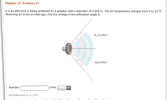 Chapter 17, Problem 17 A 3.24-kHz tone is being produced by a speaker with a diameter of 0.202 m. The air temperature changes from 0 to 23 °C Assuming air to be an ideal gas, find the change in the diffraction angle θ. (colder) θ2(hotter) Number Units the tolerance is +/-290
You're outside on a cold day (Tout = 0 °C)listening to your iPod with an external...
You're outside on a cold day (Tout = 0 °C)listening to your iPod with an external circular speaker having a diameter 0.0730 m. Because of the cold you decide to go inside where the temperature is 31.9 °C. If your favorite song begins with a 9.29-kHz tone, find the change in the diffraction angle of this tone assuming the air behaves as an ideal gas.
A sound wave with a frequency of 12.6 kHz emerges through a circular opening that has...
A sound wave with a frequency of 12.6 kHz emerges through a circular opening that has a diameter of 0.217 m. Find the diffraction angle θ when the sound travels (a) in air and (b) in water. (Note: The speed of sound in air is 343 m/s and the speed of sound in water is 1482 m/s.)
A sound wave with a frequency of 12.1 kHz emerges through a circular opening that has...
A sound wave with a frequency of 12.1 kHz emerges through a circular opening that has a diameter of 0.212 m. Find the diffraction angle θ when the sound travels (a) in air and (b) in water. (Note: The speed of sound in air is 343 m/s and the speed of sound in water is 1482 m/s.)
4. Loudspeakers A and B are vibrating in phase and are playing the same tone, which...
 4. Loudspeakers A and B are vibrating in phase and are playing the same tone, which has a frequency of 250 Hz. They are set up as in Figure 17.7, and point C is located as shown there. However, the distance between the speakers and the distance between speaker B and point C have the same value d. The speed of sound is 343 m/s. What is the smallest value of d, such that constructive interference occurs at point C?...
A sound wave a frequency of 20 kHz emerges through a circular opening that has a...
 A sound wave a frequency of 20 kHz emerges through a circular opening that has a diameter of 0.78 m. Concepts: The diffraction angle for a wave emerging through a circular opening is given by sin(theta) = 1.22 /D, where is the wavelength of the sound and D is the diameter of the opening. What is meant by the diffraction angle? the angle that the sound wave bends away from the center before passing through the opening the location of...
4) The work produced by a piston-cylinder device depends on the pressure inside the cylinder and ...
 visual studio 2017 c++
4) The work produced by a piston-cylinder device depends on the pressure inside the cylinder and the amount the piston moves, resulting in a change in volume inside the cylinder. Mathematically In order to integrate this equation, we need to understand how the pressure changes with the volume. We can model most combustion gases as air and assume that they follow the ideal gas law PV- nRT where P- pressure, kPa, volume, m n- number of...
visual studio 2017 c++
4) The work produced by a piston-cylinder device depends on the pressure inside the cylinder and the amount the piston moves, resulting in a change in volume inside the cylinder. Mathematically In order to integrate this equation, we need to understand how the pressure changes with the volume. We can model most combustion gases as air and assume that they follow the ideal gas law PV- nRT where P- pressure, kPa, volume, m n- number of...
visual studio 2017 c++ 4) The work produced by a piston-cylinder device depends on the pressure...
 visual studio 2017 c++
4) The work produced by a piston-cylinder device depends on the pressure inside the cylinder and the amount the piston moves, resulting in a change in volume inside the cylinder. Mathematically In order to integrate this equation, we need to understand how the pressure changes with the volume. We can model most combustion gases as air and assume that they follow the ideal gas law PV- nRT where P- pressure, kPa, volume, m n- number of...
visual studio 2017 c++
4) The work produced by a piston-cylinder device depends on the pressure inside the cylinder and the amount the piston moves, resulting in a change in volume inside the cylinder. Mathematically In order to integrate this equation, we need to understand how the pressure changes with the volume. We can model most combustion gases as air and assume that they follow the ideal gas law PV- nRT where P- pressure, kPa, volume, m n- number of...
Help please! A volume of 7.16 m 3 of air in a rigid, insulated container fitted...
Help please! A volume of 7.16 m 3 of air in a rigid, insulated container fitted with a paddle wheel is initially at 347 K, 3.6 bar. The air receives 539 kJ by work from the paddle wheel. Assuming the ideal gas model with c v = 0.66 kJ/kg • K, determine for the air: a) The amount of entropy produced, in J/K, and The final temperature in Kelvin
 Chapter 17, Problem 17 A 3.24-kHz tone is being produced by a speaker with a diameter of 0.202 m. The air temperature changes from 0 to 23 °C Assuming air to be an ideal gas, find the change in the diffraction angle θ. (colder) θ2(hotter) Number Units the tolerance is +/-290
 4. Loudspeakers A and B are vibrating in phase and are playing the same tone, which has a frequency of 250 Hz. They are set up as in Figure 17.7, and point C is located as shown there. However, the distance between the speakers and the distance between speaker B and point C have the same value d. The speed of sound is 343 m/s. What is the smallest value of d, such that constructive interference occurs at point C?...
 A sound wave a frequency of 20 kHz emerges through a circular opening that has a diameter of 0.78 m. Concepts: The diffraction angle for a wave emerging through a circular opening is given by sin(theta) = 1.22 /D, where is the wavelength of the sound and D is the diameter of the opening. What is meant by the diffraction angle? the angle that the sound wave bends away from the center before passing through the opening the location of...
 visual studio 2017 c++
4) The work produced by a piston-cylinder device depends on the pressure inside the cylinder and the amount the piston moves, resulting in a change in volume inside the cylinder. Mathematically In order to integrate this equation, we need to understand how the pressure changes with the volume. We can model most combustion gases as air and assume that they follow the ideal gas law PV- nRT where P- pressure, kPa, volume, m n- number of...
visual studio 2017 c++
4) The work produced by a piston-cylinder device depends on the pressure inside the cylinder and the amount the piston moves, resulting in a change in volume inside the cylinder. Mathematically In order to integrate this equation, we need to understand how the pressure changes with the volume. We can model most combustion gases as air and assume that they follow the ideal gas law PV- nRT where P- pressure, kPa, volume, m n- number of...
 visual studio 2017 c++
4) The work produced by a piston-cylinder device depends on the pressure inside the cylinder and the amount the piston moves, resulting in a change in volume inside the cylinder. Mathematically In order to integrate this equation, we need to understand how the pressure changes with the volume. We can model most combustion gases as air and assume that they follow the ideal gas law PV- nRT where P- pressure, kPa, volume, m n- number of...
visual studio 2017 c++
4) The work produced by a piston-cylinder device depends on the pressure inside the cylinder and the amount the piston moves, resulting in a change in volume inside the cylinder. Mathematically In order to integrate this equation, we need to understand how the pressure changes with the volume. We can model most combustion gases as air and assume that they follow the ideal gas law PV- nRT where P- pressure, kPa, volume, m n- number of...
Most questions answered within 3 hours.
-
Where is the error in this code sequence?
String s1 = "Hello";
String s2 = "ello";...
asked 10 months ago -
Financial data for Joel de Paris, Inc., for last year
follow:
Joel de Paris, Inc.
Balance...
asked 10 months ago -
Consider this reaction:
Al2(SO4)3 (aq)+ BaCl3
(aq) Al2Cl6 (aq)- +
3BaSO4(s) . What is the...
asked 10 months ago -
Suppose that Savneet is considering increasing her
recent random sample from 20 car rentals to 40...
asked 10 months ago -
Trucks arrive at an unloading terminal at an average rate of 120
per hour.
Trucks arrive...
asked 10 months ago -
Why are methanol and ethanol completely soluble in water while
octanol is not very little soluble....
asked 10 months ago -
A facilities manager at a university reads in a research report
that the mean amount of...
asked 10 months ago -
When the CuSO4 is rehydrated by adding water to the anhydrous
compound, is this an endothermic...
asked 10 months ago -
A ray of sunlight is passing from diamond into crown glass; the
angle of incidence is...
asked 10 months ago -
A block of mass 0.249 kg is placed on top of a light, vertical
spring of...
asked 10 months ago -
how do the kidneys compensate in the presences of acidosis
a) trigger hyperventilate
b) reserve acid...
asked 10 months ago -
Question 501 pts
The rental rate of capital to the firm increases. Which of the
following...
asked 10 months ago