
Homework Answers
Add Answer to:
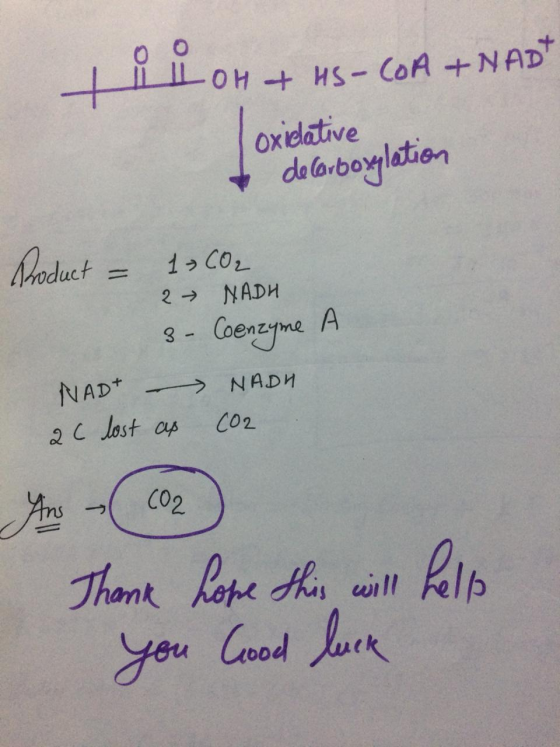
What is a product of the following reaction? oxidative decarboxylation -OH + HS -CoA + NAD+...
Krebs cycle fill in the blank... In reaction 1 of the Krebs cycle, acetyl-CoA formed in...
 Krebs cycle fill in the blank...
In reaction 1 of the Krebs cycle, acetyl-CoA formed in the pyruvate dehydrogenase reaction condenses with the four-carbon compound to form with the elimination of coenzyme A. Since the product has three carboxyl groups, this pathway is referred to as the cycle. In reaction 2 of the Krebs cycle, this product then undergoes to form The enzyme is called aconitase because the compound cis-aconitate is a(n) of the reaction. Reaction 3 eliminates CO_2 to...
Krebs cycle fill in the blank...
In reaction 1 of the Krebs cycle, acetyl-CoA formed in the pyruvate dehydrogenase reaction condenses with the four-carbon compound to form with the elimination of coenzyme A. Since the product has three carboxyl groups, this pathway is referred to as the cycle. In reaction 2 of the Krebs cycle, this product then undergoes to form The enzyme is called aconitase because the compound cis-aconitate is a(n) of the reaction. Reaction 3 eliminates CO_2 to...
4. (20 points) The reaction of pyruvate to acetyl-CoA and CO2 is the bridge reaction between...
 4. (20 points) The reaction of pyruvate to acetyl-CoA and CO2 is the bridge reaction between glycolysis and the citric acid cycle. The carbon atoms in pyruvate are numbered and where they end up in the products are indicated CO0Θ 2 C=O + HS-CoA 3 CH3 Pyruvate S-COA 2C=O 3 CH3 Acetyl CoA Pyruvate dehydrogenase +1 CO2 a) Is C atom 1 in CO2 in a more reduced state or more oxidized state compared to its state in pyruvate? Why?...
Oxaloacetic Acetyl Coa » Coa Citric acid acid NADH NAD Malic acid Isocitric acid Fumaric acid...
 Oxaloacetic Acetyl Coa » Coa Citric acid acid NADH NAD Malic acid Isocitric acid Fumaric acid NAD CO2 NADH FADH, FAD+ Q-ketoglutaric acid Succinic acid CO2 NAD+ Succinyl-CoA NADH ADP+P; ATP Figure 9.1 2 26) Refer to Figure 9.1. If citric acid has six carbon atoms, how many carbon atoms does succinic acid have? A) 4 B) 12 C)5 D)1 E) 6 27) Refer to Figure 9.1. Starting with one acetyl CoA molecule, what is the maximum number of ATP...
please help!! 37. What is the name of the enzyme that creates ATP in oxidative phosphorylation?...
 please help!!
37. What is the name of the enzyme that creates ATP in oxidative phosphorylation? A) ATP synthase B) ATP dehydrogenase C) ATP transferase D ) ATP ligase 38. This is another name for Coenzyme Q. A) ubiquinone B) quantum carrier C) glutamine D) vitamin B6 39. Choose the two correct paths taken by a pair of electrons as it travels down the electron-transport chain. (1) NADH - complex / -- COQ - Complex - C C . complex...
please help!!
37. What is the name of the enzyme that creates ATP in oxidative phosphorylation? A) ATP synthase B) ATP dehydrogenase C) ATP transferase D ) ATP ligase 38. This is another name for Coenzyme Q. A) ubiquinone B) quantum carrier C) glutamine D) vitamin B6 39. Choose the two correct paths taken by a pair of electrons as it travels down the electron-transport chain. (1) NADH - complex / -- COQ - Complex - C C . complex...
The reaction pyruvate + CoA + NAD + rightarrow acetyl CoA + Co2 + NADH, is...
 The reaction pyruvate + CoA + NAD + rightarrow acetyl CoA + Co2 + NADH, is catalyzed by pyruvate dehydrogenase. If an inhibitor of this enzyme was added to cells, then ___ levels in the cytoplasm would increase. A. Oxygen B. NADH C. Pyruvate D. Acetyl CoA E. CO2 Which of the following types cells is matched with the WRONG stem cell category? A. embryonic of stem cells: pluripotent B. embryonic germ cells: pluripotent C. hematopoietic stem cells: multipotent D....
Biochem: please label the following biochemical pathways with the name of each compound, the enzyme involved...
 Biochem: please label the following biochemical pathways with
the name of each compound, the enzyme involved in each reaction,
the byproducts of each reaction if there are any (ATP, ADP, NADH,
NADPH, FADH2, CO2, H2O etc.) and
if possible where reaction is capable of occuring (cytosol,
mitochondria, etc.) and the type of reaction (clevage,
transamination, isomerization, hydration, decarboxylation,
etc.)
Thank you
FADH, NAD FAD COA NADH, H COA COA H 1 2 3 H 4 18 NH P-ribose COA çoo...
Biochem: please label the following biochemical pathways with
the name of each compound, the enzyme involved in each reaction,
the byproducts of each reaction if there are any (ATP, ADP, NADH,
NADPH, FADH2, CO2, H2O etc.) and
if possible where reaction is capable of occuring (cytosol,
mitochondria, etc.) and the type of reaction (clevage,
transamination, isomerization, hydration, decarboxylation,
etc.)
Thank you
FADH, NAD FAD COA NADH, H COA COA H 1 2 3 H 4 18 NH P-ribose COA çoo...
Read the following choices and identify the one that is NOT correct. (A) Aerobically, oxidative decarboxylation...
 Read the following choices and identify the one that is NOT correct. (A) Aerobically, oxidative decarboxylation of pyruvate forms acetate that enters the citric acid cycle. (B) In anaerobic muscle, pyruvate is converted to lactate. (C) In yeast growing anaerobically, pyruvate is converted to ethanol. (D) Reduction of pyruvate to lactate regenerates a cofactor essential for glycolysis. (E) Under anaerobic conditions pyruvate does not form because glycolysis does not occur.
10) What is the product of the following reaction? EtMgBr OH OH * * * OH...
 10) What is the product of the following reaction? EtMgBr OH OH * * * OH Page < 3 > of 4 9) What is the major product from the following reaction? ICH MgBe 2.11,0 oooo Page < 3 of 4 8) What is the major product from the following reaction? I.CH,MgBr (204.) OCH, 2. H0 Ye Ye Ye ya 9) What is the major product from the following reaction? ICH MB Page < 2 > of 4 0 Tu...
The reaction catalyzed by malate dehydrogenase, Malate + NAD+ → oxaloacetate + NADH + H+ has...
The reaction catalyzed by malate dehydrogenase, Malate + NAD+ → oxaloacetate + NADH + H+ has a ΔG°′ value of +29.7 kJ · mol−1. (a) Would this reaction occur spontaneously in a cell? (b) How does the citrate synthase reaction (described in Problem 7) promote the malate dehydrogenase reac- tion in the cell? What is the overall change in free energy for the two reactions? 7. Citrate synthase catalyzes the reaction Oxaloacetate + acetyl-CoA → citrate + HS-CoA The standard...
Canvas What is the major organic product obtained from the following reaction? H OH 2 OH...
 Canvas What is the major organic product obtained from the following reaction? H OH 2 OH 1. Os04 2. NaHSO, H20 .st OH OH 3 1 02 3 U Question 54 3.33 pts Question 54 Which functional group below will show a strong peak around 3300 to 3600 cm 1: strong peak at 1700 cm 1, and moderate peak at 1000-1100 cm 1 Carboxylic Acid Carboxylic Ester Amide Alcohol
 Krebs cycle fill in the blank...
In reaction 1 of the Krebs cycle, acetyl-CoA formed in the pyruvate dehydrogenase reaction condenses with the four-carbon compound to form with the elimination of coenzyme A. Since the product has three carboxyl groups, this pathway is referred to as the cycle. In reaction 2 of the Krebs cycle, this product then undergoes to form The enzyme is called aconitase because the compound cis-aconitate is a(n) of the reaction. Reaction 3 eliminates CO_2 to...
Krebs cycle fill in the blank...
In reaction 1 of the Krebs cycle, acetyl-CoA formed in the pyruvate dehydrogenase reaction condenses with the four-carbon compound to form with the elimination of coenzyme A. Since the product has three carboxyl groups, this pathway is referred to as the cycle. In reaction 2 of the Krebs cycle, this product then undergoes to form The enzyme is called aconitase because the compound cis-aconitate is a(n) of the reaction. Reaction 3 eliminates CO_2 to...
 4. (20 points) The reaction of pyruvate to acetyl-CoA and CO2 is the bridge reaction between glycolysis and the citric acid cycle. The carbon atoms in pyruvate are numbered and where they end up in the products are indicated CO0Θ 2 C=O + HS-CoA 3 CH3 Pyruvate S-COA 2C=O 3 CH3 Acetyl CoA Pyruvate dehydrogenase +1 CO2 a) Is C atom 1 in CO2 in a more reduced state or more oxidized state compared to its state in pyruvate? Why?...
 Oxaloacetic Acetyl Coa » Coa Citric acid acid NADH NAD Malic acid Isocitric acid Fumaric acid NAD CO2 NADH FADH, FAD+ Q-ketoglutaric acid Succinic acid CO2 NAD+ Succinyl-CoA NADH ADP+P; ATP Figure 9.1 2 26) Refer to Figure 9.1. If citric acid has six carbon atoms, how many carbon atoms does succinic acid have? A) 4 B) 12 C)5 D)1 E) 6 27) Refer to Figure 9.1. Starting with one acetyl CoA molecule, what is the maximum number of ATP...
 please help!!
37. What is the name of the enzyme that creates ATP in oxidative phosphorylation? A) ATP synthase B) ATP dehydrogenase C) ATP transferase D ) ATP ligase 38. This is another name for Coenzyme Q. A) ubiquinone B) quantum carrier C) glutamine D) vitamin B6 39. Choose the two correct paths taken by a pair of electrons as it travels down the electron-transport chain. (1) NADH - complex / -- COQ - Complex - C C . complex...
please help!!
37. What is the name of the enzyme that creates ATP in oxidative phosphorylation? A) ATP synthase B) ATP dehydrogenase C) ATP transferase D ) ATP ligase 38. This is another name for Coenzyme Q. A) ubiquinone B) quantum carrier C) glutamine D) vitamin B6 39. Choose the two correct paths taken by a pair of electrons as it travels down the electron-transport chain. (1) NADH - complex / -- COQ - Complex - C C . complex...
 The reaction pyruvate + CoA + NAD + rightarrow acetyl CoA + Co2 + NADH, is catalyzed by pyruvate dehydrogenase. If an inhibitor of this enzyme was added to cells, then ___ levels in the cytoplasm would increase. A. Oxygen B. NADH C. Pyruvate D. Acetyl CoA E. CO2 Which of the following types cells is matched with the WRONG stem cell category? A. embryonic of stem cells: pluripotent B. embryonic germ cells: pluripotent C. hematopoietic stem cells: multipotent D....
 Biochem: please label the following biochemical pathways with
the name of each compound, the enzyme involved in each reaction,
the byproducts of each reaction if there are any (ATP, ADP, NADH,
NADPH, FADH2, CO2, H2O etc.) and
if possible where reaction is capable of occuring (cytosol,
mitochondria, etc.) and the type of reaction (clevage,
transamination, isomerization, hydration, decarboxylation,
etc.)
Thank you
FADH, NAD FAD COA NADH, H COA COA H 1 2 3 H 4 18 NH P-ribose COA çoo...
Biochem: please label the following biochemical pathways with
the name of each compound, the enzyme involved in each reaction,
the byproducts of each reaction if there are any (ATP, ADP, NADH,
NADPH, FADH2, CO2, H2O etc.) and
if possible where reaction is capable of occuring (cytosol,
mitochondria, etc.) and the type of reaction (clevage,
transamination, isomerization, hydration, decarboxylation,
etc.)
Thank you
FADH, NAD FAD COA NADH, H COA COA H 1 2 3 H 4 18 NH P-ribose COA çoo...
 Read the following choices and identify the one that is NOT correct. (A) Aerobically, oxidative decarboxylation of pyruvate forms acetate that enters the citric acid cycle. (B) In anaerobic muscle, pyruvate is converted to lactate. (C) In yeast growing anaerobically, pyruvate is converted to ethanol. (D) Reduction of pyruvate to lactate regenerates a cofactor essential for glycolysis. (E) Under anaerobic conditions pyruvate does not form because glycolysis does not occur.
 10) What is the product of the following reaction? EtMgBr OH OH * * * OH Page < 3 > of 4 9) What is the major product from the following reaction? ICH MgBe 2.11,0 oooo Page < 3 of 4 8) What is the major product from the following reaction? I.CH,MgBr (204.) OCH, 2. H0 Ye Ye Ye ya 9) What is the major product from the following reaction? ICH MB Page < 2 > of 4 0 Tu...
 Canvas What is the major organic product obtained from the following reaction? H OH 2 OH 1. Os04 2. NaHSO, H20 .st OH OH 3 1 02 3 U Question 54 3.33 pts Question 54 Which functional group below will show a strong peak around 3300 to 3600 cm 1: strong peak at 1700 cm 1, and moderate peak at 1000-1100 cm 1 Carboxylic Acid Carboxylic Ester Amide Alcohol
Most questions answered within 3 hours.
-
Where is the error in this code sequence?
String s1 = "Hello";
String s2 = "ello";...
asked 11 months ago -
Financial data for Joel de Paris, Inc., for last year
follow:
Joel de Paris, Inc.
Balance...
asked 11 months ago -
Consider this reaction:
Al2(SO4)3 (aq)+ BaCl3
(aq) Al2Cl6 (aq)- +
3BaSO4(s) . What is the...
asked 11 months ago -
Suppose that Savneet is considering increasing her
recent random sample from 20 car rentals to 40...
asked 11 months ago -
Trucks arrive at an unloading terminal at an average rate of 120
per hour.
Trucks arrive...
asked 11 months ago -
Why are methanol and ethanol completely soluble in water while
octanol is not very little soluble....
asked 11 months ago -
A facilities manager at a university reads in a research report
that the mean amount of...
asked 11 months ago -
When the CuSO4 is rehydrated by adding water to the anhydrous
compound, is this an endothermic...
asked 11 months ago -
A ray of sunlight is passing from diamond into crown glass; the
angle of incidence is...
asked 11 months ago -
A block of mass 0.249 kg is placed on top of a light, vertical
spring of...
asked 11 months ago -
how do the kidneys compensate in the presences of acidosis
a) trigger hyperventilate
b) reserve acid...
asked 11 months ago -
Question 501 pts
The rental rate of capital to the firm increases. Which of the
following...
asked 11 months ago