
Homework Answers
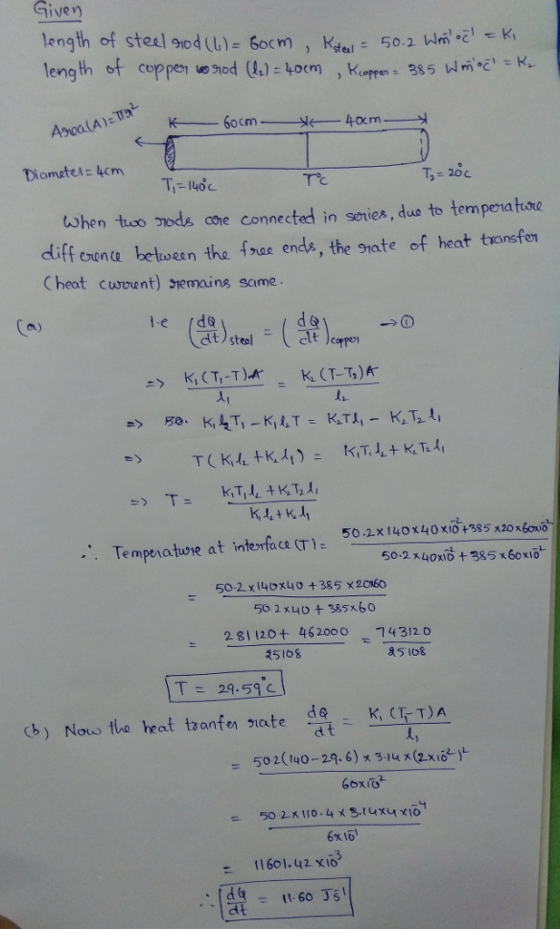
One end of a long rod 3 cm in diameter is inserted into a furnace with the
One end of a long rod 3 cm in diameter is inserted into a furnace with the (3 outer end projecting into the outside air. Once the steady state is reached the temperature of the rod is measured at two points, 15 cm apart and found to be 140°C and 100°C, when the atmospheric air is at 30°C with convection coefficient of 20 W/m2.K. Calculate the thermal conductivity of *.the rod material Consider a stainless steel spoon(k = 15.1 W/m.K), partially...
A long steel bar with a diameter of 4 cm (ρ = 7840 kg / m3...
A long steel bar with a diameter of 4 cm (ρ = 7840 kg / m3 , cp = 580 J / kg ° K, k = 52 W / mK, α = 1.21x10⁻⁵ m2 / s), internal enters the 2 m long moving belt heat treatment furnace at ambient temperature of 900 ° C at 40 ° C. Since the film coefficient in the oven is 100 W / m2K, the center axis temperature of the bar at the...
One end of a 58-cm-long copper rod with a diameter of 2.4 cm is kept at...
One end of a 58-cm-long copper rod with a diameter of 2.4 cm is kept at 500 ∘C, and the other is immersed in water at 24 ∘C. Calculate the heat conduction rate along the rod. Q/t=?
One end of an iron rod 37 cm long and 3.5 cm in diameter is in...
One end of an iron rod 37 cm long and 3.5 cm in diameter is in ice water, the other in boiling water (the figure(Figure 1) ). The rod is well insulated so no heat is lost out the sides. What is the heat-flow rate along the rod? Express your answer using two significant figures. Can you please show me every single step..
One end of a 56-cm-long copper rod with a diameter of 3.0 cm is kept at...
One end of a 56-cm-long copper rod with a diameter of 3.0 cm is kept at 430 ∘C∘, and the other is immersed in water at 24 ∘C∘. Calculate the heat conduction rate along the rod. Express your answer to two significant figures and include the appropriate units.
One end of a 64-cm-long copper rod with a diameter of 2.0 cm is kept at...
One end of a 64-cm-long copper rod with a diameter of 2.0 cm is kept at 500 ∘C, and the other is immersed in water at 24 ∘C. Part A Calculate the heat conduction rate along the rod. Express your answer to two significant figures and include the appropriate units.
One end of a 70-cm-long copper rod with a diameter of 2.4 cm is kept at...
 One end of a 70-cm-long copper rod with a diameter of 2.4 cm is kept at 400 degree C, and the other is immersed in water at 20 degree C. Calculate the heat conduction rate along the rod. Express your answer to two significant figures and include the appropriate units. Q/t
A long slender solid cylindrical rod made of copper is 2 cm in diameter. It is...
A long slender solid cylindrical rod made of copper is 2 cm in diameter. It is taken out of a liquid nitrogen bath at 77 K and exposed to a stream of warm air at a temperature of 50 C. Neglect internal temperature gradients find the time taken by the rod to heat up to a temperature of 10 C if the surface heat transfer coefficient is 20 W/m^2K. For copper, take k=330 W/mK and ?=95*10^-6 m^2/s.
An 80 cm long wire is made by welding a 1.8 mm diameter, 20 cm long...
An 80 cm long wire is made by welding a 1.8 mm diameter, 20 cm long copper wire to a 1.8 mm diameter, 60 cm long iron wire at normal room temperature (20 ∘C). When two wires are connected end to end, their resistances add together. The resistivity of copper is 1.68×10⁻⁸Ωm and the of iron is 1.00×10⁻⁷Ωm. The temperature coefficients are: copper = 0.0039/∘C and iron = 0.0050/∘C. What is the resistance of the iron section of wire?
An 80 cm long wire is made by welding a 1.8 mm diameter, 20 cm long...
An 80 cm long wire is made by welding a 1.8 mm diameter, 20 cm long copper wire to a 1.8 mm diameter, 60 cm long iron wire at normal room temperature (20 ∘C). When two wires are connected end to end, their resistances add together. The resistivity of copper is 1.68×10⁻⁸Ωm and the of iron is 1.00×10⁻⁷Ωm. The temperature coefficients are: copper = 0.0039/∘C and iron = 0.0050/∘C. What is the resistance of the copper section of wire?
 One end of a 70-cm-long copper rod with a diameter of 2.4 cm is kept at 400 degree C, and the other is immersed in water at 20 degree C. Calculate the heat conduction rate along the rod. Express your answer to two significant figures and include the appropriate units. Q/t
Most questions answered within 3 hours.
-
Where is the error in this code sequence?
String s1 = "Hello";
String s2 = "ello";...
asked 11 months ago -
Financial data for Joel de Paris, Inc., for last year
follow:
Joel de Paris, Inc.
Balance...
asked 11 months ago -
Consider this reaction:
Al2(SO4)3 (aq)+ BaCl3
(aq) Al2Cl6 (aq)- +
3BaSO4(s) . What is the...
asked 11 months ago -
Suppose that Savneet is considering increasing her
recent random sample from 20 car rentals to 40...
asked 11 months ago -
Trucks arrive at an unloading terminal at an average rate of 120
per hour.
Trucks arrive...
asked 11 months ago -
Why are methanol and ethanol completely soluble in water while
octanol is not very little soluble....
asked 11 months ago -
A facilities manager at a university reads in a research report
that the mean amount of...
asked 11 months ago -
When the CuSO4 is rehydrated by adding water to the anhydrous
compound, is this an endothermic...
asked 11 months ago -
A ray of sunlight is passing from diamond into crown glass; the
angle of incidence is...
asked 11 months ago -
A block of mass 0.249 kg is placed on top of a light, vertical
spring of...
asked 11 months ago -
how do the kidneys compensate in the presences of acidosis
a) trigger hyperventilate
b) reserve acid...
asked 11 months ago -
Question 501 pts
The rental rate of capital to the firm increases. Which of the
following...
asked 11 months ago