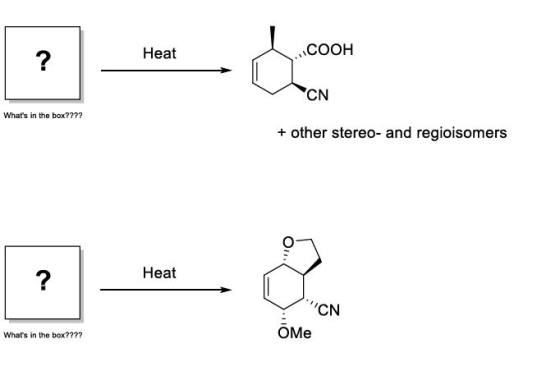
Diels Alder problems
I am trouble determining the reagents that create the product. Show the curved arrows and all steps to get to the product
Homework Answers
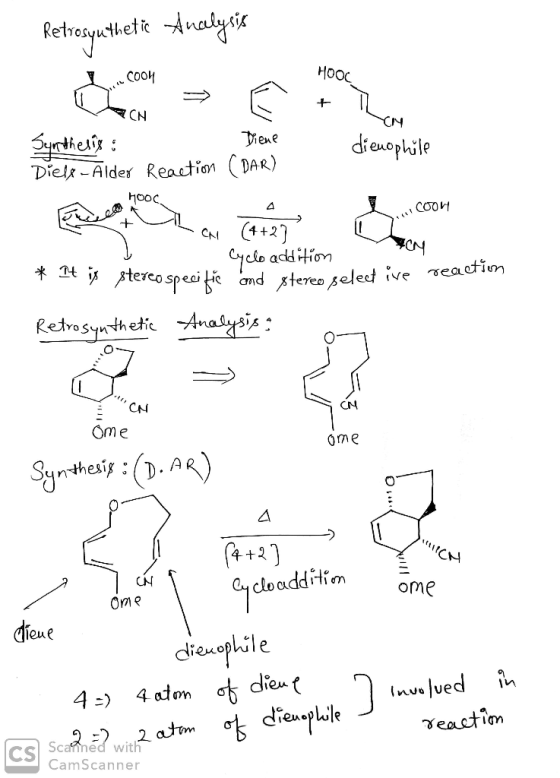
Add Answer to:
Diels Alder problems
I am trouble determining the reagents that create the product.
Show the curved...
Identify major product and include stereochemistry if needed. Show all steps to get product with curved...
 Identify major product and include stereochemistry if needed.
Show all steps to get product with curved arrows to denote electron
movement, please.
1. NaOH 2. H20+ 3. Heat
Identify major product and include stereochemistry if needed.
Show all steps to get product with curved arrows to denote electron
movement, please.
1. NaOH 2. H20+ 3. Heat
Show the most efficient synthesis of the product from the starting material. Show all reagents your...
 Show the most efficient synthesis of the product from the starting material. Show all reagents your need over each arrow, and draw all products and intermediates (do not combine steps). You do not need to show the mechanism for any steps. Show all molecules synthesized along the way, and pay attention to stereochemistry. If a racemic mixture is produced in any step, show both products formed. If you make a mixture of regioisomers in any of the steps, place a...
I need help determining the reagents needed for these reactions. Part 5. Draw the mechanism. Draw...
 I need help determining the reagents needed for these
reactions.
Part 5. Draw the mechanism. Draw the mechanism for each of the following reactions shown below. Be sure to show all steps in the reaction, the intermediates formed at each step, and use curved arrows to track the flow of electrons (20 pts) H2SO4 OH H6-3-sit GO Draw your mechanism below: 4 o Acid so ontsler deprotonation first step 12 000 BP2 + HBO Draw your mechanism below: +HBO, +H-Br
I need help determining the reagents needed for these
reactions.
Part 5. Draw the mechanism. Draw the mechanism for each of the following reactions shown below. Be sure to show all steps in the reaction, the intermediates formed at each step, and use curved arrows to track the flow of electrons (20 pts) H2SO4 OH H6-3-sit GO Draw your mechanism below: 4 o Acid so ontsler deprotonation first step 12 000 BP2 + HBO Draw your mechanism below: +HBO, +H-Br
I need help calculating theoretical yield for my Diels-Alder lab experiment. This reaction was between 1,3-butadiene...
 I need help calculating theoretical yield for my
Diels-Alder lab experiment. This reaction was between 1,3-butadiene
and maleic anhydride, forming cis 1,2,3,6-tetrahydrophthalic
anhydride. In this experiment 1.0g of maleic anhydride was combined
with 1.8g 3-sulfolene and 2 mL dry xylene and refluxed for 30 mins.
6 mL of xylene was added to dissolve solids and then decanted, then
warm pet. ether was added to form crystalline product after
cooling. some of this info may be irrelevant in what is needed...
I need help calculating theoretical yield for my
Diels-Alder lab experiment. This reaction was between 1,3-butadiene
and maleic anhydride, forming cis 1,2,3,6-tetrahydrophthalic
anhydride. In this experiment 1.0g of maleic anhydride was combined
with 1.8g 3-sulfolene and 2 mL dry xylene and refluxed for 30 mins.
6 mL of xylene was added to dissolve solids and then decanted, then
warm pet. ether was added to form crystalline product after
cooling. some of this info may be irrelevant in what is needed...
The first four are correct, I just do not know how to do the following steps...
 The first four are correct, I just do not know how to do the
following steps to get the final product (which I also
know)
Draw the curved arrow mechanism for the reaction of 3-methylbutanenitrile and CH3Li, followed by the addition of acid to give the major product in the fewest steps. When given the choice, draw the arrows that lead to resonance structures with full octets around each atom other than hydrogen. Draw all atoms, electrons, and es if...
The first four are correct, I just do not know how to do the
following steps to get the final product (which I also
know)
Draw the curved arrow mechanism for the reaction of 3-methylbutanenitrile and CH3Li, followed by the addition of acid to give the major product in the fewest steps. When given the choice, draw the arrows that lead to resonance structures with full octets around each atom other than hydrogen. Draw all atoms, electrons, and es if...
Hello, Please help me with my Lab work problems I am having trouble. Please show all...
Hello, Please help me with my Lab work problems I am having trouble. Please show all Work! How would you make a 200 mL solution of 0.5 M NaCl? How would you make a 250 mL of 8% sucrose solution from a 20% sucrose solution? How would you make a 150 mL solution of 5M NaCl from a 8M NaCl? How would you make a 500 mL solution of 10 mM NaCl and 0.2M NaOH? If given a vial of...
I am having trouble computing the NPV for this problem (A). Can you show me the...
I am having trouble computing the NPV for this problem (A). Can you show me the steps to take to calculate this? Grace and Lydia met as engineering students and quickly discovered they both liked building things, gardening and most mountain sports. As students they earned extra money helping to construct geodesic style greenhouse kits. The women worked on about a dozen of these projects and soon realized a couple of things: The kits were expensive They used all virgin materials...
I am having problems with this part of my assignment would i be able to get some help and show the working for these qu...
 I am having problems with this part of my assignment would i be
able to get some help and show the working for these questions
4. (a) A function f has first derivative f'()- and second derivative 12 (z +3) f"(x) It is also known that the function f has r-intercept at (-3, 0), and a y-intercept at (0,0) (i) Find all critical points, and use them to identify the intervals over which you will examine the behaviour of the...
I am having problems with this part of my assignment would i be
able to get some help and show the working for these questions
4. (a) A function f has first derivative f'()- and second derivative 12 (z +3) f"(x) It is also known that the function f has r-intercept at (-3, 0), and a y-intercept at (0,0) (i) Find all critical points, and use them to identify the intervals over which you will examine the behaviour of the...
Complete questions 10-27 PART II: REACTIONS: Here is another different" question. Pretend you have been asked...
 Complete questions 10-27
PART II: REACTIONS: Here is another different" question. Pretend you have been asked by me to put together a bunch of one-step reactions WITH starting materials (your choice), reagents and answers to help me with writing a final exam. For example: let's say I ask you to give an example of a free radical chlorination with a non-cyclic compound. Below would be your answer. As I am pretty sure you can figure out, there are millions of...
Complete questions 10-27
PART II: REACTIONS: Here is another different" question. Pretend you have been asked by me to put together a bunch of one-step reactions WITH starting materials (your choice), reagents and answers to help me with writing a final exam. For example: let's say I ask you to give an example of a free radical chlorination with a non-cyclic compound. Below would be your answer. As I am pretty sure you can figure out, there are millions of...
my chemistry lab did the composition of hydrogen peroxide. i am having trouble trying to fugure...
 my chemistry lab did the composition of hydrogen peroxide. i
am having trouble trying to fugure out how to fill in the table. i
dont understand why “s” is added to pvnrt and how to apply that to
my equation. these are the steps on how to solve but i believe they
are rather confusing. please help! thank you!
i
dont know how to convert PV=nRT so m/s for the initial rate. im
confused on how to fill out the...
my chemistry lab did the composition of hydrogen peroxide. i
am having trouble trying to fugure out how to fill in the table. i
dont understand why “s” is added to pvnrt and how to apply that to
my equation. these are the steps on how to solve but i believe they
are rather confusing. please help! thank you!
i
dont know how to convert PV=nRT so m/s for the initial rate. im
confused on how to fill out the...
 Identify major product and include stereochemistry if needed.
Show all steps to get product with curved arrows to denote electron
movement, please.
1. NaOH 2. H20+ 3. Heat
Identify major product and include stereochemistry if needed.
Show all steps to get product with curved arrows to denote electron
movement, please.
1. NaOH 2. H20+ 3. Heat
 Show the most efficient synthesis of the product from the starting material. Show all reagents your need over each arrow, and draw all products and intermediates (do not combine steps). You do not need to show the mechanism for any steps. Show all molecules synthesized along the way, and pay attention to stereochemistry. If a racemic mixture is produced in any step, show both products formed. If you make a mixture of regioisomers in any of the steps, place a...
 I need help determining the reagents needed for these
reactions.
Part 5. Draw the mechanism. Draw the mechanism for each of the following reactions shown below. Be sure to show all steps in the reaction, the intermediates formed at each step, and use curved arrows to track the flow of electrons (20 pts) H2SO4 OH H6-3-sit GO Draw your mechanism below: 4 o Acid so ontsler deprotonation first step 12 000 BP2 + HBO Draw your mechanism below: +HBO, +H-Br
I need help determining the reagents needed for these
reactions.
Part 5. Draw the mechanism. Draw the mechanism for each of the following reactions shown below. Be sure to show all steps in the reaction, the intermediates formed at each step, and use curved arrows to track the flow of electrons (20 pts) H2SO4 OH H6-3-sit GO Draw your mechanism below: 4 o Acid so ontsler deprotonation first step 12 000 BP2 + HBO Draw your mechanism below: +HBO, +H-Br
 I need help calculating theoretical yield for my
Diels-Alder lab experiment. This reaction was between 1,3-butadiene
and maleic anhydride, forming cis 1,2,3,6-tetrahydrophthalic
anhydride. In this experiment 1.0g of maleic anhydride was combined
with 1.8g 3-sulfolene and 2 mL dry xylene and refluxed for 30 mins.
6 mL of xylene was added to dissolve solids and then decanted, then
warm pet. ether was added to form crystalline product after
cooling. some of this info may be irrelevant in what is needed...
I need help calculating theoretical yield for my
Diels-Alder lab experiment. This reaction was between 1,3-butadiene
and maleic anhydride, forming cis 1,2,3,6-tetrahydrophthalic
anhydride. In this experiment 1.0g of maleic anhydride was combined
with 1.8g 3-sulfolene and 2 mL dry xylene and refluxed for 30 mins.
6 mL of xylene was added to dissolve solids and then decanted, then
warm pet. ether was added to form crystalline product after
cooling. some of this info may be irrelevant in what is needed...
 The first four are correct, I just do not know how to do the
following steps to get the final product (which I also
know)
Draw the curved arrow mechanism for the reaction of 3-methylbutanenitrile and CH3Li, followed by the addition of acid to give the major product in the fewest steps. When given the choice, draw the arrows that lead to resonance structures with full octets around each atom other than hydrogen. Draw all atoms, electrons, and es if...
The first four are correct, I just do not know how to do the
following steps to get the final product (which I also
know)
Draw the curved arrow mechanism for the reaction of 3-methylbutanenitrile and CH3Li, followed by the addition of acid to give the major product in the fewest steps. When given the choice, draw the arrows that lead to resonance structures with full octets around each atom other than hydrogen. Draw all atoms, electrons, and es if...
 I am having problems with this part of my assignment would i be
able to get some help and show the working for these questions
4. (a) A function f has first derivative f'()- and second derivative 12 (z +3) f"(x) It is also known that the function f has r-intercept at (-3, 0), and a y-intercept at (0,0) (i) Find all critical points, and use them to identify the intervals over which you will examine the behaviour of the...
I am having problems with this part of my assignment would i be
able to get some help and show the working for these questions
4. (a) A function f has first derivative f'()- and second derivative 12 (z +3) f"(x) It is also known that the function f has r-intercept at (-3, 0), and a y-intercept at (0,0) (i) Find all critical points, and use them to identify the intervals over which you will examine the behaviour of the...
 Complete questions 10-27
PART II: REACTIONS: Here is another different" question. Pretend you have been asked by me to put together a bunch of one-step reactions WITH starting materials (your choice), reagents and answers to help me with writing a final exam. For example: let's say I ask you to give an example of a free radical chlorination with a non-cyclic compound. Below would be your answer. As I am pretty sure you can figure out, there are millions of...
Complete questions 10-27
PART II: REACTIONS: Here is another different" question. Pretend you have been asked by me to put together a bunch of one-step reactions WITH starting materials (your choice), reagents and answers to help me with writing a final exam. For example: let's say I ask you to give an example of a free radical chlorination with a non-cyclic compound. Below would be your answer. As I am pretty sure you can figure out, there are millions of...
 my chemistry lab did the composition of hydrogen peroxide. i
am having trouble trying to fugure out how to fill in the table. i
dont understand why “s” is added to pvnrt and how to apply that to
my equation. these are the steps on how to solve but i believe they
are rather confusing. please help! thank you!
i
dont know how to convert PV=nRT so m/s for the initial rate. im
confused on how to fill out the...
my chemistry lab did the composition of hydrogen peroxide. i
am having trouble trying to fugure out how to fill in the table. i
dont understand why “s” is added to pvnrt and how to apply that to
my equation. these are the steps on how to solve but i believe they
are rather confusing. please help! thank you!
i
dont know how to convert PV=nRT so m/s for the initial rate. im
confused on how to fill out the...
Most questions answered within 3 hours.
-
Where is the error in this code sequence?
String s1 = "Hello";
String s2 = "ello";...
asked 10 months ago -
Financial data for Joel de Paris, Inc., for last year
follow:
Joel de Paris, Inc.
Balance...
asked 10 months ago -
Consider this reaction:
Al2(SO4)3 (aq)+ BaCl3
(aq) Al2Cl6 (aq)- +
3BaSO4(s) . What is the...
asked 10 months ago -
Suppose that Savneet is considering increasing her
recent random sample from 20 car rentals to 40...
asked 10 months ago -
Trucks arrive at an unloading terminal at an average rate of 120
per hour.
Trucks arrive...
asked 10 months ago -
Why are methanol and ethanol completely soluble in water while
octanol is not very little soluble....
asked 10 months ago -
A facilities manager at a university reads in a research report
that the mean amount of...
asked 10 months ago -
When the CuSO4 is rehydrated by adding water to the anhydrous
compound, is this an endothermic...
asked 10 months ago -
A ray of sunlight is passing from diamond into crown glass; the
angle of incidence is...
asked 10 months ago -
A block of mass 0.249 kg is placed on top of a light, vertical
spring of...
asked 10 months ago -
how do the kidneys compensate in the presences of acidosis
a) trigger hyperventilate
b) reserve acid...
asked 10 months ago -
Question 501 pts
The rental rate of capital to the firm increases. Which of the
following...
asked 10 months ago