
Homework Answers

An ideal gas enclosed in a volume V is composed of N identical particles in equilibrium...
An ideal gas enclosed in a volume V is composed of N identical particles in equilibrium at temperature T. (a) Write down the N-particle classical partition function Z in terms of the single-particle partition function ζ, and show that Z it can be written as ln(Z)=N(ln (V/N) + 3/2ln(T)+σ (1) where σ does not depend on either N, T or V . (b) From Equation 1 derive the mean energy E, the equation of state of the ideal gas and...
1 The Gibbs Paradox Consider N particles, each of mass m, in a 3-dimensional volume V at temperature T. Each particle i...
 1 The Gibbs Paradox Consider N particles, each of mass m, in a 3-dimensional volume V at temperature T. Each particle i has momentum pi. Assume that the particles are non-interacting (ideal gas) and distinguishable. a) (2P) Calculate the canonical partition function N P for the N-particle system. Make sure to work out the integral. b) (2P) Calculate the free energy F--kBTlnZ from the partition function Z. Is F an extensive quantity? c) (2P) Calculate the entropy S F/oT from...
Figure 2.4 shows a cyclic path in the P -V diagram of an ideal gas. The...
 Figure 2.4 shows a cyclic path in the P -V diagram of an ideal
gas. The result is that the net work done on the gas is the
negative of the area enclosed by the path
.
Assume that the gas is ideal with N particles and calculate the
energy transfer by heating in each step of the process. Then
explain why the net work done on the gas is negative and show that
the net change of the internal...
Figure 2.4 shows a cyclic path in the P -V diagram of an ideal
gas. The result is that the net work done on the gas is the
negative of the area enclosed by the path
.
Assume that the gas is ideal with N particles and calculate the
energy transfer by heating in each step of the process. Then
explain why the net work done on the gas is negative and show that
the net change of the internal...
Problem 6.15. Mean energy of a toy model of an ideal Bose gas (a) Calculate the...
 Problem 6.15. Mean energy of a toy model of an ideal Bose gas (a) Calculate the mean energy of an ideal gas of N 2 identical bosons in equilibrium with a heat (b) Calculate the mean energy for N 2 distinguishable particles assuming that each particle can (c) If E1 is the mean energy for one particle and Eg is the mean energy for the two-particle system, bath at temperature T, assuming that each particle can be in one of...
An isolated system contains an ideal gas with state parameters: U, T, S, P, V, M,...
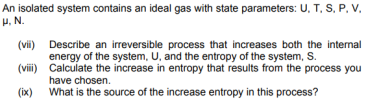 An isolated system contains an ideal gas with state parameters: U, T, S, P, V, M, N. (vii) (viii) Describe an irreversible process that increases both the internal energy of the system, U, and the entropy of the system, S. Calculate the increase in entropy that results from the process you have chosen. What is the source of the increase entropy in this process? (ix)
Consider a system in thermal and diffusive contact with a reservoir. Treat the reservoir as ideal...
Consider a system in thermal and diffusive contact with a reservoir. Treat the reservoir as ideal gas of particles at temperature τ . The system can be in either of the following three states: unoccupied with energy zero, occupied with energy zero (ground state), and occupied with energy ∆ (excited state). (a) Calculate the thermal average occupancy of the ground and excited sates. (b) Find the gas pressure at which the average occupancy of the system is 1/2. (c) Calculate...
Isotherms Adiabatic process T. Figure 1 5. Given is the P-V diagram, a gas system from...
 Isotherms Adiabatic process T. Figure 1 5. Given is the P-V diagram, a gas system from state is undergoing a thermodynamic process which lead to a different state f. Assume the gas is monoatomic and following the ideal gas condition ) Show that the, area under i-flineP 1-7 i) If the system contains 5 mol of this gas with an initially temperature of 293 1 m3 to Vi K. Calculate the work done by the system expanding from V -4m3...
B.2 The multiplicity of a monatomic ideal gas is given by 2 = f(N)VN U3N/2, where...
 B.2 The multiplicity of a monatomic ideal gas is given by 2 = f(N)VN U3N/2, where V is the volume occupied by the gas, U its internal energy, N the number of particles in the gas and f(N) a complicated function of N. [2] (i) Show that the entropy S of this system is given by 3 S = Nkg In V + ŽNkg In U + g(N), where g(N) is some function of N. (ii) Define the temperature T...
• (6.45) For a monatomic ideal gas, derive LO S = = Nkr In .N •...
 • (6.45) For a monatomic ideal gas, derive LO S = = Nkr In .N • And DE V и — = -krT in AN Nvo I TV Partition Function for an Ideal Gas . For one particle Z=e-E(s)/kp7 Vo = ve = (v2nimkot) • For N particles 1/VN V ve)
1. Ideal Gas. A volume V = 0.1 m3 contains n = 5 moles of gas....
1. Ideal Gas. A volume V = 0.1 m3 contains n = 5 moles of gas. Calculate the pressure (in N/m2) when the temperature T is 500 K. 5. Adiabatic Process. The same gas starts as it does in Problem 1. This time, the gas is allowed to expand to V2 = 0.25 m3 in an adiabatic way – no heat is allowed to transfer to or from the gas. Calculate the final pressure and temperature.
 1 The Gibbs Paradox Consider N particles, each of mass m, in a 3-dimensional volume V at temperature T. Each particle i has momentum pi. Assume that the particles are non-interacting (ideal gas) and distinguishable. a) (2P) Calculate the canonical partition function N P for the N-particle system. Make sure to work out the integral. b) (2P) Calculate the free energy F--kBTlnZ from the partition function Z. Is F an extensive quantity? c) (2P) Calculate the entropy S F/oT from...
 Figure 2.4 shows a cyclic path in the P -V diagram of an ideal
gas. The result is that the net work done on the gas is the
negative of the area enclosed by the path
.
Assume that the gas is ideal with N particles and calculate the
energy transfer by heating in each step of the process. Then
explain why the net work done on the gas is negative and show that
the net change of the internal...
Figure 2.4 shows a cyclic path in the P -V diagram of an ideal
gas. The result is that the net work done on the gas is the
negative of the area enclosed by the path
.
Assume that the gas is ideal with N particles and calculate the
energy transfer by heating in each step of the process. Then
explain why the net work done on the gas is negative and show that
the net change of the internal...
 Problem 6.15. Mean energy of a toy model of an ideal Bose gas (a) Calculate the mean energy of an ideal gas of N 2 identical bosons in equilibrium with a heat (b) Calculate the mean energy for N 2 distinguishable particles assuming that each particle can (c) If E1 is the mean energy for one particle and Eg is the mean energy for the two-particle system, bath at temperature T, assuming that each particle can be in one of...
 An isolated system contains an ideal gas with state parameters: U, T, S, P, V, M, N. (vii) (viii) Describe an irreversible process that increases both the internal energy of the system, U, and the entropy of the system, S. Calculate the increase in entropy that results from the process you have chosen. What is the source of the increase entropy in this process? (ix)
 Isotherms Adiabatic process T. Figure 1 5. Given is the P-V diagram, a gas system from state is undergoing a thermodynamic process which lead to a different state f. Assume the gas is monoatomic and following the ideal gas condition ) Show that the, area under i-flineP 1-7 i) If the system contains 5 mol of this gas with an initially temperature of 293 1 m3 to Vi K. Calculate the work done by the system expanding from V -4m3...
 B.2 The multiplicity of a monatomic ideal gas is given by 2 = f(N)VN U3N/2, where V is the volume occupied by the gas, U its internal energy, N the number of particles in the gas and f(N) a complicated function of N. [2] (i) Show that the entropy S of this system is given by 3 S = Nkg In V + ŽNkg In U + g(N), where g(N) is some function of N. (ii) Define the temperature T...
 • (6.45) For a monatomic ideal gas, derive LO S = = Nkr In .N • And DE V и — = -krT in AN Nvo I TV Partition Function for an Ideal Gas . For one particle Z=e-E(s)/kp7 Vo = ve = (v2nimkot) • For N particles 1/VN V ve)
Most questions answered within 3 hours.
-
Where is the error in this code sequence?
String s1 = "Hello";
String s2 = "ello";...
asked 10 months ago -
Financial data for Joel de Paris, Inc., for last year
follow:
Joel de Paris, Inc.
Balance...
asked 10 months ago -
Consider this reaction:
Al2(SO4)3 (aq)+ BaCl3
(aq) Al2Cl6 (aq)- +
3BaSO4(s) . What is the...
asked 10 months ago -
Suppose that Savneet is considering increasing her
recent random sample from 20 car rentals to 40...
asked 10 months ago -
Trucks arrive at an unloading terminal at an average rate of 120
per hour.
Trucks arrive...
asked 10 months ago -
Why are methanol and ethanol completely soluble in water while
octanol is not very little soluble....
asked 10 months ago -
A facilities manager at a university reads in a research report
that the mean amount of...
asked 10 months ago -
When the CuSO4 is rehydrated by adding water to the anhydrous
compound, is this an endothermic...
asked 10 months ago -
A ray of sunlight is passing from diamond into crown glass; the
angle of incidence is...
asked 10 months ago -
A block of mass 0.249 kg is placed on top of a light, vertical
spring of...
asked 10 months ago -
how do the kidneys compensate in the presences of acidosis
a) trigger hyperventilate
b) reserve acid...
asked 10 months ago -
Question 501 pts
The rental rate of capital to the firm increases. Which of the
following...
asked 10 months ago