
Homework Answers

Add Answer to:
17. Does the solution to the time-dependent Schrodinger equation for a free particle satisfy the classical...
I. Show that ψ-Aei(kx-ut) is a solution to the time dependent 1-D Schrodinger Equation for a free...
 I. Show that ψ-Aei(kx-ut) is a solution to the time dependent 1-D Schrodinger Equation for a free particle
I. Show that ψ-Aei(kx-ut) is a solution to the time dependent 1-D Schrodinger Equation for a free particle
I. Show that ψ-Aei(kx-ut) is a solution to the time dependent 1-D Schrodinger Equation for a free particle
6. Plane Wave Suppose jb' = eilkr-wt). (Note that o= eik-i-wt) satisfies the free particle Schrodinger...
 6. Plane Wave Suppose jb' = eilkr-wt). (Note that o= eik-i-wt) satisfies the free particle Schrodinger equation.) (a) If y satisfies the Schrodinger equation with given potentials A and V, find the potentials for ' that satisfy the Schrodinger equation for a charged particle in the presence of an electromagnetic field. (b) Interpret the potential obtained.
The time-independent Schroedinger equation is given by: − Wave functions that satisfy this equation are called...
 The time-independent Schroedinger equation is given by:
− Wave functions that satisfy this equation are called energy
eigenstates. a) If U=0 for all positions, this represents a free
particle. For a wave function with definite momentum ℏ,, compute E.
b) Is the relationship derived from a) consistent with what we know
from classical mechanics for a free particle? Explain how or how
not. c) Consider the wave function ((^b[j + ^bâj), with A some
number and c, d not equal...
The time-independent Schroedinger equation is given by:
− Wave functions that satisfy this equation are called energy
eigenstates. a) If U=0 for all positions, this represents a free
particle. For a wave function with definite momentum ℏ,, compute E.
b) Is the relationship derived from a) consistent with what we know
from classical mechanics for a free particle? Explain how or how
not. c) Consider the wave function ((^b[j + ^bâj), with A some
number and c, d not equal...
Obtain the Schrodinger Equation for steady state and time dependent of Y = A cos (wt...
Obtain the Schrodinger Equation for steady state and time dependent of Y = A cos (wt - x)
1. The time-dependent Schrödinger equation The time-dependent Schrödinger equation is -R2 824(1,t) + V (1,t) (1,t)...
 1. The time-dependent Schrödinger equation The time-dependent Schrödinger equation is -R2 824(1,t) + V (1,t) (1,t) = in 2m 0:2 . (a) For V1, t) = 0, show that the wave function (1,t) = A sin (kr - wt) does not satisfy the time- dependent Schrödinger equation. (b) For VI,t) = 0, Show that I, t) = A cos(kr - wt) + i sin (kr - wt) does satisfy this equation. This is a simple demonstration that the wavefunction in...
CHEM how does the time independent schrodinger equation (Hpsi=E*psi) give us total energy and what exactly...
CHEM how does the time independent schrodinger equation (Hpsi=E*psi) give us total energy and what exactly is an "operator for energy (H)". what does tue product of energy and wave function give us.
b. The 1-D time-independent Schrodinger equation for the stationary states of a harmonic oscillator is given...
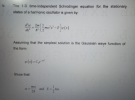 b. The 1-D time-independent Schrodinger equation for the stationary states of a harmonic oscillator is given by: Assuming that the simplest solution is the Gaussian wave function of the form: 4(x) = Copa Show that: a mo and E no
2. [16 points] What is the solution of the time-dependent Schrödinger Equation Ψ(x, t) for the...
 2. [16 points] What is the solution of the time-dependent Schrödinger Equation Ψ(x, t) for the solution of the time-independent Schrödinger Equation Ψ(x) = ,in (m) in the particle in the box model? Write ω =-explicitly in terms of the parameters of the problem. Explicily show that W,(Cx.t) solves the time-dependent Schrödinger Equation 2
Problem 2: Time development of a free particle The wave function of a free particle at time t- 0 is given by exp(2K1T N...
 Problem 2: Time development of a free particle The wave function of a free particle at time t- 0 is given by exp(2K1T Now answer the questions below. l. what is the time evolved wave function ψ(z,t) ? points 2. What is the average momentum at any future time? 4 points 3. What is the average energy at any future time ? 3 points
Problem 2: Time development of a free particle The wave function of a free particle at...
Problem 2: Time development of a free particle The wave function of a free particle at time t- 0 is given by exp(2K1T Now answer the questions below. l. what is the time evolved wave function ψ(z,t) ? points 2. What is the average momentum at any future time? 4 points 3. What is the average energy at any future time ? 3 points
Problem 2: Time development of a free particle The wave function of a free particle at...
Free quantum particle. In Quantum Mechanics, is the time-independent Schrodinger's equation for a free particle in...
 Free quantum particle. In Quantum Mechanics, is the time-independent Schrodinger's equation for a free particle in one dimension. In this equation. is the wavefnnction of the particle, m is its mass. E is its (kinetic) energy, while is the fundamental Planck constant.
 I. Show that ψ-Aei(kx-ut) is a solution to the time dependent 1-D Schrodinger Equation for a free particle
I. Show that ψ-Aei(kx-ut) is a solution to the time dependent 1-D Schrodinger Equation for a free particle
I. Show that ψ-Aei(kx-ut) is a solution to the time dependent 1-D Schrodinger Equation for a free particle
 6. Plane Wave Suppose jb' = eilkr-wt). (Note that o= eik-i-wt) satisfies the free particle Schrodinger equation.) (a) If y satisfies the Schrodinger equation with given potentials A and V, find the potentials for ' that satisfy the Schrodinger equation for a charged particle in the presence of an electromagnetic field. (b) Interpret the potential obtained.
 The time-independent Schroedinger equation is given by:
− Wave functions that satisfy this equation are called energy
eigenstates. a) If U=0 for all positions, this represents a free
particle. For a wave function with definite momentum ℏ,, compute E.
b) Is the relationship derived from a) consistent with what we know
from classical mechanics for a free particle? Explain how or how
not. c) Consider the wave function ((^b[j + ^bâj), with A some
number and c, d not equal...
The time-independent Schroedinger equation is given by:
− Wave functions that satisfy this equation are called energy
eigenstates. a) If U=0 for all positions, this represents a free
particle. For a wave function with definite momentum ℏ,, compute E.
b) Is the relationship derived from a) consistent with what we know
from classical mechanics for a free particle? Explain how or how
not. c) Consider the wave function ((^b[j + ^bâj), with A some
number and c, d not equal...
 1. The time-dependent Schrödinger equation The time-dependent Schrödinger equation is -R2 824(1,t) + V (1,t) (1,t) = in 2m 0:2 . (a) For V1, t) = 0, show that the wave function (1,t) = A sin (kr - wt) does not satisfy the time- dependent Schrödinger equation. (b) For VI,t) = 0, Show that I, t) = A cos(kr - wt) + i sin (kr - wt) does satisfy this equation. This is a simple demonstration that the wavefunction in...
 b. The 1-D time-independent Schrodinger equation for the stationary states of a harmonic oscillator is given by: Assuming that the simplest solution is the Gaussian wave function of the form: 4(x) = Copa Show that: a mo and E no
 2. [16 points] What is the solution of the time-dependent Schrödinger Equation Ψ(x, t) for the solution of the time-independent Schrödinger Equation Ψ(x) = ,in (m) in the particle in the box model? Write ω =-explicitly in terms of the parameters of the problem. Explicily show that W,(Cx.t) solves the time-dependent Schrödinger Equation 2
 Problem 2: Time development of a free particle The wave function of a free particle at time t- 0 is given by exp(2K1T Now answer the questions below. l. what is the time evolved wave function ψ(z,t) ? points 2. What is the average momentum at any future time? 4 points 3. What is the average energy at any future time ? 3 points
Problem 2: Time development of a free particle The wave function of a free particle at...
Problem 2: Time development of a free particle The wave function of a free particle at time t- 0 is given by exp(2K1T Now answer the questions below. l. what is the time evolved wave function ψ(z,t) ? points 2. What is the average momentum at any future time? 4 points 3. What is the average energy at any future time ? 3 points
Problem 2: Time development of a free particle The wave function of a free particle at...
 Free quantum particle. In Quantum Mechanics, is the time-independent Schrodinger's equation for a free particle in one dimension. In this equation. is the wavefnnction of the particle, m is its mass. E is its (kinetic) energy, while is the fundamental Planck constant.
Most questions answered within 3 hours.
-
Where is the error in this code sequence?
String s1 = "Hello";
String s2 = "ello";...
asked 10 months ago -
Financial data for Joel de Paris, Inc., for last year
follow:
Joel de Paris, Inc.
Balance...
asked 10 months ago -
Consider this reaction:
Al2(SO4)3 (aq)+ BaCl3
(aq) Al2Cl6 (aq)- +
3BaSO4(s) . What is the...
asked 10 months ago -
Suppose that Savneet is considering increasing her
recent random sample from 20 car rentals to 40...
asked 10 months ago -
Trucks arrive at an unloading terminal at an average rate of 120
per hour.
Trucks arrive...
asked 10 months ago -
Why are methanol and ethanol completely soluble in water while
octanol is not very little soluble....
asked 10 months ago -
A facilities manager at a university reads in a research report
that the mean amount of...
asked 10 months ago -
When the CuSO4 is rehydrated by adding water to the anhydrous
compound, is this an endothermic...
asked 10 months ago -
A ray of sunlight is passing from diamond into crown glass; the
angle of incidence is...
asked 10 months ago -
A block of mass 0.249 kg is placed on top of a light, vertical
spring of...
asked 10 months ago -
how do the kidneys compensate in the presences of acidosis
a) trigger hyperventilate
b) reserve acid...
asked 10 months ago -
Question 501 pts
The rental rate of capital to the firm increases. Which of the
following...
asked 10 months ago