Homework Answers
Answer:
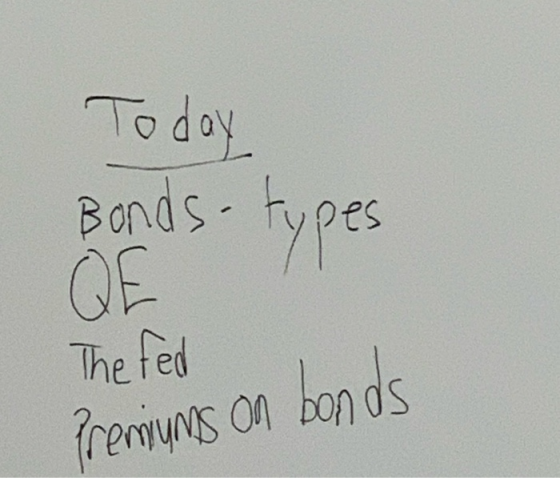
Bonds- It is a fixed income security that represents a loan, made by an investor to the borrower. Owner of the bond is called Creditor. This is one of the financial instruments, it pays interest in return.
Types of Bonds- Are as following:
Treasury bonds- Bonds and notes, issued by the Government, is called treasury bonds. These are the most secured bonds but they pay lower rate of interest. Treasury bills are for short term (1 year), treasury bonds are for long term (from 10 to 30 years).
Risk- They are the risk free bonds
Municipal bonds- These are issued by local and state government to raise the funds to build schools, colleges, parks, highways etc. Sometimes, these bonds are exempt from federal income tax. There are two types of municipal bonds, General obligation that are secured by the full faith and credit of the issuer and supported by the issuer's taxing power. Revenue bonds are repaid using revenue generated by the individual project the bond
Risk- They have moderate risk as the local Government may go bankrupt.
Corporate bonds- These bonds are issued by the companies to raise the funds for their operations of capital budgeting. They provide very high return. Companies also issue convertible bonds that can be later converted into shares.
Risk- Risk is higher in these bonds.
Zero coupon bonds- As the name suggests, these bonds provide no coupon payment, means no interest but they are issued at deep discount, the bond is redeemed at the full value or face value at the time of maturity.
Risk- Are subject to inflation, interest rate and credit risk.
Junk bonds- These bonds provide higher yield but have higher risk. These bonds generally have lower credit ratings. These are issued by companies who seek instant funding.
Risk- Risk is the highest.
Add Answer to:
its from introduction to finance 1/2 chapters mpod can you
help me
they want a
classification...
Can you help me with the accounting and finance questions? Accounting and Finance: 1. What are...
Can you help me with the accounting and finance questions? Accounting and Finance: 1. What are the requirements and characteristics of the company to raise and prepare its financial statements, (i.e. accounting policies, internal rules and regulations, etc.)? 2. What are the important metrics when establishing an operational, sales, etc. budget? 3. What are the users of the accounting information internally and what do they emphasize when analyzing them? 4. What are the users of the external accounting information? 5....
Can you help me to solve my Introduction to electronics homework as soon as possible please?...
 Can
you help me to solve my Introduction to electronics homework as
soon as possible please? I have a limited time. Thanks
2 Question 2 (25 points) We want to drive a resistor of 2k2 with a charged capacitor to supply 12V for 10 seconds. The accepted voltage range for the resistor is 12-9V. Draw the circuit, and determine the value of the capacitor ?
Can
you help me to solve my Introduction to electronics homework as
soon as possible please? I have a limited time. Thanks
2 Question 2 (25 points) We want to drive a resistor of 2k2 with a charged capacitor to supply 12V for 10 seconds. The accepted voltage range for the resistor is 12-9V. Draw the circuit, and determine the value of the capacitor ?
Can you please help me solve these problems. The subject is Principles of Finances Chapter 6...
 Can you please help me solve these problems. The
subject is Principles of Finances Chapter 6 Interest Rates.
a) THIS IS TRUE b) THIS IS FALSE 2. Johnson Corporation's 5-year bonds yield 6.85%, and 5-year T-bonds yield 4.75%. The real risk-free rate is r* 2.80%, the default risk premium for Johnson's bonds is DRPs 0.85% versus zero for T-bonds, the liquidity premium on Johnson's bonds is LP 1.25%, and the maturity risk premium for all bonds is found with the...
Can you please help me solve these problems. The
subject is Principles of Finances Chapter 6 Interest Rates.
a) THIS IS TRUE b) THIS IS FALSE 2. Johnson Corporation's 5-year bonds yield 6.85%, and 5-year T-bonds yield 4.75%. The real risk-free rate is r* 2.80%, the default risk premium for Johnson's bonds is DRPs 0.85% versus zero for T-bonds, the liquidity premium on Johnson's bonds is LP 1.25%, and the maturity risk premium for all bonds is found with the...
Name Date Principles of Finance Chapters 1 & 2 Week 6 11. Which of the following...
 Name Date Principles of Finance Chapters 1 & 2 Week 6 11. Which of the following statements is correct? a. A warrant is basically a long-term option that enables the holder to sell common stock back to the firm at an agreed upon price, at a specified time in the future. b. Generally, warrants are distributed along with preferred stock in order to make the preferred stock less risky. c. If a company issuing coupon paying debt wanted to reduce...
auditory vs visual processing experiment introduction and discussion. can you help me to write 2 paragraphs...
auditory vs visual processing experiment introduction and discussion. can you help me to write 2 paragraphs each thank you
Exhibit 10.5 Please can you help me with this exercise? Sikes Corporation, whose annual accounting period...
 Exhibit 10.5
Please can you help me with this exercise?
Sikes Corporation, whose annual accounting period ends on December 31, issued the following bonds Date of bonds: January 1, 2015 Maturity amount and date: $110,000 due in 10 years (December 31, 2024) Interest: 10 percent per year payable each December 31 Date issued: January 1, 2015 Required: 1. For each of the three independent cases that follow, provide the following amounts to be reported on the January 1, 2015, financial...
Exhibit 10.5
Please can you help me with this exercise?
Sikes Corporation, whose annual accounting period ends on December 31, issued the following bonds Date of bonds: January 1, 2015 Maturity amount and date: $110,000 due in 10 years (December 31, 2024) Interest: 10 percent per year payable each December 31 Date issued: January 1, 2015 Required: 1. For each of the three independent cases that follow, provide the following amounts to be reported on the January 1, 2015, financial...
Can someone help me with this problem? I attached an example to help. Question 5 1...
 Can
someone help me with this problem? I attached an example to help.
Question 5 1 pts 5. Two bonds we used for the price and h o upons andres for face value of 100 Bond Y o upons of anderes for 170. Both bonds the end of years Calce na A 4 B) 20 ) 24 D) 27 D 31 Two bonds are purchased for the same price to yield 6%. Bond X has 5% annual coupons and matures...
Can
someone help me with this problem? I attached an example to help.
Question 5 1 pts 5. Two bonds we used for the price and h o upons andres for face value of 100 Bond Y o upons of anderes for 170. Both bonds the end of years Calce na A 4 B) 20 ) 24 D) 27 D 31 Two bonds are purchased for the same price to yield 6%. Bond X has 5% annual coupons and matures...
Please help me solve all the Requirements 1, 2, and 3. (please use clear details and...
 Please help me solve all the Requirements 1, 2, and 3.
(please use clear details and explanations)
Thank you, have a nice day!
P12-47 Describing bonds, journalizing transactions for bonds payable using the straight-line amortization method, and journalizing transactions for a mortgage payable This problem continues the Canyon Canoe Company situation from Chapter 11. Canyon Canoe Company is considering raising additional capital for further expansion. The company wants to finance a new business venture into guided trips down the Amazon...
Please help me solve all the Requirements 1, 2, and 3.
(please use clear details and explanations)
Thank you, have a nice day!
P12-47 Describing bonds, journalizing transactions for bonds payable using the straight-line amortization method, and journalizing transactions for a mortgage payable This problem continues the Canyon Canoe Company situation from Chapter 11. Canyon Canoe Company is considering raising additional capital for further expansion. The company wants to finance a new business venture into guided trips down the Amazon...
can someone help me write an introduction for this lab? thank you. this is how to...
 can
someone help me write an introduction for this lab? thank you. this
is how to do it for the first pic, 2nd pic is the actual lab.
Introduction Biochemistry Lab Reports Laboratory reports must be received by 5:00pm on the due date unless previous Late reports will be docked 10% per arrangements have been made with Dr Marzena day. The laboratory reports should follow the format described below Biochemistry Laboratory Report Outline Expectations -Please write the report in your...
can
someone help me write an introduction for this lab? thank you. this
is how to do it for the first pic, 2nd pic is the actual lab.
Introduction Biochemistry Lab Reports Laboratory reports must be received by 5:00pm on the due date unless previous Late reports will be docked 10% per arrangements have been made with Dr Marzena day. The laboratory reports should follow the format described below Biochemistry Laboratory Report Outline Expectations -Please write the report in your...
Can you help me answer the questions for the Introduction/Background? 1. Introduced the techniques of thin-layer...
 Can you help me answer the questions for the
Introduction/Background?
1. Introduced the techniques of thin-layer and flask column
chromatography. Discuss how a solvent is elected as eluent.
2. Discuss all the applications of TLC. What is it used for?
3. Discuss the mobile and stationary phases of TLC and column
chromatography.
4. Explain how column chromatography can be used to separate a
mixture on a larger scale than TLC.
Post-Lab: Objective State the objective of the experiment in your...
Can you help me answer the questions for the
Introduction/Background?
1. Introduced the techniques of thin-layer and flask column
chromatography. Discuss how a solvent is elected as eluent.
2. Discuss all the applications of TLC. What is it used for?
3. Discuss the mobile and stationary phases of TLC and column
chromatography.
4. Explain how column chromatography can be used to separate a
mixture on a larger scale than TLC.
Post-Lab: Objective State the objective of the experiment in your...
 Can
you help me to solve my Introduction to electronics homework as
soon as possible please? I have a limited time. Thanks
2 Question 2 (25 points) We want to drive a resistor of 2k2 with a charged capacitor to supply 12V for 10 seconds. The accepted voltage range for the resistor is 12-9V. Draw the circuit, and determine the value of the capacitor ?
Can
you help me to solve my Introduction to electronics homework as
soon as possible please? I have a limited time. Thanks
2 Question 2 (25 points) We want to drive a resistor of 2k2 with a charged capacitor to supply 12V for 10 seconds. The accepted voltage range for the resistor is 12-9V. Draw the circuit, and determine the value of the capacitor ?
 Can you please help me solve these problems. The
subject is Principles of Finances Chapter 6 Interest Rates.
a) THIS IS TRUE b) THIS IS FALSE 2. Johnson Corporation's 5-year bonds yield 6.85%, and 5-year T-bonds yield 4.75%. The real risk-free rate is r* 2.80%, the default risk premium for Johnson's bonds is DRPs 0.85% versus zero for T-bonds, the liquidity premium on Johnson's bonds is LP 1.25%, and the maturity risk premium for all bonds is found with the...
Can you please help me solve these problems. The
subject is Principles of Finances Chapter 6 Interest Rates.
a) THIS IS TRUE b) THIS IS FALSE 2. Johnson Corporation's 5-year bonds yield 6.85%, and 5-year T-bonds yield 4.75%. The real risk-free rate is r* 2.80%, the default risk premium for Johnson's bonds is DRPs 0.85% versus zero for T-bonds, the liquidity premium on Johnson's bonds is LP 1.25%, and the maturity risk premium for all bonds is found with the...
 Name Date Principles of Finance Chapters 1 & 2 Week 6 11. Which of the following statements is correct? a. A warrant is basically a long-term option that enables the holder to sell common stock back to the firm at an agreed upon price, at a specified time in the future. b. Generally, warrants are distributed along with preferred stock in order to make the preferred stock less risky. c. If a company issuing coupon paying debt wanted to reduce...
 Exhibit 10.5
Please can you help me with this exercise?
Sikes Corporation, whose annual accounting period ends on December 31, issued the following bonds Date of bonds: January 1, 2015 Maturity amount and date: $110,000 due in 10 years (December 31, 2024) Interest: 10 percent per year payable each December 31 Date issued: January 1, 2015 Required: 1. For each of the three independent cases that follow, provide the following amounts to be reported on the January 1, 2015, financial...
Exhibit 10.5
Please can you help me with this exercise?
Sikes Corporation, whose annual accounting period ends on December 31, issued the following bonds Date of bonds: January 1, 2015 Maturity amount and date: $110,000 due in 10 years (December 31, 2024) Interest: 10 percent per year payable each December 31 Date issued: January 1, 2015 Required: 1. For each of the three independent cases that follow, provide the following amounts to be reported on the January 1, 2015, financial...
 Can
someone help me with this problem? I attached an example to help.
Question 5 1 pts 5. Two bonds we used for the price and h o upons andres for face value of 100 Bond Y o upons of anderes for 170. Both bonds the end of years Calce na A 4 B) 20 ) 24 D) 27 D 31 Two bonds are purchased for the same price to yield 6%. Bond X has 5% annual coupons and matures...
Can
someone help me with this problem? I attached an example to help.
Question 5 1 pts 5. Two bonds we used for the price and h o upons andres for face value of 100 Bond Y o upons of anderes for 170. Both bonds the end of years Calce na A 4 B) 20 ) 24 D) 27 D 31 Two bonds are purchased for the same price to yield 6%. Bond X has 5% annual coupons and matures...
 Please help me solve all the Requirements 1, 2, and 3.
(please use clear details and explanations)
Thank you, have a nice day!
P12-47 Describing bonds, journalizing transactions for bonds payable using the straight-line amortization method, and journalizing transactions for a mortgage payable This problem continues the Canyon Canoe Company situation from Chapter 11. Canyon Canoe Company is considering raising additional capital for further expansion. The company wants to finance a new business venture into guided trips down the Amazon...
Please help me solve all the Requirements 1, 2, and 3.
(please use clear details and explanations)
Thank you, have a nice day!
P12-47 Describing bonds, journalizing transactions for bonds payable using the straight-line amortization method, and journalizing transactions for a mortgage payable This problem continues the Canyon Canoe Company situation from Chapter 11. Canyon Canoe Company is considering raising additional capital for further expansion. The company wants to finance a new business venture into guided trips down the Amazon...
 can
someone help me write an introduction for this lab? thank you. this
is how to do it for the first pic, 2nd pic is the actual lab.
Introduction Biochemistry Lab Reports Laboratory reports must be received by 5:00pm on the due date unless previous Late reports will be docked 10% per arrangements have been made with Dr Marzena day. The laboratory reports should follow the format described below Biochemistry Laboratory Report Outline Expectations -Please write the report in your...
can
someone help me write an introduction for this lab? thank you. this
is how to do it for the first pic, 2nd pic is the actual lab.
Introduction Biochemistry Lab Reports Laboratory reports must be received by 5:00pm on the due date unless previous Late reports will be docked 10% per arrangements have been made with Dr Marzena day. The laboratory reports should follow the format described below Biochemistry Laboratory Report Outline Expectations -Please write the report in your...
 Can you help me answer the questions for the
Introduction/Background?
1. Introduced the techniques of thin-layer and flask column
chromatography. Discuss how a solvent is elected as eluent.
2. Discuss all the applications of TLC. What is it used for?
3. Discuss the mobile and stationary phases of TLC and column
chromatography.
4. Explain how column chromatography can be used to separate a
mixture on a larger scale than TLC.
Post-Lab: Objective State the objective of the experiment in your...
Can you help me answer the questions for the
Introduction/Background?
1. Introduced the techniques of thin-layer and flask column
chromatography. Discuss how a solvent is elected as eluent.
2. Discuss all the applications of TLC. What is it used for?
3. Discuss the mobile and stationary phases of TLC and column
chromatography.
4. Explain how column chromatography can be used to separate a
mixture on a larger scale than TLC.
Post-Lab: Objective State the objective of the experiment in your...
Most questions answered within 3 hours.
-
Where is the error in this code sequence?
String s1 = "Hello";
String s2 = "ello";...
asked 10 months ago -
Financial data for Joel de Paris, Inc., for last year
follow:
Joel de Paris, Inc.
Balance...
asked 10 months ago -
Consider this reaction:
Al2(SO4)3 (aq)+ BaCl3
(aq) Al2Cl6 (aq)- +
3BaSO4(s) . What is the...
asked 10 months ago -
Suppose that Savneet is considering increasing her
recent random sample from 20 car rentals to 40...
asked 10 months ago -
Trucks arrive at an unloading terminal at an average rate of 120
per hour.
Trucks arrive...
asked 10 months ago -
Why are methanol and ethanol completely soluble in water while
octanol is not very little soluble....
asked 10 months ago -
A facilities manager at a university reads in a research report
that the mean amount of...
asked 10 months ago -
When the CuSO4 is rehydrated by adding water to the anhydrous
compound, is this an endothermic...
asked 10 months ago -
A ray of sunlight is passing from diamond into crown glass; the
angle of incidence is...
asked 10 months ago -
A block of mass 0.249 kg is placed on top of a light, vertical
spring of...
asked 10 months ago -
how do the kidneys compensate in the presences of acidosis
a) trigger hyperventilate
b) reserve acid...
asked 10 months ago -
Question 501 pts
The rental rate of capital to the firm increases. Which of the
following...
asked 10 months ago