
Homework Answers
False - the machanism of broad spectrum antibiotics is different broad spectrum antibiotics are bactericidal drugs. They kill susceptible bacterial by inhibiting the synthesis of the bacterial peptidoglycan cell wall.
The peptidoglycan provides the cell with rigid stability due to its highly cross-linked structure.
Add Answer to:
48) When an anti-microbial drug affets the DNA it iends to be a broad spectrum drug.
microbiology Question 12 1 pts AZT is an anti-HIV drug. Viral replication is inhibited when AZT...
 microbiology
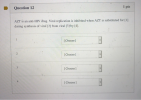
Question 12 1 pts AZT is an anti-HIV drug. Viral replication is inhibited when AZT is substituted for [1] during synthesis of viral [2] from viral [3] by [4]. [Choose] 2 [Choose ] فر [Choose ] 4 [Choose) 1 pts Question 12 AZT is an anti-HIV drug. Viral replication is inhibited when AZT is substituted for [1] during synthesis of viral [2] from viral [3] by [4). 1 otase ✓ Choose ] reverse trar thymine RNA DNA 2 3...
microbiology
Question 12 1 pts AZT is an anti-HIV drug. Viral replication is inhibited when AZT is substituted for [1] during synthesis of viral [2] from viral [3] by [4]. [Choose] 2 [Choose ] فر [Choose ] 4 [Choose) 1 pts Question 12 AZT is an anti-HIV drug. Viral replication is inhibited when AZT is substituted for [1] during synthesis of viral [2] from viral [3] by [4). 1 otase ✓ Choose ] reverse trar thymine RNA DNA 2 3...
Consider that a certain antimicrobial drug prevents bacterial growth. However, when the drug treatment is stopped,...
Consider that a certain antimicrobial drug prevents bacterial growth. However, when the drug treatment is stopped, the bacteria resumes growth. This antimicrobial drug would be considered. Select one: a. bacteriostatic. b. narrow-spectrum. c. toxic. d. broad-spectrum. e. bacteriocidal. Broad-spectrum drugs target a wide variety of bacterial pathogens. Even when the broad-spectrum drug is capable of killing a target pathogen, it may not be the best treatment. Which statement best explains why a broad spectrum drug might be an undesirable treatment...
What factors determine the effectiveness of any given anti-microbial procedure?
What factors determine the effectiveness of any given anti-microbial procedure?
Why is isolating and analyzing a protein with anti-microbial properties a useful endeavor?
Why is isolating and analyzing a protein with anti-microbial properties a useful endeavor?
1. Pharmacodynamics and Pharmacokinetics 2. Principles of anti-microbial therapy a. Goal of antibiotic therapy b. &nbs
1. Pharmacodynamics and Pharmacokinetics 2. Principles of anti-microbial therapy a. Goal of antibiotic therapy b. Principles of Antibiotic Resistance c. Organ specific toxicities = signs and symptoms 3. Core drug knowledge / Core patient variables a. Penicillin = adverse effects, nursing interventions b. Cephalosporin: Cephalexin, Cefaclor = nursing interventions c. Gentamicin = adverse effects, nursing interventions d. Amphotericin B = adverse effects e. Rifampicin / Rifampin = adverse effects f. Isoniazid = adverse effect, nursing interventions g. Clotrimazole = indications 4. Core drug knowledge / Core patient variables a. Aspirin...
Ciprofloxacin, erythromycin, and acyclovir are used to treat microbial infections. Ciprofloxacin inhibits DNA gyrase. Erythromycin binds...
Ciprofloxacin, erythromycin, and acyclovir are used to treat microbial infections. Ciprofloxacin inhibits DNA gyrase. Erythromycin binds in front of the A site on the 50S subunit of a ribosome. Acyclovir is a guanine analog. What steps in protein synthesis are inhibited by each drug? Which drug is more effective against bacteria? Why? Which drug is more effective against viruses? Why? Which drugs will have effects on the host's cells? Why? Use the index to identify the disease for which acyclovir...
1. Pharmacodynamics and Pharmacokinetics 2. Principles of anti-microbial therapy a. Goal of antibiotic therapy b. Principles...
 1. Pharmacodynamics and Pharmacokinetics 2. Principles of anti-microbial therapy a. Goal of antibiotic therapy b. Principles of Antibiotic Resistance c. Organ specific toxicities = signs and symptoms 3. Core drug knowledge / Core patient variables a. Penicillin = adverse effects, nursing interventions b. Cephalosporin: Cephalexin, Cefaclor = nursing interventions c. Gentamicin = adverse effects, nursing interventions, drug classification d. Amphotericin B = adverse effects e. Ciprofloxacin = drug classification f. Rifampicin / Rifampin = adverse effects 8. Isoniazid = adverse...
Explain how phagocytosis, complement system and inflammation response and anti microbial normal flora protects the host...
Explain how phagocytosis, complement system and inflammation response and anti microbial normal flora protects the host from infectious diseases.
Benzoic acid has anti-microbial activity but benzoate does not. Based on the pKa of benzoic acid...
Benzoic acid has anti-microbial activity but benzoate does not. Based on the pKa of benzoic acid (4.2) , what types of foods would be well preserved with benzoate?
what is the difference between a broad spectrum and narrow-spectrum antibiotics? Why can't every antibiotic work...
what is the difference between a broad spectrum and narrow-spectrum antibiotics? Why can't every antibiotic work for every organism?
 microbiology
Question 12 1 pts AZT is an anti-HIV drug. Viral replication is inhibited when AZT is substituted for [1] during synthesis of viral [2] from viral [3] by [4]. [Choose] 2 [Choose ] فر [Choose ] 4 [Choose) 1 pts Question 12 AZT is an anti-HIV drug. Viral replication is inhibited when AZT is substituted for [1] during synthesis of viral [2] from viral [3] by [4). 1 otase ✓ Choose ] reverse trar thymine RNA DNA 2 3...
microbiology
Question 12 1 pts AZT is an anti-HIV drug. Viral replication is inhibited when AZT is substituted for [1] during synthesis of viral [2] from viral [3] by [4]. [Choose] 2 [Choose ] فر [Choose ] 4 [Choose) 1 pts Question 12 AZT is an anti-HIV drug. Viral replication is inhibited when AZT is substituted for [1] during synthesis of viral [2] from viral [3] by [4). 1 otase ✓ Choose ] reverse trar thymine RNA DNA 2 3...
 1. Pharmacodynamics and Pharmacokinetics 2. Principles of anti-microbial therapy a. Goal of antibiotic therapy b. Principles of Antibiotic Resistance c. Organ specific toxicities = signs and symptoms 3. Core drug knowledge / Core patient variables a. Penicillin = adverse effects, nursing interventions b. Cephalosporin: Cephalexin, Cefaclor = nursing interventions c. Gentamicin = adverse effects, nursing interventions, drug classification d. Amphotericin B = adverse effects e. Ciprofloxacin = drug classification f. Rifampicin / Rifampin = adverse effects 8. Isoniazid = adverse...
Most questions answered within 3 hours.
-
Where is the error in this code sequence?
String s1 = "Hello";
String s2 = "ello";...
asked 10 months ago -
Financial data for Joel de Paris, Inc., for last year
follow:
Joel de Paris, Inc.
Balance...
asked 10 months ago -
Consider this reaction:
Al2(SO4)3 (aq)+ BaCl3
(aq) Al2Cl6 (aq)- +
3BaSO4(s) . What is the...
asked 10 months ago -
Suppose that Savneet is considering increasing her
recent random sample from 20 car rentals to 40...
asked 10 months ago -
Trucks arrive at an unloading terminal at an average rate of 120
per hour.
Trucks arrive...
asked 10 months ago -
Why are methanol and ethanol completely soluble in water while
octanol is not very little soluble....
asked 10 months ago -
A facilities manager at a university reads in a research report
that the mean amount of...
asked 10 months ago -
When the CuSO4 is rehydrated by adding water to the anhydrous
compound, is this an endothermic...
asked 10 months ago -
A ray of sunlight is passing from diamond into crown glass; the
angle of incidence is...
asked 10 months ago -
A block of mass 0.249 kg is placed on top of a light, vertical
spring of...
asked 10 months ago -
how do the kidneys compensate in the presences of acidosis
a) trigger hyperventilate
b) reserve acid...
asked 10 months ago -
Question 501 pts
The rental rate of capital to the firm increases. Which of the
following...
asked 10 months ago