
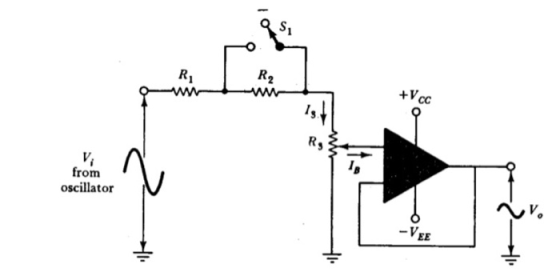
+V cc ww from oscillator -VEE
Homework Answers
The circuit is evaluated for two cases one is (0-0.3)V and second is (0-3)V. The position of Variac will change the attenuation factor.
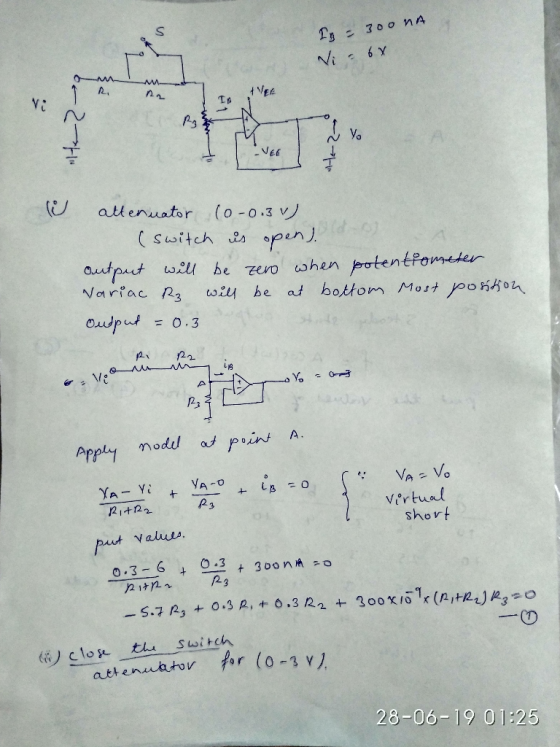

The values of resistances will change if we change the value of resistance R3;
All the values of resistances will be in the range of mega ohms.
Add Answer to:
11-3 The attenuator in Figure 11-3 is to have (0 to 0.3) V and (0 to...
3-13. For the circuit of Problem 3-9 (Figure P3-9), assume that the op-amp bias and offset para m...
 3-13 please
3-13. For the circuit of Problem 3-9 (Figure P3-9), assume that the op-amp bias and offset para meters are as follows: Input offset voltage 1.2 mV Input bias current-60 nA Input offset current 8 nA a. Determine the magnitude of the output de voltage al produced, by the input offiset b. With Rc 0, determine the magnitude of the output de voltage al produced by the inp (You may now assume the ideal gain equation from Chapter 2...
3-13 please
3-13. For the circuit of Problem 3-9 (Figure P3-9), assume that the op-amp bias and offset para meters are as follows: Input offset voltage 1.2 mV Input bias current-60 nA Input offset current 8 nA a. Determine the magnitude of the output de voltage al produced, by the input offiset b. With Rc 0, determine the magnitude of the output de voltage al produced by the inp (You may now assume the ideal gain equation from Chapter 2...
Question 3 3 pts Focus on Op-amp U1 (Both op-amps have to be completely connected as...
 Question 3 3 pts Focus on Op-amp U1 (Both op-amps have to be completely connected as shown in Figure A) Use myDAQ's oscilloscope to capture the input waveform Vin (on Channel 0) and the intermediate output waveform Vout1 (on Channel 1) superimposed. Set the amplitude scale for both channels of the oscilloscope to 500 mV/Div Set the time scale of the oscilloscope to 200 us/Div 1. Take a screenshot of the oscilloscope (both waveform in the same picture) and embed...
Problem 7 (CLO 3, 4, 11 - Ideal Op-Amps, Design): We will now design an Op-Amp...
 Problem 7 (CLO 3, 4, 11 - Ideal Op-Amps, Design): We will now design an Op-Amp circuit to perform the function where v1 - input voltage 1, input voltage 2, = input voltage 3, Vo = output voltage. It may be helpful to consult your recitation 6 (week 7) results as well as Table 4-3 for this problem. 7.a: Select an Op-Amp configuration for your design. Sketch the Op-Amp configuration with symbolic resistors (Rf, Ri, R2, etc) indicated. Do not...
Laboratory 1: operation amplifier characteristics A. Objectives: 1. To study the basic characteri...
 thanks
Laboratory 1: operation amplifier characteristics A. Objectives: 1. To study the basic characteristics of an operational amplifier 2. To study the bias circuit of an operational amplifier B. Apparatus: 1. DC Power supply 2. Experimental board and corresponding components 3. Electronic calculator (prepared by students) 4. Digital camera (prepared by students for photo taking of the experimental results) 5. Laptop computer with the software PicoScope 6 and Microsoft Word installed. 6. PicoScope PC Oscilloscope and its accessories. 7. Multimeter...
thanks
Laboratory 1: operation amplifier characteristics A. Objectives: 1. To study the basic characteristics of an operational amplifier 2. To study the bias circuit of an operational amplifier B. Apparatus: 1. DC Power supply 2. Experimental board and corresponding components 3. Electronic calculator (prepared by students) 4. Digital camera (prepared by students for photo taking of the experimental results) 5. Laptop computer with the software PicoScope 6 and Microsoft Word installed. 6. PicoScope PC Oscilloscope and its accessories. 7. Multimeter...
Use the circuit diagram as shown in Figure A below to conduct the experiment and answer...
 Use the circuit diagram as shown in Figure A below to conduct the experiment and answer the questions 1 to 6. VCC VCC 15V 15V U2 U1 + R3 + 741 Voutt Vouth 6 R1 741 1.0kΩ 2.2k VEE VEE -15V Vin= 0.75 VIP-pl @ 2 kHz -15V R2 R4 TH 4.7ΚΩ 10kΩ Figure A Question 5 3 pts Op-amp U1&U2 • Use myDAQ's oscilloscope to capture the input waveform Vin (on Channel O) and the final output waveform Vout2...
Please answer in full detail, show all work. thank you FInd all the DC collector currents showing...
 please answer in full detail, show all work. thank you FInd all
the DC collector currents showing all work.
Reference First stage Second stage Output stage current cc (+15 V) 13A 12 13 B 14 19 27 Ω Out 18 | R10 = 40 kΩ 27 Ω Q2 39 kΩ In In l CC 30 pF REF 24 I 16 10 17 50 kΩ 100 Ω 024 50 kΩ VEE 15 v) Figure 13.14 The 741 op-amp circuit: Qu, Qi2,...
please answer in full detail, show all work. thank you FInd all
the DC collector currents showing all work.
Reference First stage Second stage Output stage current cc (+15 V) 13A 12 13 B 14 19 27 Ω Out 18 | R10 = 40 kΩ 27 Ω Q2 39 kΩ In In l CC 30 pF REF 24 I 16 10 17 50 kΩ 100 Ω 024 50 kΩ VEE 15 v) Figure 13.14 The 741 op-amp circuit: Qu, Qi2,...
What would be the expression for the closed-loop voltage gain A-Vo(t)/v(t) in figure 5 assuing it...
 What would be the expression for the closed-loop voltage gain A-Vo(t)/v(t) in figure 5 assuing it is an ideal op-am model? 1) 2) What would be the input resistiance of figure 5? 3) What would R, and R2 (from the list below) must be to obtain a voltage gain of A 2.5 1.2 kS2, 1.5 kS2 (2), 1.8 k2, 2.2 k2, 10 k2, 12 k2, 15 k2, 18 k2, 22 k2 +5 V Rs= 1.5 k(2 in(0 5 V VoltageSource...
Problem 3 +12 V MOSFET Parameters 0-0, are matched devices 200 2 = 2.0mA/V/2 λ=0 x0.2...
 Problem 3 +12 V MOSFET Parameters 0-0, are matched devices 200 2 = 2.0mA/V/2 λ=0 x0.2 (body effect) 0.8 V GI 12 V S1 75 Ω 2, 02 -12 V This problem is designed to illustrate the principle of impedance matching and the relationships between the DC bias current of a MOSFET and its ac circuit parameters. We would like to choose a DC value of drain current, Iog, so that Rm matches the generator's resistance Rs. In other words,...
Vss (b) Find ( Drav amp the variation of D 7.103 Figure P7.103 feedback-bias circuit of...
 Vss (b) Find ( Drav amp the variation of D 7.103 Figure P7.103 feedback-bias circuit of Fig. 7.50. Using a 5-V supply with an NMOS transistor for which V, =0.8 V, k. = 8 mA/V =0, provide a design that biases the transistor at I = 1 nA, with Vps large enough to allow saturation operation for a 2-V negative signal swing at the drain. Use 22 MS2 as the largest resistor in the feedback-bias network. What values of R...
Problem 3: Design Problem On Figure P3a, you have a Common Source (CS) n-channel MOSFET amplifier....
 Problem 3: Design Problem On Figure P3a, you have a Common Source (CS) n-channel MOSFET amplifier. Notice the absence of a source resistor Rsig and load resistor R. If we know how the present amplifier (the one on Figure P3a) behaves without Rsig and RL, we can infer its behaviors if Rsig and R were to be added. design the amplifier circuit on Figure P3a, i.e., you have to find appropriate values for RGj You are to RG,, RD, and...
 3-13 please
3-13. For the circuit of Problem 3-9 (Figure P3-9), assume that the op-amp bias and offset para meters are as follows: Input offset voltage 1.2 mV Input bias current-60 nA Input offset current 8 nA a. Determine the magnitude of the output de voltage al produced, by the input offiset b. With Rc 0, determine the magnitude of the output de voltage al produced by the inp (You may now assume the ideal gain equation from Chapter 2...
3-13 please
3-13. For the circuit of Problem 3-9 (Figure P3-9), assume that the op-amp bias and offset para meters are as follows: Input offset voltage 1.2 mV Input bias current-60 nA Input offset current 8 nA a. Determine the magnitude of the output de voltage al produced, by the input offiset b. With Rc 0, determine the magnitude of the output de voltage al produced by the inp (You may now assume the ideal gain equation from Chapter 2...
 Question 3 3 pts Focus on Op-amp U1 (Both op-amps have to be completely connected as shown in Figure A) Use myDAQ's oscilloscope to capture the input waveform Vin (on Channel 0) and the intermediate output waveform Vout1 (on Channel 1) superimposed. Set the amplitude scale for both channels of the oscilloscope to 500 mV/Div Set the time scale of the oscilloscope to 200 us/Div 1. Take a screenshot of the oscilloscope (both waveform in the same picture) and embed...
 Problem 7 (CLO 3, 4, 11 - Ideal Op-Amps, Design): We will now design an Op-Amp circuit to perform the function where v1 - input voltage 1, input voltage 2, = input voltage 3, Vo = output voltage. It may be helpful to consult your recitation 6 (week 7) results as well as Table 4-3 for this problem. 7.a: Select an Op-Amp configuration for your design. Sketch the Op-Amp configuration with symbolic resistors (Rf, Ri, R2, etc) indicated. Do not...
 thanks
Laboratory 1: operation amplifier characteristics A. Objectives: 1. To study the basic characteristics of an operational amplifier 2. To study the bias circuit of an operational amplifier B. Apparatus: 1. DC Power supply 2. Experimental board and corresponding components 3. Electronic calculator (prepared by students) 4. Digital camera (prepared by students for photo taking of the experimental results) 5. Laptop computer with the software PicoScope 6 and Microsoft Word installed. 6. PicoScope PC Oscilloscope and its accessories. 7. Multimeter...
thanks
Laboratory 1: operation amplifier characteristics A. Objectives: 1. To study the basic characteristics of an operational amplifier 2. To study the bias circuit of an operational amplifier B. Apparatus: 1. DC Power supply 2. Experimental board and corresponding components 3. Electronic calculator (prepared by students) 4. Digital camera (prepared by students for photo taking of the experimental results) 5. Laptop computer with the software PicoScope 6 and Microsoft Word installed. 6. PicoScope PC Oscilloscope and its accessories. 7. Multimeter...
 Use the circuit diagram as shown in Figure A below to conduct the experiment and answer the questions 1 to 6. VCC VCC 15V 15V U2 U1 + R3 + 741 Voutt Vouth 6 R1 741 1.0kΩ 2.2k VEE VEE -15V Vin= 0.75 VIP-pl @ 2 kHz -15V R2 R4 TH 4.7ΚΩ 10kΩ Figure A Question 5 3 pts Op-amp U1&U2 • Use myDAQ's oscilloscope to capture the input waveform Vin (on Channel O) and the final output waveform Vout2...
 please answer in full detail, show all work. thank you FInd all
the DC collector currents showing all work.
Reference First stage Second stage Output stage current cc (+15 V) 13A 12 13 B 14 19 27 Ω Out 18 | R10 = 40 kΩ 27 Ω Q2 39 kΩ In In l CC 30 pF REF 24 I 16 10 17 50 kΩ 100 Ω 024 50 kΩ VEE 15 v) Figure 13.14 The 741 op-amp circuit: Qu, Qi2,...
please answer in full detail, show all work. thank you FInd all
the DC collector currents showing all work.
Reference First stage Second stage Output stage current cc (+15 V) 13A 12 13 B 14 19 27 Ω Out 18 | R10 = 40 kΩ 27 Ω Q2 39 kΩ In In l CC 30 pF REF 24 I 16 10 17 50 kΩ 100 Ω 024 50 kΩ VEE 15 v) Figure 13.14 The 741 op-amp circuit: Qu, Qi2,...
 What would be the expression for the closed-loop voltage gain A-Vo(t)/v(t) in figure 5 assuing it is an ideal op-am model? 1) 2) What would be the input resistiance of figure 5? 3) What would R, and R2 (from the list below) must be to obtain a voltage gain of A 2.5 1.2 kS2, 1.5 kS2 (2), 1.8 k2, 2.2 k2, 10 k2, 12 k2, 15 k2, 18 k2, 22 k2 +5 V Rs= 1.5 k(2 in(0 5 V VoltageSource...
 Problem 3 +12 V MOSFET Parameters 0-0, are matched devices 200 2 = 2.0mA/V/2 λ=0 x0.2 (body effect) 0.8 V GI 12 V S1 75 Ω 2, 02 -12 V This problem is designed to illustrate the principle of impedance matching and the relationships between the DC bias current of a MOSFET and its ac circuit parameters. We would like to choose a DC value of drain current, Iog, so that Rm matches the generator's resistance Rs. In other words,...
 Vss (b) Find ( Drav amp the variation of D 7.103 Figure P7.103 feedback-bias circuit of Fig. 7.50. Using a 5-V supply with an NMOS transistor for which V, =0.8 V, k. = 8 mA/V =0, provide a design that biases the transistor at I = 1 nA, with Vps large enough to allow saturation operation for a 2-V negative signal swing at the drain. Use 22 MS2 as the largest resistor in the feedback-bias network. What values of R...
 Problem 3: Design Problem On Figure P3a, you have a Common Source (CS) n-channel MOSFET amplifier. Notice the absence of a source resistor Rsig and load resistor R. If we know how the present amplifier (the one on Figure P3a) behaves without Rsig and RL, we can infer its behaviors if Rsig and R were to be added. design the amplifier circuit on Figure P3a, i.e., you have to find appropriate values for RGj You are to RG,, RD, and...
Most questions answered within 3 hours.
-
Where is the error in this code sequence?
String s1 = "Hello";
String s2 = "ello";...
asked 11 months ago -
Financial data for Joel de Paris, Inc., for last year
follow:
Joel de Paris, Inc.
Balance...
asked 11 months ago -
Consider this reaction:
Al2(SO4)3 (aq)+ BaCl3
(aq) Al2Cl6 (aq)- +
3BaSO4(s) . What is the...
asked 11 months ago -
Suppose that Savneet is considering increasing her
recent random sample from 20 car rentals to 40...
asked 11 months ago -
Trucks arrive at an unloading terminal at an average rate of 120
per hour.
Trucks arrive...
asked 11 months ago -
Why are methanol and ethanol completely soluble in water while
octanol is not very little soluble....
asked 11 months ago -
A facilities manager at a university reads in a research report
that the mean amount of...
asked 11 months ago -
When the CuSO4 is rehydrated by adding water to the anhydrous
compound, is this an endothermic...
asked 11 months ago -
A ray of sunlight is passing from diamond into crown glass; the
angle of incidence is...
asked 11 months ago -
A block of mass 0.249 kg is placed on top of a light, vertical
spring of...
asked 11 months ago -
how do the kidneys compensate in the presences of acidosis
a) trigger hyperventilate
b) reserve acid...
asked 11 months ago -
Question 501 pts
The rental rate of capital to the firm increases. Which of the
following...
asked 11 months ago