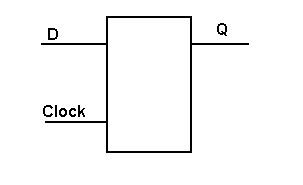
Please show the following D flip flop using logic gates. Keep in mind there should only be one output Q.
Homework Answers

Add Answer to:
Please show the following D flip flop using logic gates. Keep in
mind there should only...
Show how a D flip-flop can be constructed using a T flip-flop and other logic gates....
Show how a D flip-flop can be constructed using a T flip-flop and other logic gates. Provide the circuit, characteristic table and a timing diagram to demonstrate the operation (generate your own inputs).
Design D Flip Flop show internal circuits using basic gates and 3 inputs data, enable, clock,...
Design D Flip Flop show internal circuits using basic gates and 3 inputs data, enable, clock, and one output Q. Show all steps in design.
Exercise 3.14 Design a synchronously settable D flip-flop using logic gates
 Exercise 3.14 Design a synchronously settable D flip-flop using logic gates
Exercise 3.14 Design a synchronously settable D flip-flop using logic gates
Exercise 3.14 Design a synchronously settable D flip-flop using logic gates
Using all D flip-flops and combinational logic (AND/OR/NOT gates only) b) using all T flip-flop...
 using all D flip-flops and combinational logic (AND/OR/NOT gates
only)
b) using all T flip-flops and a multiplexer of size 8:1
Problem 3: (10 pts) Design a synchronous machine (Transition Table, K-maps, Final Equations, Circuit Diagram) that counts through the following sequence in the order shown below. Note, there are no inputs or output variables, so your Q values must reflect the Hex value listed B 74 2 D9 3 0 and repeat a) using all D flip-flops and combinational...
using all D flip-flops and combinational logic (AND/OR/NOT gates
only)
b) using all T flip-flops and a multiplexer of size 8:1
Problem 3: (10 pts) Design a synchronous machine (Transition Table, K-maps, Final Equations, Circuit Diagram) that counts through the following sequence in the order shown below. Note, there are no inputs or output variables, so your Q values must reflect the Hex value listed B 74 2 D9 3 0 and repeat a) using all D flip-flops and combinational...
Use the gated SR latch design with only NAND gates to design a gated SR flip–flop....
Use the gated SR latch design with only NAND gates to design a gated SR flip–flop. The stored bit Q can only change on the positive edge (rising edge) of the clock cycle. Draw the circuit using only logic gates and create a symbol for the flip–flop you designed.
Design a double edge-triggered D flip-flop using multiplexers only. The output of the flip-flop Q should...
Design a double edge-triggered D flip-flop using multiplexers only. The output of the flip-flop Q should “sample” the value of the input D on both rising (+ve) and falling (-ve) edges of the clock CLK. Provide detailed solution and explanation.
Design a positive-edge T flip-flop using a positive-edge-triggered D flip-flop and other logic gates.
Design a positive-edge T flip-flop using a positive-edge-triggered D flip-flop and other logic gates.
PROBLEM 3 (16 PTS) ▪ With a D flip flop and logic gates, sketch the circuit...
 PROBLEM 3 (16 PTS) ▪ With a D
flip flop and logic gates, sketch the circuit whose excitation
equation is given by:
PROBLEM 3 (16 PTS) • With a D flip flop and logic gates, sketch the circuit whose excitation equation is given by: Qit+1) + y + Q(t) + y(t) (4 pts) • Complete the timing diagram of the circuit whose VHDL description is shown below. Also, get the excitation equation for q. library ieee: elsaf (cll'event and clk...
PROBLEM 3 (16 PTS) ▪ With a D
flip flop and logic gates, sketch the circuit whose excitation
equation is given by:
PROBLEM 3 (16 PTS) • With a D flip flop and logic gates, sketch the circuit whose excitation equation is given by: Qit+1) + y + Q(t) + y(t) (4 pts) • Complete the timing diagram of the circuit whose VHDL description is shown below. Also, get the excitation equation for q. library ieee: elsaf (cll'event and clk...
T-flip flop Problem #8 (15 Points) Use one T flip flop and additional logic gates to...
 T-flip flop
Problem #8 (15 Points) Use one T flip flop and additional logic gates to implement a JK flip flop (draw the Logic Circut Solution:
T-flip flop
Problem #8 (15 Points) Use one T flip flop and additional logic gates to implement a JK flip flop (draw the Logic Circut Solution:
a) (5 marks) Explain the difference between a latch, a gated latch and a flip flop....
 a) (5 marks) Explain the difference between a latch, a gated latch and a flip flop. b) (5 marks) A gated SR latch has the following schematic diagram CLK a) Draw a timing diagram showing the Q and Q outputs for the following sequence of inputs: CLK R Assume that the initial state of the outputs is Q 0 and Q 1 c) (5 marks) Draw a schematic diagram for a rising edge-triggered master-slave D flip- flop built using two...
 Exercise 3.14 Design a synchronously settable D flip-flop using logic gates
Exercise 3.14 Design a synchronously settable D flip-flop using logic gates
Exercise 3.14 Design a synchronously settable D flip-flop using logic gates
 using all D flip-flops and combinational logic (AND/OR/NOT gates
only)
b) using all T flip-flops and a multiplexer of size 8:1
Problem 3: (10 pts) Design a synchronous machine (Transition Table, K-maps, Final Equations, Circuit Diagram) that counts through the following sequence in the order shown below. Note, there are no inputs or output variables, so your Q values must reflect the Hex value listed B 74 2 D9 3 0 and repeat a) using all D flip-flops and combinational...
using all D flip-flops and combinational logic (AND/OR/NOT gates
only)
b) using all T flip-flops and a multiplexer of size 8:1
Problem 3: (10 pts) Design a synchronous machine (Transition Table, K-maps, Final Equations, Circuit Diagram) that counts through the following sequence in the order shown below. Note, there are no inputs or output variables, so your Q values must reflect the Hex value listed B 74 2 D9 3 0 and repeat a) using all D flip-flops and combinational...
 PROBLEM 3 (16 PTS) ▪ With a D
flip flop and logic gates, sketch the circuit whose excitation
equation is given by:
PROBLEM 3 (16 PTS) • With a D flip flop and logic gates, sketch the circuit whose excitation equation is given by: Qit+1) + y + Q(t) + y(t) (4 pts) • Complete the timing diagram of the circuit whose VHDL description is shown below. Also, get the excitation equation for q. library ieee: elsaf (cll'event and clk...
PROBLEM 3 (16 PTS) ▪ With a D
flip flop and logic gates, sketch the circuit whose excitation
equation is given by:
PROBLEM 3 (16 PTS) • With a D flip flop and logic gates, sketch the circuit whose excitation equation is given by: Qit+1) + y + Q(t) + y(t) (4 pts) • Complete the timing diagram of the circuit whose VHDL description is shown below. Also, get the excitation equation for q. library ieee: elsaf (cll'event and clk...
 T-flip flop
Problem #8 (15 Points) Use one T flip flop and additional logic gates to implement a JK flip flop (draw the Logic Circut Solution:
T-flip flop
Problem #8 (15 Points) Use one T flip flop and additional logic gates to implement a JK flip flop (draw the Logic Circut Solution:
 a) (5 marks) Explain the difference between a latch, a gated latch and a flip flop. b) (5 marks) A gated SR latch has the following schematic diagram CLK a) Draw a timing diagram showing the Q and Q outputs for the following sequence of inputs: CLK R Assume that the initial state of the outputs is Q 0 and Q 1 c) (5 marks) Draw a schematic diagram for a rising edge-triggered master-slave D flip- flop built using two...
Most questions answered within 3 hours.
-
Where is the error in this code sequence?
String s1 = "Hello";
String s2 = "ello";...
asked 10 months ago -
Financial data for Joel de Paris, Inc., for last year
follow:
Joel de Paris, Inc.
Balance...
asked 10 months ago -
Consider this reaction:
Al2(SO4)3 (aq)+ BaCl3
(aq) Al2Cl6 (aq)- +
3BaSO4(s) . What is the...
asked 10 months ago -
Suppose that Savneet is considering increasing her
recent random sample from 20 car rentals to 40...
asked 10 months ago -
Trucks arrive at an unloading terminal at an average rate of 120
per hour.
Trucks arrive...
asked 10 months ago -
Why are methanol and ethanol completely soluble in water while
octanol is not very little soluble....
asked 10 months ago -
A facilities manager at a university reads in a research report
that the mean amount of...
asked 10 months ago -
When the CuSO4 is rehydrated by adding water to the anhydrous
compound, is this an endothermic...
asked 10 months ago -
A ray of sunlight is passing from diamond into crown glass; the
angle of incidence is...
asked 10 months ago -
A block of mass 0.249 kg is placed on top of a light, vertical
spring of...
asked 10 months ago -
how do the kidneys compensate in the presences of acidosis
a) trigger hyperventilate
b) reserve acid...
asked 10 months ago -
Question 501 pts
The rental rate of capital to the firm increases. Which of the
following...
asked 10 months ago