What is the transfer function of the following circuit in terms of circuit components and frequency ω

Homework Answers

Add Answer to:
What is the transfer function of the following circuit in terms
of circuit components and frequency...
This filter is an active bandpass filter Compute the transfer function for the circuit of in term...
 This filter is an active bandpass filter
Compute the transfer function for the circuit of in
terms of the circuit constants R1 R2 R3 C1 and C2. Then, replace
the complex variable with omega, and the circuit constants with
their numerical values and plot the magnitude versus radian
frequency .
What kind of filter is this? Find the transfer function of the circuit and Use MATLAB to plot IVout/Vin over frequency to verify your answer. 0.01 μF 106.1 kΩ 0...
This filter is an active bandpass filter
Compute the transfer function for the circuit of in
terms of the circuit constants R1 R2 R3 C1 and C2. Then, replace
the complex variable with omega, and the circuit constants with
their numerical values and plot the magnitude versus radian
frequency .
What kind of filter is this? Find the transfer function of the circuit and Use MATLAB to plot IVout/Vin over frequency to verify your answer. 0.01 μF 106.1 kΩ 0...
Using Op-Amps, design a circuit to have the following transfer function: H (s) = Kps + Ki Where Kp 3.12, Ki 2346. a) b) c) Construct the s-domain circuit of the controller. Find the voltage the c...
 Using Op-Amps, design a circuit to have the following transfer function: H (s) = Kps + Ki Where Kp 3.12, Ki 2346. a) b) c) Construct the s-domain circuit of the controller. Find the voltage the controller transfer function in terms of R's and C's. Choose the component values to match the transfer function. The design components must have standard values. d) We have a RL load of R 332 and L-12 mH, we want the current to be a...
Pre-Laboratory Task 4: Derive an expression for the magnitude of the transfer function, H(Go)Vout(jo)/Wn(j, and the phase of the transfer function LH (ja) for the LCR circuit in Figure 4. Plot H(ja)l...
 Pre-Laboratory Task 4: Derive an expression for the magnitude of the transfer function, H(Go)Vout(jo)/Wn(j, and the phase of the transfer function LH (ja) for the LCR circuit in Figure 4. Plot H(ja)l and H(jo) vs. frequency (o) in the form of a Bode plot indicating the damping frequency and the value of |H(jo)| at the damping frequency. Also determine the 3dB frequency and the roll off rate for Ir(ja)1 when ω > ω3dB. Vounlius R 470Ω C 100 nF Figure...
the voltage transfer function Avi) Vo(s)/Vin(s) (s-plane representation) for your selected circuit. What is the frequency...
 the voltage transfer function Avi) Vo(s)/Vin(s) (s-plane representation) for your selected circuit. What is the frequency response for this circuit (both magnitude and phase)? What is the corner frequency in Hz and rad/sec? What kind of filter is this? (2+2+1+1) points 1 Vi ?.
1. Find the transfer function (voltage gain) of the following amplifier. You may assume a high...
 1. Find the transfer function (voltage gain) of the following amplifier. You may assume a high frequency model for the transistor. You may assume that the transistor has been biased properly. Your answer will indeed be in terms of circuit components. Vcc 10v C1 01 R2 V1 C2 RE Vout
For the circuit shown below, a) Determine the transfer function vo/vi b) Plot lVolvil versus ω...
 For the circuit shown below, a) Determine the transfer function vo/vi b) Plot lVolvil versus ω c) Find the cutoff frequency, n. Vi C=40pF
Derive the transfer function of the circuit in Fig.P2.93(foranidealopamp)andshowthatitcanbewritten in the form Vo Vi = −R2/R1...
 Derive the transfer function of the circuit in
Fig.P2.93(foranidealopamp)andshowthatitcanbewritten in the
form
Vo Vi = −R2/R1 [1+(ω1/jω)][1+j(ω/ω2)] whereω1=1/C1R1
andω2=1/C2R2.Assumingthatthecircuit is designed such that ω2 ω1,
find approximate expressions
for the transfer function in the following frequency regions: (a)
ωω1 (b) ω1 ωω2 (c) ωω2
Vo
FigureP2.93
Use these approximations to sketch a Bode plot for the magnitude
response. Observe that the circuit performs as an amplifier whose
gain rolls off at the low-frequency end in the manner of a
high-pass...
Derive the transfer function of the circuit in
Fig.P2.93(foranidealopamp)andshowthatitcanbewritten in the
form
Vo Vi = −R2/R1 [1+(ω1/jω)][1+j(ω/ω2)] whereω1=1/C1R1
andω2=1/C2R2.Assumingthatthecircuit is designed such that ω2 ω1,
find approximate expressions
for the transfer function in the following frequency regions: (a)
ωω1 (b) ω1 ωω2 (c) ωω2
Vo
FigureP2.93
Use these approximations to sketch a Bode plot for the magnitude
response. Observe that the circuit performs as an amplifier whose
gain rolls off at the low-frequency end in the manner of a
high-pass...
27. (a) The circuit below has transfer function H(s)--out . It is known that L =0.5...
 27. (a) The circuit below has transfer function H(s)--out . It is known that L =0.5 H ist andRI = 4 Ω and R2=2Q. (i) Compute the transfer function. (ii) Compute the COMPLETE range of for which the circuit is BIBO stable. R2 out C : 0.25 F. Compute H(s)-out ) Determ ne the complete range of m for which Vin(s) (b) Let R= 2 Ω the circuit is BIBO stable in out mvtt) out
etermine the transfer function of the circuit where i^(t) is the output variable and v.ct) is...
 etermine the transfer function of the circuit where i^(t) is the output variable and v.ct) is the input variable. Generate the Bode plot showing the frequency response of the circuit. Only show the asymptotic plot of the terms making the transfer function as 5 H 10 k2 10 H 25 H 62.5 nF U) well as the composite plot for both the magnitude and phase.
Given the circuit below, determine the transfer function V (s)/V,(s) in terms of the parameters given....
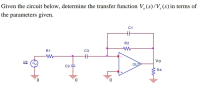 Given the circuit below, determine the transfer function V (s)/V,(s) in terms of the parameters given. LE +? UD ok
 This filter is an active bandpass filter
Compute the transfer function for the circuit of in
terms of the circuit constants R1 R2 R3 C1 and C2. Then, replace
the complex variable with omega, and the circuit constants with
their numerical values and plot the magnitude versus radian
frequency .
What kind of filter is this? Find the transfer function of the circuit and Use MATLAB to plot IVout/Vin over frequency to verify your answer. 0.01 μF 106.1 kΩ 0...
This filter is an active bandpass filter
Compute the transfer function for the circuit of in
terms of the circuit constants R1 R2 R3 C1 and C2. Then, replace
the complex variable with omega, and the circuit constants with
their numerical values and plot the magnitude versus radian
frequency .
What kind of filter is this? Find the transfer function of the circuit and Use MATLAB to plot IVout/Vin over frequency to verify your answer. 0.01 μF 106.1 kΩ 0...
 Using Op-Amps, design a circuit to have the following transfer function: H (s) = Kps + Ki Where Kp 3.12, Ki 2346. a) b) c) Construct the s-domain circuit of the controller. Find the voltage the controller transfer function in terms of R's and C's. Choose the component values to match the transfer function. The design components must have standard values. d) We have a RL load of R 332 and L-12 mH, we want the current to be a...
 Pre-Laboratory Task 4: Derive an expression for the magnitude of the transfer function, H(Go)Vout(jo)/Wn(j, and the phase of the transfer function LH (ja) for the LCR circuit in Figure 4. Plot H(ja)l and H(jo) vs. frequency (o) in the form of a Bode plot indicating the damping frequency and the value of |H(jo)| at the damping frequency. Also determine the 3dB frequency and the roll off rate for Ir(ja)1 when ω > ω3dB. Vounlius R 470Ω C 100 nF Figure...
 the voltage transfer function Avi) Vo(s)/Vin(s) (s-plane representation) for your selected circuit. What is the frequency response for this circuit (both magnitude and phase)? What is the corner frequency in Hz and rad/sec? What kind of filter is this? (2+2+1+1) points 1 Vi ?.
 1. Find the transfer function (voltage gain) of the following amplifier. You may assume a high frequency model for the transistor. You may assume that the transistor has been biased properly. Your answer will indeed be in terms of circuit components. Vcc 10v C1 01 R2 V1 C2 RE Vout
 For the circuit shown below, a) Determine the transfer function vo/vi b) Plot lVolvil versus ω c) Find the cutoff frequency, n. Vi C=40pF
 Derive the transfer function of the circuit in
Fig.P2.93(foranidealopamp)andshowthatitcanbewritten in the
form
Vo Vi = −R2/R1 [1+(ω1/jω)][1+j(ω/ω2)] whereω1=1/C1R1
andω2=1/C2R2.Assumingthatthecircuit is designed such that ω2 ω1,
find approximate expressions
for the transfer function in the following frequency regions: (a)
ωω1 (b) ω1 ωω2 (c) ωω2
Vo
FigureP2.93
Use these approximations to sketch a Bode plot for the magnitude
response. Observe that the circuit performs as an amplifier whose
gain rolls off at the low-frequency end in the manner of a
high-pass...
Derive the transfer function of the circuit in
Fig.P2.93(foranidealopamp)andshowthatitcanbewritten in the
form
Vo Vi = −R2/R1 [1+(ω1/jω)][1+j(ω/ω2)] whereω1=1/C1R1
andω2=1/C2R2.Assumingthatthecircuit is designed such that ω2 ω1,
find approximate expressions
for the transfer function in the following frequency regions: (a)
ωω1 (b) ω1 ωω2 (c) ωω2
Vo
FigureP2.93
Use these approximations to sketch a Bode plot for the magnitude
response. Observe that the circuit performs as an amplifier whose
gain rolls off at the low-frequency end in the manner of a
high-pass...
 27. (a) The circuit below has transfer function H(s)--out . It is known that L =0.5 H ist andRI = 4 Ω and R2=2Q. (i) Compute the transfer function. (ii) Compute the COMPLETE range of for which the circuit is BIBO stable. R2 out C : 0.25 F. Compute H(s)-out ) Determ ne the complete range of m for which Vin(s) (b) Let R= 2 Ω the circuit is BIBO stable in out mvtt) out
 etermine the transfer function of the circuit where i^(t) is the output variable and v.ct) is the input variable. Generate the Bode plot showing the frequency response of the circuit. Only show the asymptotic plot of the terms making the transfer function as 5 H 10 k2 10 H 25 H 62.5 nF U) well as the composite plot for both the magnitude and phase.
 Given the circuit below, determine the transfer function V (s)/V,(s) in terms of the parameters given. LE +? UD ok
Most questions answered within 3 hours.
-
Where is the error in this code sequence?
String s1 = "Hello";
String s2 = "ello";...
asked 10 months ago -
Financial data for Joel de Paris, Inc., for last year
follow:
Joel de Paris, Inc.
Balance...
asked 10 months ago -
Consider this reaction:
Al2(SO4)3 (aq)+ BaCl3
(aq) Al2Cl6 (aq)- +
3BaSO4(s) . What is the...
asked 10 months ago -
Suppose that Savneet is considering increasing her
recent random sample from 20 car rentals to 40...
asked 10 months ago -
Trucks arrive at an unloading terminal at an average rate of 120
per hour.
Trucks arrive...
asked 10 months ago -
Why are methanol and ethanol completely soluble in water while
octanol is not very little soluble....
asked 10 months ago -
A facilities manager at a university reads in a research report
that the mean amount of...
asked 10 months ago -
When the CuSO4 is rehydrated by adding water to the anhydrous
compound, is this an endothermic...
asked 10 months ago -
A ray of sunlight is passing from diamond into crown glass; the
angle of incidence is...
asked 10 months ago -
A block of mass 0.249 kg is placed on top of a light, vertical
spring of...
asked 10 months ago -
how do the kidneys compensate in the presences of acidosis
a) trigger hyperventilate
b) reserve acid...
asked 10 months ago -
Question 501 pts
The rental rate of capital to the firm increases. Which of the
following...
asked 10 months ago