
Homework Answers
The decrease in Reduced vital capacity and Total lung capacity
leads to restrictive lung disease or chronic lung condition.
This cause limit the person lungs to expand during
inhalation.Mostly due to shortage of O2 during inhalation breathing
rate increases to meet their oxygen demands.
Add Answer to:
question#50
Clinical Question 50. An 82-year-old man has trouble breathing and has been referred to a...
Mrs X is a 56 year old lady who presents with dyspnea on exertion that has...
Mrs X is a 56 year old lady who presents with dyspnea on exertion that has slowly and progressively gotten worse over the last year. She has had a minor non-productive cough. She denies fever, nausea, vomiting or night sweats. Her past medical history is positive for hypertension and hyperlipidemia. Her current medications include simvastatin and lisinopril. She has smoked 1-2 packs of cigarettes daily for 25 years. Her vital are remarkable for respiratory rate of 24 and O2 Sat...
A 23-year old female has generalized skeletal muscles weakness but is otherwise normal. Which of the...
A 23-year old female has generalized skeletal muscles weakness but is otherwise normal. Which of the following lung volume or lung capacity most likely would be normal? a. Inspiratory reserve volume b. Functional residual capacity c. Residual volume d. Total lung capacity e. Vital capacity Defend your answer by describing why each of the other answers are not correct
A 50-year-old man was admitted to the hospital with the diagnosis of chronic obstructive lung disease....
A 50-year-old man was admitted to the hospital with the diagnosis of chronic obstructive lung disease. On review of the chart, the nurse noted the patient is both hypoxic and has an elevated carbon dioxide level. When examining the patient, the nurse notes an increased respiratory effort and use of accessory muscles 1. Explain the difference between the central and peripheral chemoteceptor and relate this back to the patient and how they would present ??
The patient is a 60 year old man who has just been diagnosed with non-small cell...
The patient is a 60 year old man who has just been diagnosed with non-small cell lung cancer. He smoked cigarettes for about 25 years starting when he was 16 years old and quit when he was 41 years old. His lung cancer is at stage I in the left lower lobe. He is distraught, saying that he can’t die now because he has one child in college and two in high school. He also fears chemotherapy and seems bitter...
A 68-year-old man comes to the emergency department because of a 1-week history of difficulty breathing....
 A 68-year-old man comes to the emergency department because of a 1-week history of difficulty breathing. He has had recurrent palpitations over the past 2 years. During this time, he has also had several episodes of anxiety despite no change in his daily life. He has occasional sharp chest pain localized to the left upper sternal border. He has no abdominal pain or leg swelling. Two years ago, he had streptococcal pharyngitis, which was promptly treated with a 10-day course...
16. A 56 year old man who smoked heavily for many years developed worsening cough with...
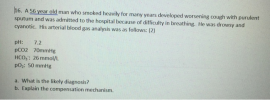 16. A 56 year old man who smoked heavily for many years developed worsening cough with purulent sputum and was admitted to the hospital because of difficulty in breathing. He was drowsy and cyanotic. His arterial blood gas analysis was as follows: (2) pHн: 7.2 PCO2 70mmHg HCO,: 26 mmol/L po2: 50 mmHg a. What is the likely diagnosis? b. Explain the compensation mechanism.
A 50-year-old man was admitted to the hospital with the diagnosis of chronic obstructive lung disease....
A 50-year-old man was admitted to the hospital with the diagnosis of chronic obstructive lung disease. On review of the chart, the nurse noted the patient is both hypoxic and has an elevated carbon dioxide level. When examining the patient, the nurse notes an increased respiratory effort and use of accessory muscles. 1. What is compliance, resistance, and residual volume as it relates to COPD. 2. In patients with chronic obstructive disease, there is a decreased surface area for diffusion....
cpt codes 15. Sherri has had trouble breathing for two days. Her primary care physician referred...
 cpt codes
15. Sherri has had trouble breathing for two days. Her primary care physician referred her to an ENT. The ENT performed a diagnostic maxillary sinusoscopy. How should the sinusoscopy be reported? 16. A single physician changed a patient's nephrostomy tube using radiologic guidance. The procedure was performed in the hospital. How should these services be reported? 17. An otherwise healthy ten-month old infant is administered general anesthetic by an anesthesiologist for a lower abdominal hernia repair. The infant...
cpt codes
15. Sherri has had trouble breathing for two days. Her primary care physician referred her to an ENT. The ENT performed a diagnostic maxillary sinusoscopy. How should the sinusoscopy be reported? 16. A single physician changed a patient's nephrostomy tube using radiologic guidance. The procedure was performed in the hospital. How should these services be reported? 17. An otherwise healthy ten-month old infant is administered general anesthetic by an anesthesiologist for a lower abdominal hernia repair. The infant...
A 60-year-old man notes that his resting heart rate has been 50-60 beats per minute after...
 A 60-year-old man notes that his resting heart rate has been 50-60 beats per minute after he started taking an new drug compared to 70-80 bpm previously. Which of the following drugs would likely lower his heart rate? What is the mechanism of each drug you select? a) metoprolol b) lisinopril c) verapamil d) digoxin e) furosemide MESSAGE * Subject
A 50-year-old man was admitted to the hospital with the diagnosis of chronic obstructive lung disease. On review of the...
A 50-year-old man was admitted to the hospital with the diagnosis of chronic obstructive lung disease. On review of the chart, the nurse noted the patient is both hypoxic and has an elevated carbon dioxide level. When examining the patient, the nurse notes an increased respiratory effort and use of accessory muscles 1. What is compliance, resistance, and residual volume as it relates to COPD. 2. In patients with chronic obstructive disease, there is a decreased surface area for diffusion....
 A 68-year-old man comes to the emergency department because of a 1-week history of difficulty breathing. He has had recurrent palpitations over the past 2 years. During this time, he has also had several episodes of anxiety despite no change in his daily life. He has occasional sharp chest pain localized to the left upper sternal border. He has no abdominal pain or leg swelling. Two years ago, he had streptococcal pharyngitis, which was promptly treated with a 10-day course...
 16. A 56 year old man who smoked heavily for many years developed worsening cough with purulent sputum and was admitted to the hospital because of difficulty in breathing. He was drowsy and cyanotic. His arterial blood gas analysis was as follows: (2) pHн: 7.2 PCO2 70mmHg HCO,: 26 mmol/L po2: 50 mmHg a. What is the likely diagnosis? b. Explain the compensation mechanism.
 cpt codes
15. Sherri has had trouble breathing for two days. Her primary care physician referred her to an ENT. The ENT performed a diagnostic maxillary sinusoscopy. How should the sinusoscopy be reported? 16. A single physician changed a patient's nephrostomy tube using radiologic guidance. The procedure was performed in the hospital. How should these services be reported? 17. An otherwise healthy ten-month old infant is administered general anesthetic by an anesthesiologist for a lower abdominal hernia repair. The infant...
cpt codes
15. Sherri has had trouble breathing for two days. Her primary care physician referred her to an ENT. The ENT performed a diagnostic maxillary sinusoscopy. How should the sinusoscopy be reported? 16. A single physician changed a patient's nephrostomy tube using radiologic guidance. The procedure was performed in the hospital. How should these services be reported? 17. An otherwise healthy ten-month old infant is administered general anesthetic by an anesthesiologist for a lower abdominal hernia repair. The infant...
 A 60-year-old man notes that his resting heart rate has been 50-60 beats per minute after he started taking an new drug compared to 70-80 bpm previously. Which of the following drugs would likely lower his heart rate? What is the mechanism of each drug you select? a) metoprolol b) lisinopril c) verapamil d) digoxin e) furosemide MESSAGE * Subject
Most questions answered within 3 hours.
-
Where is the error in this code sequence?
String s1 = "Hello";
String s2 = "ello";...
asked 10 months ago -
Financial data for Joel de Paris, Inc., for last year
follow:
Joel de Paris, Inc.
Balance...
asked 10 months ago -
Consider this reaction:
Al2(SO4)3 (aq)+ BaCl3
(aq) Al2Cl6 (aq)- +
3BaSO4(s) . What is the...
asked 10 months ago -
Suppose that Savneet is considering increasing her
recent random sample from 20 car rentals to 40...
asked 10 months ago -
Trucks arrive at an unloading terminal at an average rate of 120
per hour.
Trucks arrive...
asked 10 months ago -
Why are methanol and ethanol completely soluble in water while
octanol is not very little soluble....
asked 10 months ago -
A facilities manager at a university reads in a research report
that the mean amount of...
asked 10 months ago -
When the CuSO4 is rehydrated by adding water to the anhydrous
compound, is this an endothermic...
asked 10 months ago -
A ray of sunlight is passing from diamond into crown glass; the
angle of incidence is...
asked 10 months ago -
A block of mass 0.249 kg is placed on top of a light, vertical
spring of...
asked 10 months ago -
how do the kidneys compensate in the presences of acidosis
a) trigger hyperventilate
b) reserve acid...
asked 10 months ago -
Question 501 pts
The rental rate of capital to the firm increases. Which of the
following...
asked 10 months ago