

Homework Answers


Add Answer to:
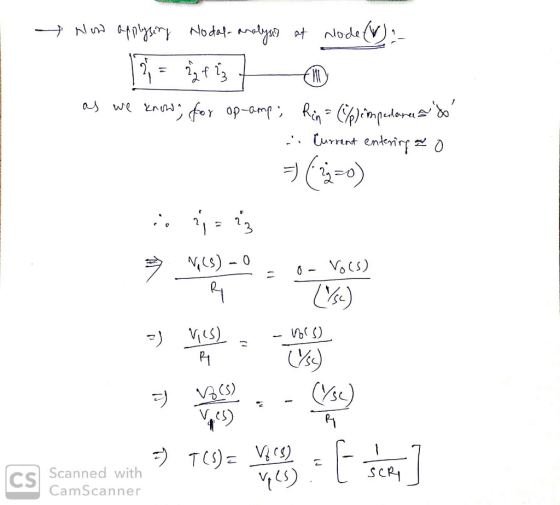
Applying Kirchoff's current law (KCL) at the blue input node and the red output node, we...
The circuit below is "Differential amplifier" The waveform of the input signal is shown below. The...
 The circuit below is "Differential amplifier" The waveform of
the input signal is shown below. The input signal is
(1) An expression of the gain of a closed loop on a circuit
Use to induce. (formerly op-amp)
The analysis method can be used. KVL and KCL can be utilized
properly.)
(2)When
set the resistance value so that the closed loop gain is 2.5 and
the output synchronized with the input signal.
Sketch the force signal (exactly mark the maximum and...
The circuit below is "Differential amplifier" The waveform of
the input signal is shown below. The input signal is
(1) An expression of the gain of a closed loop on a circuit
Use to induce. (formerly op-amp)
The analysis method can be used. KVL and KCL can be utilized
properly.)
(2)When
set the resistance value so that the closed loop gain is 2.5 and
the output synchronized with the input signal.
Sketch the force signal (exactly mark the maximum and...
Laboratory 1: operation amplifier characteristics A. Objectives: 1. To study the basic characteri...
 thanks
Laboratory 1: operation amplifier characteristics A. Objectives: 1. To study the basic characteristics of an operational amplifier 2. To study the bias circuit of an operational amplifier B. Apparatus: 1. DC Power supply 2. Experimental board and corresponding components 3. Electronic calculator (prepared by students) 4. Digital camera (prepared by students for photo taking of the experimental results) 5. Laptop computer with the software PicoScope 6 and Microsoft Word installed. 6. PicoScope PC Oscilloscope and its accessories. 7. Multimeter...
thanks
Laboratory 1: operation amplifier characteristics A. Objectives: 1. To study the basic characteristics of an operational amplifier 2. To study the bias circuit of an operational amplifier B. Apparatus: 1. DC Power supply 2. Experimental board and corresponding components 3. Electronic calculator (prepared by students) 4. Digital camera (prepared by students for photo taking of the experimental results) 5. Laptop computer with the software PicoScope 6 and Microsoft Word installed. 6. PicoScope PC Oscilloscope and its accessories. 7. Multimeter...
Simulation For each filter mentioned in the following cases, first simulate the circuit using Multisim. You can get a plot of the transfer function that is called the Bode plot. From the right toolba...
 Simulation For each filter mentioned in the following cases, first simulate the circuit using Multisim. You can get a plot of the transfer function that is called the Bode plot. From the right toolbar, select "Bode Plotter". Change initial (I) and final (F) frequencies to 1Hz and 200 KHz, respectively. Use a Voltage AC source as the input signal. You do not need to change any parameter from voltage AC source. Connect "Bode Plotter" to input and output of your...
For each filter mentioned in the following cases, first simulate the circuit using Multisim. You can get a plot of the transfer function that is called the Bode plot. From the right toolbar, select &...
 For each filter mentioned in the following cases, first simulate the circuit using Multisim. You can get a plot of the transfer function that is called the Bode plot. From the right toolbar, select "Bode Plotter". Change initial (I) and final (F frequencies to 1Hz and 200 KHz, respectively. Use a Voltage AC source as the input signal. You do not need to change any parameter from voltage AC source Connect "Bode Plotter" to input and output of your circuit...
*Note : MOSFET-2N7002 Parameter => Vt : 1.47V, kn = 0.048 A/V^2 1. Obtain [ the...
 *Note : MOSFET-2N7002 Parameter => Vt : 1.47V, kn = 0.048
A/V^2
1. Obtain [ the Voltage and current ] of [ each node and branch
] at DC bias point (operating point) in the common-source +
source-follower figure above.
2. Obtain the small-signal equivalent model of the figure above
at DC bias point , then obtain open-circuit voltage gain Avo, input
resistance Rin, output resistance Rout.
tran 0 100m 99m 0.001m ;op 0 100m 99m 0.001m VDD V1 +...
*Note : MOSFET-2N7002 Parameter => Vt : 1.47V, kn = 0.048
A/V^2
1. Obtain [ the Voltage and current ] of [ each node and branch
] at DC bias point (operating point) in the common-source +
source-follower figure above.
2. Obtain the small-signal equivalent model of the figure above
at DC bias point , then obtain open-circuit voltage gain Avo, input
resistance Rin, output resistance Rout.
tran 0 100m 99m 0.001m ;op 0 100m 99m 0.001m VDD V1 +...
Determine the period number of the ufk-4 cos(K+TT/2) discrete time signal! Select one: O A. 34 O ...
 Determine the period number of the ufk-4 cos(K+TT/2) discrete time signal! Select one: O A. 34 O D. Non periodic O E. 34/3 A coil (L 5 mH) is parallel connected to two serially connected resistors (6 kΩ and 4 k2). Calculate the time constant of the above two-pole! Select one: Ο Α.0.5s OC. 5 s Ο D. 0.5 με Ο Ε.0.5 Ms Consider the following sequential network: Z2 Di Ct ㄍ洼 S2 Q2 CLK Choose which function does this...
Vout should be a sinusoid signal of 12Vp-p Dc voltage to uA741 : +/-8.5V Please simulate...
 Vout should be a sinusoid signal of 12Vp-p
Dc voltage to uA741 : +/-8.5V
Please simulate as well
please help, im completely lost on this
this is all of the information
Experiment 5. RC Sinusoidal Oscillators PURPOSE: This laboratory provides an introduction to the background, analysis and design of sinusoidal oscillators using RC feedback networks and active devices to achieve the criteria for continuous oscillations to occur. EQUIPMENT REQUIRED : 1 Operational amplifier u.A741 1 CEU development station Resistors and...
Vout should be a sinusoid signal of 12Vp-p
Dc voltage to uA741 : +/-8.5V
Please simulate as well
please help, im completely lost on this
this is all of the information
Experiment 5. RC Sinusoidal Oscillators PURPOSE: This laboratory provides an introduction to the background, analysis and design of sinusoidal oscillators using RC feedback networks and active devices to achieve the criteria for continuous oscillations to occur. EQUIPMENT REQUIRED : 1 Operational amplifier u.A741 1 CEU development station Resistors and...
 The circuit below is "Differential amplifier" The waveform of
the input signal is shown below. The input signal is
(1) An expression of the gain of a closed loop on a circuit
Use to induce. (formerly op-amp)
The analysis method can be used. KVL and KCL can be utilized
properly.)
(2)When
set the resistance value so that the closed loop gain is 2.5 and
the output synchronized with the input signal.
Sketch the force signal (exactly mark the maximum and...
The circuit below is "Differential amplifier" The waveform of
the input signal is shown below. The input signal is
(1) An expression of the gain of a closed loop on a circuit
Use to induce. (formerly op-amp)
The analysis method can be used. KVL and KCL can be utilized
properly.)
(2)When
set the resistance value so that the closed loop gain is 2.5 and
the output synchronized with the input signal.
Sketch the force signal (exactly mark the maximum and...
 thanks
Laboratory 1: operation amplifier characteristics A. Objectives: 1. To study the basic characteristics of an operational amplifier 2. To study the bias circuit of an operational amplifier B. Apparatus: 1. DC Power supply 2. Experimental board and corresponding components 3. Electronic calculator (prepared by students) 4. Digital camera (prepared by students for photo taking of the experimental results) 5. Laptop computer with the software PicoScope 6 and Microsoft Word installed. 6. PicoScope PC Oscilloscope and its accessories. 7. Multimeter...
thanks
Laboratory 1: operation amplifier characteristics A. Objectives: 1. To study the basic characteristics of an operational amplifier 2. To study the bias circuit of an operational amplifier B. Apparatus: 1. DC Power supply 2. Experimental board and corresponding components 3. Electronic calculator (prepared by students) 4. Digital camera (prepared by students for photo taking of the experimental results) 5. Laptop computer with the software PicoScope 6 and Microsoft Word installed. 6. PicoScope PC Oscilloscope and its accessories. 7. Multimeter...
 Simulation For each filter mentioned in the following cases, first simulate the circuit using Multisim. You can get a plot of the transfer function that is called the Bode plot. From the right toolbar, select "Bode Plotter". Change initial (I) and final (F) frequencies to 1Hz and 200 KHz, respectively. Use a Voltage AC source as the input signal. You do not need to change any parameter from voltage AC source. Connect "Bode Plotter" to input and output of your...
 For each filter mentioned in the following cases, first simulate the circuit using Multisim. You can get a plot of the transfer function that is called the Bode plot. From the right toolbar, select "Bode Plotter". Change initial (I) and final (F frequencies to 1Hz and 200 KHz, respectively. Use a Voltage AC source as the input signal. You do not need to change any parameter from voltage AC source Connect "Bode Plotter" to input and output of your circuit...
 *Note : MOSFET-2N7002 Parameter => Vt : 1.47V, kn = 0.048
A/V^2
1. Obtain [ the Voltage and current ] of [ each node and branch
] at DC bias point (operating point) in the common-source +
source-follower figure above.
2. Obtain the small-signal equivalent model of the figure above
at DC bias point , then obtain open-circuit voltage gain Avo, input
resistance Rin, output resistance Rout.
tran 0 100m 99m 0.001m ;op 0 100m 99m 0.001m VDD V1 +...
*Note : MOSFET-2N7002 Parameter => Vt : 1.47V, kn = 0.048
A/V^2
1. Obtain [ the Voltage and current ] of [ each node and branch
] at DC bias point (operating point) in the common-source +
source-follower figure above.
2. Obtain the small-signal equivalent model of the figure above
at DC bias point , then obtain open-circuit voltage gain Avo, input
resistance Rin, output resistance Rout.
tran 0 100m 99m 0.001m ;op 0 100m 99m 0.001m VDD V1 +...
 Determine the period number of the ufk-4 cos(K+TT/2) discrete time signal! Select one: O A. 34 O D. Non periodic O E. 34/3 A coil (L 5 mH) is parallel connected to two serially connected resistors (6 kΩ and 4 k2). Calculate the time constant of the above two-pole! Select one: Ο Α.0.5s OC. 5 s Ο D. 0.5 με Ο Ε.0.5 Ms Consider the following sequential network: Z2 Di Ct ㄍ洼 S2 Q2 CLK Choose which function does this...
 Vout should be a sinusoid signal of 12Vp-p
Dc voltage to uA741 : +/-8.5V
Please simulate as well
please help, im completely lost on this
this is all of the information
Experiment 5. RC Sinusoidal Oscillators PURPOSE: This laboratory provides an introduction to the background, analysis and design of sinusoidal oscillators using RC feedback networks and active devices to achieve the criteria for continuous oscillations to occur. EQUIPMENT REQUIRED : 1 Operational amplifier u.A741 1 CEU development station Resistors and...
Vout should be a sinusoid signal of 12Vp-p
Dc voltage to uA741 : +/-8.5V
Please simulate as well
please help, im completely lost on this
this is all of the information
Experiment 5. RC Sinusoidal Oscillators PURPOSE: This laboratory provides an introduction to the background, analysis and design of sinusoidal oscillators using RC feedback networks and active devices to achieve the criteria for continuous oscillations to occur. EQUIPMENT REQUIRED : 1 Operational amplifier u.A741 1 CEU development station Resistors and...
Most questions answered within 3 hours.
-
Where is the error in this code sequence?
String s1 = "Hello";
String s2 = "ello";...
asked 10 months ago -
Financial data for Joel de Paris, Inc., for last year
follow:
Joel de Paris, Inc.
Balance...
asked 10 months ago -
Consider this reaction:
Al2(SO4)3 (aq)+ BaCl3
(aq) Al2Cl6 (aq)- +
3BaSO4(s) . What is the...
asked 10 months ago -
Suppose that Savneet is considering increasing her
recent random sample from 20 car rentals to 40...
asked 10 months ago -
Trucks arrive at an unloading terminal at an average rate of 120
per hour.
Trucks arrive...
asked 10 months ago -
Why are methanol and ethanol completely soluble in water while
octanol is not very little soluble....
asked 10 months ago -
A facilities manager at a university reads in a research report
that the mean amount of...
asked 10 months ago -
When the CuSO4 is rehydrated by adding water to the anhydrous
compound, is this an endothermic...
asked 10 months ago -
A ray of sunlight is passing from diamond into crown glass; the
angle of incidence is...
asked 10 months ago -
A block of mass 0.249 kg is placed on top of a light, vertical
spring of...
asked 10 months ago -
how do the kidneys compensate in the presences of acidosis
a) trigger hyperventilate
b) reserve acid...
asked 10 months ago -
Question 501 pts
The rental rate of capital to the firm increases. Which of the
following...
asked 10 months ago