
Homework Answers
Add Answer to:
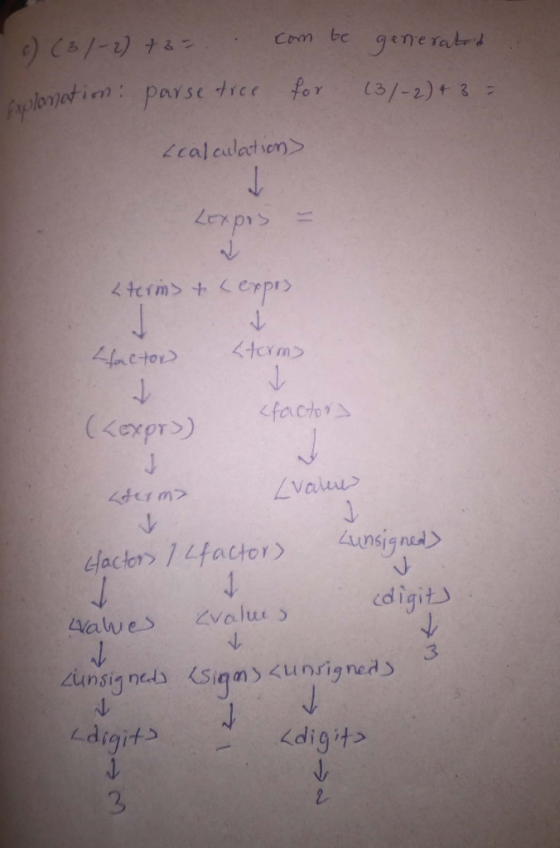
Question 9 (10 points) Consider the following EBNF grammar for a "Calculator Language": <calculation> <expr> =...
Question 9 (10 points) Consider the following EBNF grammar for a “Calculator Language": <calculation> → <expr>=...
 Question 9 (10 points) Consider the following EBNF grammar for a “Calculator Language": <calculation> → <expr>= <expr> <term> (+1-) <expr> <term> <term> <factor> (* ) <term> <factor> <factor> → (<expr>) <value> <value> → [<sign> ] <unsigned> [. <unsigned> ] <unsigned> <digit> { <digit> } <digit> → 01|2|3|4|567| 8 | 9 <sign> → +|- which of the following sentences is in the language generated by this grammar ? Why? a. 3/+2.5 = b. 5-*3/4= c. (3/-2) + 3 = d. 5...
Q3. Convert the following recursive BNF grammar to EBNF: (20%) <assign>-> <id> = <expr> <expr> ->...
 Q3. Convert the following recursive BNF grammar to EBNF: (20%) <assign>-> <id> = <expr> <expr> -> <d>+ <expr> | <id> * <expr> 1 (<expr>) | <i>
Question 3: Given the following grammar: assign → id := expr expr → expr + term \ term term -term *factor lfactor factor-(expr) id Using the above grammar, show a leftmost derivation (first five step...
 Question 3: Given the following grammar: assign → id := expr expr → expr + term \ term term -term *factor lfactor factor-(expr) id Using the above grammar, show a leftmost derivation (first five steps) for the following assignment statement: A ((A B)+ C) a. [3 marks] b. Using the above grammar, show a rightmost derivation (first five steps) for the following assignment statement: A:-A+B+C)+A [3 marks] Draw the abstract syntax tree for each of the above statements [4 marks]...
Considering the following BNF grammar, answer the questions. <prog> - <assign> | <expr> <assign> = <id>...
 Considering the following BNF grammar, answer the questions. <prog> - <assign> | <expr> <assign> = <id> = <expr> <expr> := <expr> + <term> | <expr> - <term> | <term> <term> := <factor> | <factor> * <term> <factor> ::= ( <expr> ) | <id> | <num> <id>::= ABC <num> := 0|1|2|3 2a - What is the associativity of the * operator? (5 points) 2b - For the * and + operators, do they have the same precedence, does the * operator...
1.a Consider the following Grammar,
1.a Consider the following Grammar, <assign> à <id> = <expr> <id> à A | B |C <expr> à < expr> + <expr> | <expr> * <expr> | ( <expr> ) | <id> Derive the following statement using leftmost derivation. A = A * (B*(C+ A)) b. 2 a}. Consider the following grammar that expresses parenthesized expressions of digits, including both addition and multiplication. <expr> := <expr> + <expr> | <expr> * <expr> | (expr>) | <digit> <digit> := 0 | 1 | 2 |...
Consider the following BNF grammar that we saw in class: EXP ::= EXP + TERM ...
Consider the following BNF grammar that we saw in class: EXP ::= EXP + TERM | EXP - TERM | TERM TERM ::= TERM * FACTOR | TERM / FACTOR | FACTOR FACTOR ::= ( EXP ) | DIGIT DIGIT ::= 0 | 1 | 2 | 3 (a) Translate into EBNF. (b) Draw syntax diagrams. (c) What are the two requirements on a grammar for a predictive parser to be able to...
Consider the following grammar expr- term term_tail term_tail -add_op term term_tail | term - factor factor_tail...
Consider the following grammar expr- term term_tail term_tail -add_op term term_tail | term - factor factor_tail factor_tail-mult_op factor factor _tail | factor -(expr) |id|literal add_op -+|- mult_op-*|/ Draw syntax tree for parsing each of cdf+(a25+84),(a25+84)*cdf,84*cdf+a25,a25+84*cdf,a25*84*cdf.Note that a25 and cdf are identifiers and 84 is a literal.You are not asked to do the tedious parsing process with stack snapshots.Instead you only need to draw sysntax trees,but you do need to do lexical analysis N.B: I need only lexical analysis for this...
3. Consider the following grammar: expr term term tail term-tail-) add-op term term-ail 1 ε term ...
 3. Consider the following grammar: expr term term tail term-tail-) add-op term term-ail 1 ε term → factor factor-tail factor. tain ε factor (expr) id literal add-op → +1 Draw a syntax tree for parsing each of cdf + (a25 + 84), (a25 + 84)*cdf, 84*cdf+ a25, a25+84 cdf a25*84*cdf. Note that a25 and cdf are identifiers and 84 is a literal You are not asked to do the tedious parsing process with stack snapshots. Instead you only need to...
1. Consider the following BNF definition of arithmetic expressions: <expression> <expression>+ <term> | <expression>-<term> <term> <term>...
 1. Consider the following BNF definition of arithmetic expressions: <expression> <expression>+ <term> | <expression>-<term> <term> <term> ::= <term>*<factor> <term>/<factor> | <factor> <factor> :: <digit>«<exponent> | <didgit>^«<exponent> <digit>(<expression> <digit>:= 01|2|3|4151617181910. <exponent> :: <sign> <val> <sign>=+1 - <val 1121314 Draw the expression trees of the following expressions, parsed according to the BNF above. a) 46 - 6/4-243. b) 4*6 -(6/4 - 243) c) 31-2-3*2 + 3/2 d) 3^2*5. e) ((3^2)).
(8) (3 marks) Write BNF grammar rules for a language that is comprised only of sentences described as follows: symbol,...
 (8) (3 marks) Write BNF grammar rules for a language that is comprised only of sentences described as follows: symbol, fol symbols orjust onéx symbol, A sequence of one or more occurrences of an a lowed by either zero or morez followed by a sequence of one or more b symbols. (9) (1 mark) The following fragment of grammar describes the syntax of the exponentiation operator. What is the associativity ot the operator as detined here? factor | expr factor...
 Question 9 (10 points) Consider the following EBNF grammar for a “Calculator Language": <calculation> → <expr>= <expr> <term> (+1-) <expr> <term> <term> <factor> (* ) <term> <factor> <factor> → (<expr>) <value> <value> → [<sign> ] <unsigned> [. <unsigned> ] <unsigned> <digit> { <digit> } <digit> → 01|2|3|4|567| 8 | 9 <sign> → +|- which of the following sentences is in the language generated by this grammar ? Why? a. 3/+2.5 = b. 5-*3/4= c. (3/-2) + 3 = d. 5...
 Q3. Convert the following recursive BNF grammar to EBNF: (20%) <assign>-> <id> = <expr> <expr> -> <d>+ <expr> | <id> * <expr> 1 (<expr>) | <i>
 Question 3: Given the following grammar: assign → id := expr expr → expr + term \ term term -term *factor lfactor factor-(expr) id Using the above grammar, show a leftmost derivation (first five steps) for the following assignment statement: A ((A B)+ C) a. [3 marks] b. Using the above grammar, show a rightmost derivation (first five steps) for the following assignment statement: A:-A+B+C)+A [3 marks] Draw the abstract syntax tree for each of the above statements [4 marks]...
 Considering the following BNF grammar, answer the questions. <prog> - <assign> | <expr> <assign> = <id> = <expr> <expr> := <expr> + <term> | <expr> - <term> | <term> <term> := <factor> | <factor> * <term> <factor> ::= ( <expr> ) | <id> | <num> <id>::= ABC <num> := 0|1|2|3 2a - What is the associativity of the * operator? (5 points) 2b - For the * and + operators, do they have the same precedence, does the * operator...
 3. Consider the following grammar: expr term term tail term-tail-) add-op term term-ail 1 ε term → factor factor-tail factor. tain ε factor (expr) id literal add-op → +1 Draw a syntax tree for parsing each of cdf + (a25 + 84), (a25 + 84)*cdf, 84*cdf+ a25, a25+84 cdf a25*84*cdf. Note that a25 and cdf are identifiers and 84 is a literal You are not asked to do the tedious parsing process with stack snapshots. Instead you only need to...
 1. Consider the following BNF definition of arithmetic expressions: <expression> <expression>+ <term> | <expression>-<term> <term> <term> ::= <term>*<factor> <term>/<factor> | <factor> <factor> :: <digit>«<exponent> | <didgit>^«<exponent> <digit>(<expression> <digit>:= 01|2|3|4151617181910. <exponent> :: <sign> <val> <sign>=+1 - <val 1121314 Draw the expression trees of the following expressions, parsed according to the BNF above. a) 46 - 6/4-243. b) 4*6 -(6/4 - 243) c) 31-2-3*2 + 3/2 d) 3^2*5. e) ((3^2)).
 (8) (3 marks) Write BNF grammar rules for a language that is comprised only of sentences described as follows: symbol, fol symbols orjust onéx symbol, A sequence of one or more occurrences of an a lowed by either zero or morez followed by a sequence of one or more b symbols. (9) (1 mark) The following fragment of grammar describes the syntax of the exponentiation operator. What is the associativity ot the operator as detined here? factor | expr factor...
Most questions answered within 3 hours.
-
Where is the error in this code sequence?
String s1 = "Hello";
String s2 = "ello";...
asked 10 months ago -
Financial data for Joel de Paris, Inc., for last year
follow:
Joel de Paris, Inc.
Balance...
asked 10 months ago -
Consider this reaction:
Al2(SO4)3 (aq)+ BaCl3
(aq) Al2Cl6 (aq)- +
3BaSO4(s) . What is the...
asked 10 months ago -
Suppose that Savneet is considering increasing her
recent random sample from 20 car rentals to 40...
asked 10 months ago -
Trucks arrive at an unloading terminal at an average rate of 120
per hour.
Trucks arrive...
asked 10 months ago -
Why are methanol and ethanol completely soluble in water while
octanol is not very little soluble....
asked 10 months ago -
A facilities manager at a university reads in a research report
that the mean amount of...
asked 10 months ago -
When the CuSO4 is rehydrated by adding water to the anhydrous
compound, is this an endothermic...
asked 10 months ago -
A ray of sunlight is passing from diamond into crown glass; the
angle of incidence is...
asked 10 months ago -
A block of mass 0.249 kg is placed on top of a light, vertical
spring of...
asked 10 months ago -
how do the kidneys compensate in the presences of acidosis
a) trigger hyperventilate
b) reserve acid...
asked 10 months ago -
Question 501 pts
The rental rate of capital to the firm increases. Which of the
following...
asked 10 months ago