
Homework Answers
Add Answer to:
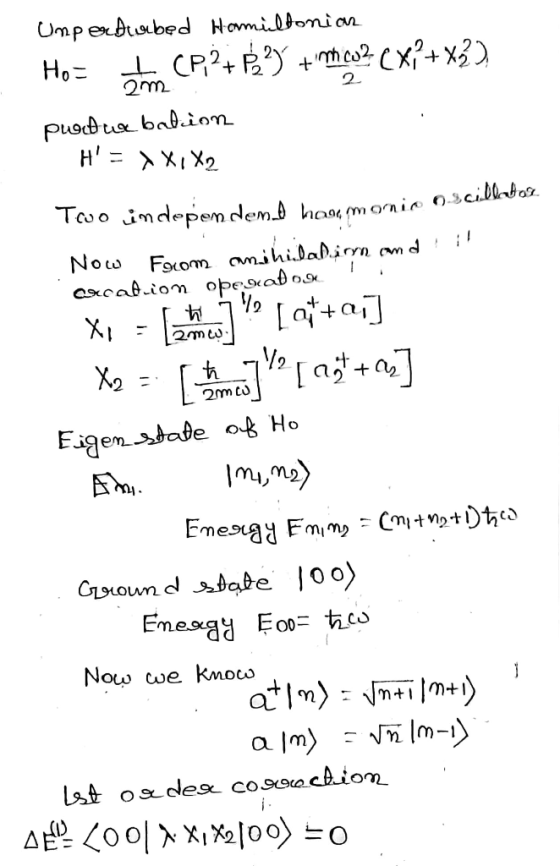
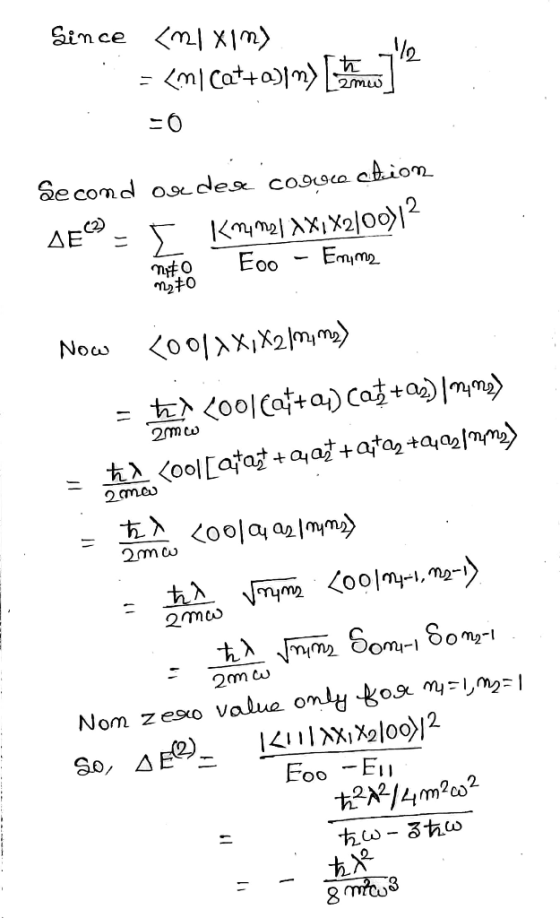
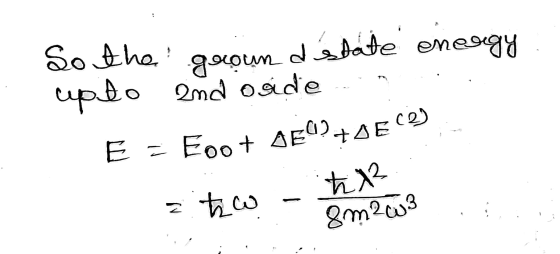
5. Stationary perturbation theory Consider two one-dimensional harmonic oscillators coupled by an interaction term, ie, -E...
H2 Consider two harmonic oscillators described by the Hamiltonians łty = ħws (atât ta+2) and =...
 H2 Consider two harmonic oscillators described by the Hamiltonians łty = ħws (atât ta+2) and = ħwz (6+6 +) with â (h) and at (@t) being the annihilation and creation operators for the first (second) oscillator, respectively. The Hamiltonian of two non-interacting oscillators is given by Ĥg = îl + Ħ2. Its eigenstates are tensor products of the eigenstates of single-oscillator states: Ĥm, n) = En,m|n, m), where İn, m) = \n) |m) and n, m = 0,1,2, ... a)...
H2 Consider two harmonic oscillators described by the Hamiltonians łty = ħws (atât ta+2) and =...
 H2 Consider two harmonic oscillators described by the Hamiltonians łty = ħws (atât ta+2) and = ħwz (6+6 +) with â (h) and at (@t) being the annihilation and creation operators for the first (second) oscillator, respectively. The Hamiltonian of two non-interacting oscillators is given by Ĥ, = îl + Ĥ2. Its eigenstates are tensor products of the eigenstates of single-oscillator states: Ĥm, n) = En,m|n, m), where İn, m) = \n) |m) and n, m = 0,1,2, ... 1....
Suppose a particle is in a one-dimensional harmonic oscillator potential. Suppose that a perturbation is added...
 Suppose a particle is in a one-dimensional harmonic oscillator
potential. Suppose that
a perturbation is added at time t = 0 of the form . Assume that at time t = 0 the
particle
is in the ground state. Use first order perturbation theory to find
the probability that at some
time t1 > 0 the particle is in the first excited state of the
harmonic oscillator.
H' = ext.
Suppose a particle is in a one-dimensional harmonic oscillator
potential. Suppose that
a perturbation is added at time t = 0 of the form . Assume that at time t = 0 the
particle
is in the ground state. Use first order perturbation theory to find
the probability that at some
time t1 > 0 the particle is in the first excited state of the
harmonic oscillator.
H' = ext.
Consider a one-dimensional (1D) harmonic oscillator problem, where the perturbation V causes a modification of the...
 Consider a one-dimensional (1D) harmonic oscillator problem, where the perturbation V causes a modification of the oscillator frequency: 2 K22 H = H. +V, (1) 2 K2 V = - K +K > 0. Of course, this problem (1), (2) is trivially solved exactly yielding the oscillator solutions with a new frequency. Show that corrections to the nth energy level as calculated within the perturbation theory indeed reproduce the exact result, restricting yourselves to terms up to the second order...
A particle of charge q and mass m is bound in the ground state of a one-dimensional harmonic osci...
 A particle of charge q and mass m is bound in the ground state of a one-dimensional harmonic oscillator potential with frequency oo. At time t-0 a weak spatially uniform electric field (E) is turned on, so that the perturbation to the Hamiltonian can be described as R'(t) =-q Exe-t/t for t> 0. Using first order, time-dependent perturbation theory, calculate the following probabilities: (a) the particle is detected in the first excited state after a very long time (t »...
4. 3D Infinite Square Well Perturbation (20 pts) Consider the three-dimensional infinite cubic well: otherwise The stationary states are where n, ny, and n, are integers. The corresponding allowed en...
 4. 3D Infinite Square Well Perturbation (20 pts) Consider the three-dimensional infinite cubic well: otherwise The stationary states are where n, ny, and n, are integers. The corresponding allowed energies are Now let us introduce the perturbation otherwise a) Find the first-order correction to the ground state energy b) Find the first-order correction to the first excited state
4. 3D Infinite Square Well Perturbation (20 pts) Consider the three-dimensional infinite cubic well: otherwise The stationary states are where n, ny,...
4. 3D Infinite Square Well Perturbation (20 pts) Consider the three-dimensional infinite cubic well: otherwise The stationary states are where n, ny, and n, are integers. The corresponding allowed energies are Now let us introduce the perturbation otherwise a) Find the first-order correction to the ground state energy b) Find the first-order correction to the first excited state
4. 3D Infinite Square Well Perturbation (20 pts) Consider the three-dimensional infinite cubic well: otherwise The stationary states are where n, ny,...
1. The two dimensional Harmonic Oscillator has the Hamiltonian n, n'>denotes the state In> of the...
 Please solve with the
explanations of notations
1. The two dimensional Harmonic Oscillator has the Hamiltonian n, n'>denotes the state In> of the x-oscillator and In'> of the y-oscillator. This system is perturbed with the potential energy: Hi-Kix y. The perturbation removes the The perturbation removes the degeneracy of the states | 1,0> and |0,1> a) In first order perturbation theory find the two nondegenerate eigenstates of the full b) Find the corresponding energy eigenvalues. На Hamiltonian as normalized linear...
Please solve with the
explanations of notations
1. The two dimensional Harmonic Oscillator has the Hamiltonian n, n'>denotes the state In> of the x-oscillator and In'> of the y-oscillator. This system is perturbed with the potential energy: Hi-Kix y. The perturbation removes the The perturbation removes the degeneracy of the states | 1,0> and |0,1> a) In first order perturbation theory find the two nondegenerate eigenstates of the full b) Find the corresponding energy eigenvalues. На Hamiltonian as normalized linear...
Electrical Perturbation (bonus problem, 50 pts) An electron moving in a one-dimensional harmonic potential of frequency...
 Electrical Perturbation (bonus problem, 50 pts) An electron moving in a one-dimensional harmonic potential of frequency ω is experiencing a weak electric field E in x-direction, resulting in the Hamiltonian 5. 2mdx2 2 Calculate the energy to the first non-zero correction using perturbation theory and compare with the exact result of e282 2mu2 Hint: Use ladder operators in H and H
1. Consider a spin-0 particle of mass m and charge q moving in a symmetric three-dimensional harm...
 1. Consider a spin-0 particle of mass m and charge q moving in a symmetric three-dimensional harmonic oscillator potential with natural frequency W.Att-0 an external magnetic field is turned on which is uniform in space but oscillates with temporal frequency W as follows. E(t)-Bo sin(at) At time t>0, the perturbation is turned off. Assuming that the system starts off at t-0 in the ground state, apply time-dependent perturbation theory to estimate the probability that the system ends up in an...
Quantum Mechanics. Consider a one-dimensional harmonic oscillator of frequency found in the ground state. At a perturbation is activated. Obtain an expression for the expected value of as a funct...
Quantum Mechanics. Consider a one-dimensional harmonic oscillator of frequency found in the ground state. At a perturbation is activated. Obtain an expression for the expected value of as a function of time using time-dependent perturbation theory. A step by step process is deeply appreciated. The best handwriting possible, please. Thank you very much. We were unable to transcribe this imageWe were unable to transcribe this imageV (t) = Fox cos (at) We were unable to transcribe this image V (t)...
 H2 Consider two harmonic oscillators described by the Hamiltonians łty = ħws (atât ta+2) and = ħwz (6+6 +) with â (h) and at (@t) being the annihilation and creation operators for the first (second) oscillator, respectively. The Hamiltonian of two non-interacting oscillators is given by Ĥg = îl + Ħ2. Its eigenstates are tensor products of the eigenstates of single-oscillator states: Ĥm, n) = En,m|n, m), where İn, m) = \n) |m) and n, m = 0,1,2, ... a)...
 H2 Consider two harmonic oscillators described by the Hamiltonians łty = ħws (atât ta+2) and = ħwz (6+6 +) with â (h) and at (@t) being the annihilation and creation operators for the first (second) oscillator, respectively. The Hamiltonian of two non-interacting oscillators is given by Ĥ, = îl + Ĥ2. Its eigenstates are tensor products of the eigenstates of single-oscillator states: Ĥm, n) = En,m|n, m), where İn, m) = \n) |m) and n, m = 0,1,2, ... 1....
 Suppose a particle is in a one-dimensional harmonic oscillator
potential. Suppose that
a perturbation is added at time t = 0 of the form . Assume that at time t = 0 the
particle
is in the ground state. Use first order perturbation theory to find
the probability that at some
time t1 > 0 the particle is in the first excited state of the
harmonic oscillator.
H' = ext.
Suppose a particle is in a one-dimensional harmonic oscillator
potential. Suppose that
a perturbation is added at time t = 0 of the form . Assume that at time t = 0 the
particle
is in the ground state. Use first order perturbation theory to find
the probability that at some
time t1 > 0 the particle is in the first excited state of the
harmonic oscillator.
H' = ext.
 Consider a one-dimensional (1D) harmonic oscillator problem, where the perturbation V causes a modification of the oscillator frequency: 2 K22 H = H. +V, (1) 2 K2 V = - K +K > 0. Of course, this problem (1), (2) is trivially solved exactly yielding the oscillator solutions with a new frequency. Show that corrections to the nth energy level as calculated within the perturbation theory indeed reproduce the exact result, restricting yourselves to terms up to the second order...
 A particle of charge q and mass m is bound in the ground state of a one-dimensional harmonic oscillator potential with frequency oo. At time t-0 a weak spatially uniform electric field (E) is turned on, so that the perturbation to the Hamiltonian can be described as R'(t) =-q Exe-t/t for t> 0. Using first order, time-dependent perturbation theory, calculate the following probabilities: (a) the particle is detected in the first excited state after a very long time (t »...
 4. 3D Infinite Square Well Perturbation (20 pts) Consider the three-dimensional infinite cubic well: otherwise The stationary states are where n, ny, and n, are integers. The corresponding allowed energies are Now let us introduce the perturbation otherwise a) Find the first-order correction to the ground state energy b) Find the first-order correction to the first excited state
4. 3D Infinite Square Well Perturbation (20 pts) Consider the three-dimensional infinite cubic well: otherwise The stationary states are where n, ny,...
4. 3D Infinite Square Well Perturbation (20 pts) Consider the three-dimensional infinite cubic well: otherwise The stationary states are where n, ny, and n, are integers. The corresponding allowed energies are Now let us introduce the perturbation otherwise a) Find the first-order correction to the ground state energy b) Find the first-order correction to the first excited state
4. 3D Infinite Square Well Perturbation (20 pts) Consider the three-dimensional infinite cubic well: otherwise The stationary states are where n, ny,...
 Please solve with the
explanations of notations
1. The two dimensional Harmonic Oscillator has the Hamiltonian n, n'>denotes the state In> of the x-oscillator and In'> of the y-oscillator. This system is perturbed with the potential energy: Hi-Kix y. The perturbation removes the The perturbation removes the degeneracy of the states | 1,0> and |0,1> a) In first order perturbation theory find the two nondegenerate eigenstates of the full b) Find the corresponding energy eigenvalues. На Hamiltonian as normalized linear...
Please solve with the
explanations of notations
1. The two dimensional Harmonic Oscillator has the Hamiltonian n, n'>denotes the state In> of the x-oscillator and In'> of the y-oscillator. This system is perturbed with the potential energy: Hi-Kix y. The perturbation removes the The perturbation removes the degeneracy of the states | 1,0> and |0,1> a) In first order perturbation theory find the two nondegenerate eigenstates of the full b) Find the corresponding energy eigenvalues. На Hamiltonian as normalized linear...
 Electrical Perturbation (bonus problem, 50 pts) An electron moving in a one-dimensional harmonic potential of frequency ω is experiencing a weak electric field E in x-direction, resulting in the Hamiltonian 5. 2mdx2 2 Calculate the energy to the first non-zero correction using perturbation theory and compare with the exact result of e282 2mu2 Hint: Use ladder operators in H and H
 1. Consider a spin-0 particle of mass m and charge q moving in a symmetric three-dimensional harmonic oscillator potential with natural frequency W.Att-0 an external magnetic field is turned on which is uniform in space but oscillates with temporal frequency W as follows. E(t)-Bo sin(at) At time t>0, the perturbation is turned off. Assuming that the system starts off at t-0 in the ground state, apply time-dependent perturbation theory to estimate the probability that the system ends up in an...
Most questions answered within 3 hours.
-
Where is the error in this code sequence?
String s1 = "Hello";
String s2 = "ello";...
asked 10 months ago -
Financial data for Joel de Paris, Inc., for last year
follow:
Joel de Paris, Inc.
Balance...
asked 10 months ago -
Consider this reaction:
Al2(SO4)3 (aq)+ BaCl3
(aq) Al2Cl6 (aq)- +
3BaSO4(s) . What is the...
asked 10 months ago -
Suppose that Savneet is considering increasing her
recent random sample from 20 car rentals to 40...
asked 10 months ago -
Trucks arrive at an unloading terminal at an average rate of 120
per hour.
Trucks arrive...
asked 10 months ago -
Why are methanol and ethanol completely soluble in water while
octanol is not very little soluble....
asked 10 months ago -
A facilities manager at a university reads in a research report
that the mean amount of...
asked 10 months ago -
When the CuSO4 is rehydrated by adding water to the anhydrous
compound, is this an endothermic...
asked 10 months ago -
A ray of sunlight is passing from diamond into crown glass; the
angle of incidence is...
asked 10 months ago -
A block of mass 0.249 kg is placed on top of a light, vertical
spring of...
asked 10 months ago -
how do the kidneys compensate in the presences of acidosis
a) trigger hyperventilate
b) reserve acid...
asked 10 months ago -
Question 501 pts
The rental rate of capital to the firm increases. Which of the
following...
asked 10 months ago