Which of the following are consequences of unequal recombination? Deletions Inversions Duplications Transformations Mutations All the...
Which of the following are consequences of unequal recombination? Deletions Inversions Duplications Transformations Mutations All the above Answers (A) and (D) Answers (A), (B), and (C) Answers (A), (B), (C), and (E)
Homework Answers

Add Answer to:
Which of the following are consequences of unequal
recombination? Deletions Inversions Duplications Transformations
Mutations All the...
QUESTION 9 Which of the following types of mutations are not caused by X-rays? a.pyrimidine dimers...
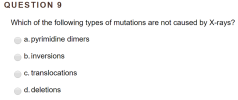 QUESTION 9 Which of the following types of mutations are not caused by X-rays? a.pyrimidine dimers b. inversions C. d. deletions
7) When Crick et al. plated large numbers of T4, with suppression mutations only, on K2...
 7) When Crick et al. plated large numbers of T4, with suppression mutations only, on K2 what did they find? a) no plaques b) xITA mutant plaques d) IIB mutant plaques c) plaques containing suppressor of suppressor mutations 8) What are the suppressors of the FCO mutation AND how do they work? a) deletions, by preventing the protein from being made b) other phage, work by complementing c) frameshifts, shift the frame back to the correct frame d ) inversions,...
A. Organisms heterozygous for inversions and translocations are viable and able to produce progeny but usually...
 A. Organisms heterozygous for inversions and translocations are
viable and able to produce progeny but usually in fewer numbers.
Explain why this is so in general terms.
B. Also, explain how would you distinguish among pericentric
inversions, paracentric inverisons, reciprocal translocations and
non reciprocal translocations as sources of semi-sterility. You
need to consider meiotic figures.
C. How can these chromosome aberrations be used to map genes to
chromosomes or linkage groups. You may use a two-point mapping
system as an...
A. Organisms heterozygous for inversions and translocations are
viable and able to produce progeny but usually in fewer numbers.
Explain why this is so in general terms.
B. Also, explain how would you distinguish among pericentric
inversions, paracentric inverisons, reciprocal translocations and
non reciprocal translocations as sources of semi-sterility. You
need to consider meiotic figures.
C. How can these chromosome aberrations be used to map genes to
chromosomes or linkage groups. You may use a two-point mapping
system as an...
What are the consequences of the missense mutations in BCR-ABLT315I and BRAFV600E? A. Both missense mutations...
What are the consequences of the missense mutations in BCR-ABLT315I and BRAFV600E? A. Both missense mutations convert drug-sensitive oncogenes to drug-resistant oncogenes. B. Both missense mutations convert two proto-oncogenes to oncogenes. C. Both missense mutations generate constitutively active tyrosine oncokinases. D. BCR-ABLT315I converts a drug-sensitive oncogene to a drug-resistant oncogene. BRAFV600E converts a proto-oncogene to an oncogene. E. Both missense mutations convert drug-sensitive oncogenes to drug-resistant oncogenes.
thumbs up for good answer! please help with my genetics, thank you!! heres a better quality...
 thumbs up for good answer! please help with my genetics, thank
you!!
heres a better quality photo
1. In the analysis of bacteriophage T4 rll locus mutants, a mixed infection experiment was eonducted. Complementation was ebierved for mutants 1 and 2, as well as for mutants 2 and 3 but mot between and 3. What can be concluded from the results? A-mutations 1 and 3 are on dferent genes B-all 3 mutations are in separate genes C-mutations 1 and 3...
thumbs up for good answer! please help with my genetics, thank
you!!
heres a better quality photo
1. In the analysis of bacteriophage T4 rll locus mutants, a mixed infection experiment was eonducted. Complementation was ebierved for mutants 1 and 2, as well as for mutants 2 and 3 but mot between and 3. What can be concluded from the results? A-mutations 1 and 3 are on dferent genes B-all 3 mutations are in separate genes C-mutations 1 and 3...
QUESTION 7 What are the potential consequences of un-repaired DNA damage (i.e. mutations) (select all that...
 QUESTION 7 What are the potential consequences of un-repaired DNA damage (i.e. mutations) (select all that apply)? A. Somatic mutations lead to changes in fitness for the affected individual ONLY B. Germ line mutations lead to cancer or other disease in the affected individual ONLY OC. Somatic mutations lead to cancer or other disease in the affected individual ONLY D. Germ line mutations lead to generation of new alleles that are passed on to the progeny E. Germ line mutations...
Which of the following statements about mutations are true? Select all that apply. Select one or...
Which of the following statements about mutations are true? Select all that apply. Select one or more: a. Both substitution and indel mutations could result in a non-sense mutation in the affected codon following the mutational event. b. Indel mutations that occurred in an exon (translated part of the gene) can be silent. c. A substitution mutation can lead to a frameshift. d. Mutations are the only source for the origin of new alleles. Consider the wild-type DNA sequence: 3'...
What are the potential consequences of un-repaired DNA damage (i.e. mutations) (select all that apply)? A....
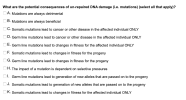 What are the potential consequences of un-repaired DNA damage (i.e. mutations) (select all that apply)? A. Mutations are always detrimental B. Mutations are always beneficial OC. Somatic mutations lead to cancer or other disease in the affected individual ONLY D. Germ line mutations lead to cancer or other disease in the affected individual ONLY E. Germ line mutations lead to changes in fitness for the affected individual ONLY OF. Somatic mutations lead to changes in fitness for the progeny OG....
6. Which of the following mutations would most likely have the severest consequences: Explain your reasoning....
 6. Which of the following mutations would most likely have the severest consequences: Explain your reasoning. a. A change in amino acid recognition of an aminoacyl-tRNA synthetase b. A frame shift mutation at the end of the coding sequence of a gene A mutation at a splice junction C.
#5 detergent All of the above. QUESTION 5 Which mutations do you think have the greatest...
 #5
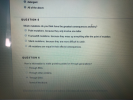
detergent All of the above. QUESTION 5 Which mutations do you think have the greatest consequences and why? Point mutations, because they only involve one letter. Frameshift mutations, because they mess up everything after the point of mutation Silent mutations, because they are more difficult to catch. All mutations are equal in their effects/consequences QUESTION 6 How is information to make proteins passed on through generations? Through RNA Through other proteins Through DNA None of the above Sau Sulit...
#5
detergent All of the above. QUESTION 5 Which mutations do you think have the greatest consequences and why? Point mutations, because they only involve one letter. Frameshift mutations, because they mess up everything after the point of mutation Silent mutations, because they are more difficult to catch. All mutations are equal in their effects/consequences QUESTION 6 How is information to make proteins passed on through generations? Through RNA Through other proteins Through DNA None of the above Sau Sulit...
 QUESTION 9 Which of the following types of mutations are not caused by X-rays? a.pyrimidine dimers b. inversions C. d. deletions
 7) When Crick et al. plated large numbers of T4, with suppression mutations only, on K2 what did they find? a) no plaques b) xITA mutant plaques d) IIB mutant plaques c) plaques containing suppressor of suppressor mutations 8) What are the suppressors of the FCO mutation AND how do they work? a) deletions, by preventing the protein from being made b) other phage, work by complementing c) frameshifts, shift the frame back to the correct frame d ) inversions,...
 A. Organisms heterozygous for inversions and translocations are
viable and able to produce progeny but usually in fewer numbers.
Explain why this is so in general terms.
B. Also, explain how would you distinguish among pericentric
inversions, paracentric inverisons, reciprocal translocations and
non reciprocal translocations as sources of semi-sterility. You
need to consider meiotic figures.
C. How can these chromosome aberrations be used to map genes to
chromosomes or linkage groups. You may use a two-point mapping
system as an...
A. Organisms heterozygous for inversions and translocations are
viable and able to produce progeny but usually in fewer numbers.
Explain why this is so in general terms.
B. Also, explain how would you distinguish among pericentric
inversions, paracentric inverisons, reciprocal translocations and
non reciprocal translocations as sources of semi-sterility. You
need to consider meiotic figures.
C. How can these chromosome aberrations be used to map genes to
chromosomes or linkage groups. You may use a two-point mapping
system as an...
 thumbs up for good answer! please help with my genetics, thank
you!!
heres a better quality photo
1. In the analysis of bacteriophage T4 rll locus mutants, a mixed infection experiment was eonducted. Complementation was ebierved for mutants 1 and 2, as well as for mutants 2 and 3 but mot between and 3. What can be concluded from the results? A-mutations 1 and 3 are on dferent genes B-all 3 mutations are in separate genes C-mutations 1 and 3...
thumbs up for good answer! please help with my genetics, thank
you!!
heres a better quality photo
1. In the analysis of bacteriophage T4 rll locus mutants, a mixed infection experiment was eonducted. Complementation was ebierved for mutants 1 and 2, as well as for mutants 2 and 3 but mot between and 3. What can be concluded from the results? A-mutations 1 and 3 are on dferent genes B-all 3 mutations are in separate genes C-mutations 1 and 3...
 QUESTION 7 What are the potential consequences of un-repaired DNA damage (i.e. mutations) (select all that apply)? A. Somatic mutations lead to changes in fitness for the affected individual ONLY B. Germ line mutations lead to cancer or other disease in the affected individual ONLY OC. Somatic mutations lead to cancer or other disease in the affected individual ONLY D. Germ line mutations lead to generation of new alleles that are passed on to the progeny E. Germ line mutations...
 What are the potential consequences of un-repaired DNA damage (i.e. mutations) (select all that apply)? A. Mutations are always detrimental B. Mutations are always beneficial OC. Somatic mutations lead to cancer or other disease in the affected individual ONLY D. Germ line mutations lead to cancer or other disease in the affected individual ONLY E. Germ line mutations lead to changes in fitness for the affected individual ONLY OF. Somatic mutations lead to changes in fitness for the progeny OG....
 6. Which of the following mutations would most likely have the severest consequences: Explain your reasoning. a. A change in amino acid recognition of an aminoacyl-tRNA synthetase b. A frame shift mutation at the end of the coding sequence of a gene A mutation at a splice junction C.
 #5
detergent All of the above. QUESTION 5 Which mutations do you think have the greatest consequences and why? Point mutations, because they only involve one letter. Frameshift mutations, because they mess up everything after the point of mutation Silent mutations, because they are more difficult to catch. All mutations are equal in their effects/consequences QUESTION 6 How is information to make proteins passed on through generations? Through RNA Through other proteins Through DNA None of the above Sau Sulit...
#5
detergent All of the above. QUESTION 5 Which mutations do you think have the greatest consequences and why? Point mutations, because they only involve one letter. Frameshift mutations, because they mess up everything after the point of mutation Silent mutations, because they are more difficult to catch. All mutations are equal in their effects/consequences QUESTION 6 How is information to make proteins passed on through generations? Through RNA Through other proteins Through DNA None of the above Sau Sulit...
Most questions answered within 3 hours.
-
Where is the error in this code sequence?
String s1 = "Hello";
String s2 = "ello";...
asked 11 months ago -
Financial data for Joel de Paris, Inc., for last year
follow:
Joel de Paris, Inc.
Balance...
asked 11 months ago -
Consider this reaction:
Al2(SO4)3 (aq)+ BaCl3
(aq) Al2Cl6 (aq)- +
3BaSO4(s) . What is the...
asked 11 months ago -
Suppose that Savneet is considering increasing her
recent random sample from 20 car rentals to 40...
asked 11 months ago -
Trucks arrive at an unloading terminal at an average rate of 120
per hour.
Trucks arrive...
asked 11 months ago -
Why are methanol and ethanol completely soluble in water while
octanol is not very little soluble....
asked 11 months ago -
A facilities manager at a university reads in a research report
that the mean amount of...
asked 11 months ago -
When the CuSO4 is rehydrated by adding water to the anhydrous
compound, is this an endothermic...
asked 11 months ago -
A ray of sunlight is passing from diamond into crown glass; the
angle of incidence is...
asked 11 months ago -
A block of mass 0.249 kg is placed on top of a light, vertical
spring of...
asked 11 months ago -
how do the kidneys compensate in the presences of acidosis
a) trigger hyperventilate
b) reserve acid...
asked 11 months ago -
Question 501 pts
The rental rate of capital to the firm increases. Which of the
following...
asked 11 months ago