Is yeast an r-selected or K-selected species? Based on the type of selection for yeast, list...
Is yeast an r-selected or K-selected species? Based on the type of selection for yeast, list four factors they exhibit
Homework Answers
Species which is population density dependent is called k-selected species and which is population density independent is called R-selected species.
Yeast is a r-selected species and exhibits following four factors :
1. They are short lived.
2. They reproduce at an early age.
3. They have fast maturation.
4. They care little for their offsprings.
Add Answer to:
Is yeast an r-selected or K-selected species? Based on the type
of selection for yeast, list...
2. Pkovide an example of a K-selected and an r-selected species. How does each species type...
 2. Pkovide an example of a K-selected and an r-selected species. How does each species type contribute to 30. With intermediate levels of disturbance, who gets the advantage (K-or r-selected)? -think of what happens after biodiversity? a low fuel burning fire.
is mutualism species an r-selected or a k-selected? explain why?
is mutualism species an r-selected or a k-selected? explain why?
discuss K-selected and R-selected species. Provide a comparison of the two types of organisms in the...
discuss K-selected and R-selected species. Provide a comparison of the two types of organisms in the form of a table or bulleted summary. Include key characteristics that differentiate the two and provide a couple of examples of each.
1. Would you expect early successional species to be r-selected or K-selected? 2. Why? 3. ?What...
 1. Would you expect early
successional species to be r-selected or K-selected?
2. Why?
3. ?What about species that dominate later in succession? Would
you expect them to be r-selected or K-selected?
You cannot see the individual modules in these photos. You may encounter some unitary organisms. Tube-dwelling worms collect particles on a retractable crown of tentacles. The mouth is in the center of the tentacle crown. The animal on the left has a flexible tube (sec arrow on left)...
1. Would you expect early
successional species to be r-selected or K-selected?
2. Why?
3. ?What about species that dominate later in succession? Would
you expect them to be r-selected or K-selected?
You cannot see the individual modules in these photos. You may encounter some unitary organisms. Tube-dwelling worms collect particles on a retractable crown of tentacles. The mouth is in the center of the tentacle crown. The animal on the left has a flexible tube (sec arrow on left)...
Explain r- and K-selection. What general patterns of lifestyle are associated with either r- or K-selection?
Explain r- and K-selection. What general patterns of lifestyle are associated with either r- or K-selection?
Question 28 (2 points) Match the following descriptions to the proper species types (K or r...
Question 28 (2 points) Match the following descriptions to the proper species types (K or r selected). Question 28 options: 12 Elephants would be an example 12 Dandelions would be an example 12 You would find these in unpredictable environments 12 They have a large number of small offspring 12 These have few, large offspring, a long gestation period, and often give long-term care to their offspring 1. K selected species 2. r selected species
5. Consider the system: dz 4y 1 dy (a) Are these species predator-prey or competing? b) What type of growth does species z exhibit in absence of species y? What type of growth does species y exhibit...
 5. Consider the system: dz 4y 1 dy (a) Are these species predator-prey or competing? b) What type of growth does species z exhibit in absence of species y? What type of growth does species y exhibit in absence of species r? (c) Find all critical (equilibrium) points d) Using the Jacobian matrix, classify (if possible) each critical (equilibrium) point as a stable node, a stable spiral point, an unstable node, an unstable spiral point, or a saddle point. (e)...
Based on standard Linnaean classification, what is the taxonomy-correct scientific name for your species? Homo sapiens...
Based on standard Linnaean classification, what is the taxonomy-correct scientific name for your species? Homo sapiens (sapiens) d. Homo humanis humanis Homo neanderthalensis e. Homo erectus All of the above (A, B, D, E) f. None of the above (A, B, D, E) Which of the following ecological components are NOT included within a description of a habitat’s community? (NOTE, not the same as species population or biome ecosystem) Flora c. Microbial life Fauna d. Abiotic factors Name 2...
PERIODIC 24.17. In the r vs. K-selection classification, which of the following best describes an selected...
 PERIODIC 24.17. In the r vs. K-selection classification, which of the following best describes an selected species? individuals grow larger live longer, reproduce later, and invest more resources into each offspring Individuals reproduce early and chen, maximizing the population growth rate individuals live longer and reproduce later but invest very little in offspring Individuals reproduce early and then and invest more resources into each offspring OPPORTUNISTIC G 0418 Recall Grime's life story classification, shown in simplified form in the figure...
8. Based on the information provided, record the interaction type between Species 1 and Species 2...
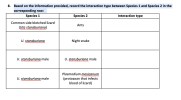 8. Based on the information provided, record the interaction type between Species 1 and Species 2 in the corresponding row: Species 1 Species 2 Interaction type Common side blotched lizard (Uta stansburiana) Ants U. stansburiana Night snake U. stansburiana male U. stansburiana male U. stansburiana male Plasmodium mexicanum (protozoan that infects blood of lizard)
 2. Pkovide an example of a K-selected and an r-selected species. How does each species type contribute to 30. With intermediate levels of disturbance, who gets the advantage (K-or r-selected)? -think of what happens after biodiversity? a low fuel burning fire.
 1. Would you expect early
successional species to be r-selected or K-selected?
2. Why?
3. ?What about species that dominate later in succession? Would
you expect them to be r-selected or K-selected?
You cannot see the individual modules in these photos. You may encounter some unitary organisms. Tube-dwelling worms collect particles on a retractable crown of tentacles. The mouth is in the center of the tentacle crown. The animal on the left has a flexible tube (sec arrow on left)...
1. Would you expect early
successional species to be r-selected or K-selected?
2. Why?
3. ?What about species that dominate later in succession? Would
you expect them to be r-selected or K-selected?
You cannot see the individual modules in these photos. You may encounter some unitary organisms. Tube-dwelling worms collect particles on a retractable crown of tentacles. The mouth is in the center of the tentacle crown. The animal on the left has a flexible tube (sec arrow on left)...
 5. Consider the system: dz 4y 1 dy (a) Are these species predator-prey or competing? b) What type of growth does species z exhibit in absence of species y? What type of growth does species y exhibit in absence of species r? (c) Find all critical (equilibrium) points d) Using the Jacobian matrix, classify (if possible) each critical (equilibrium) point as a stable node, a stable spiral point, an unstable node, an unstable spiral point, or a saddle point. (e)...
 PERIODIC 24.17. In the r vs. K-selection classification, which of the following best describes an selected species? individuals grow larger live longer, reproduce later, and invest more resources into each offspring Individuals reproduce early and chen, maximizing the population growth rate individuals live longer and reproduce later but invest very little in offspring Individuals reproduce early and then and invest more resources into each offspring OPPORTUNISTIC G 0418 Recall Grime's life story classification, shown in simplified form in the figure...
 8. Based on the information provided, record the interaction type between Species 1 and Species 2 in the corresponding row: Species 1 Species 2 Interaction type Common side blotched lizard (Uta stansburiana) Ants U. stansburiana Night snake U. stansburiana male U. stansburiana male U. stansburiana male Plasmodium mexicanum (protozoan that infects blood of lizard)
Most questions answered within 3 hours.
-
Where is the error in this code sequence?
String s1 = "Hello";
String s2 = "ello";...
asked 10 months ago -
Financial data for Joel de Paris, Inc., for last year
follow:
Joel de Paris, Inc.
Balance...
asked 10 months ago -
Consider this reaction:
Al2(SO4)3 (aq)+ BaCl3
(aq) Al2Cl6 (aq)- +
3BaSO4(s) . What is the...
asked 10 months ago -
Suppose that Savneet is considering increasing her
recent random sample from 20 car rentals to 40...
asked 10 months ago -
Trucks arrive at an unloading terminal at an average rate of 120
per hour.
Trucks arrive...
asked 10 months ago -
Why are methanol and ethanol completely soluble in water while
octanol is not very little soluble....
asked 10 months ago -
A facilities manager at a university reads in a research report
that the mean amount of...
asked 10 months ago -
When the CuSO4 is rehydrated by adding water to the anhydrous
compound, is this an endothermic...
asked 10 months ago -
A ray of sunlight is passing from diamond into crown glass; the
angle of incidence is...
asked 10 months ago -
A block of mass 0.249 kg is placed on top of a light, vertical
spring of...
asked 10 months ago -
how do the kidneys compensate in the presences of acidosis
a) trigger hyperventilate
b) reserve acid...
asked 10 months ago -
Question 501 pts
The rental rate of capital to the firm increases. Which of the
following...
asked 10 months ago