is mutualism species an r-selected or a k-selected? explain why?
is mutualism species an r-selected or a k-selected? explain why?
Homework Answers
QUESTION-1
ANSWER
Mutualism species are K-selected.
Explanation-
K-selected species are adjusted to stable environments.
Mutualism species like bird and flower, bacteria and human, etc are K-selected species.
K-selected species produce less number of offsprings.
K-selected species reproduce more than once while r-selected species only reproduce once.
Life expectancy is more in case of K-selected.
r-selected species are found in unstable environments.
GOOD LUCK!!!
2. Pkovide an example of a K-selected and an r-selected species. How does each species type...
 2. Pkovide an example of a K-selected and an r-selected species. How does each species type contribute to 30. With intermediate levels of disturbance, who gets the advantage (K-or r-selected)? -think of what happens after biodiversity? a low fuel burning fire.
1. Would you expect early successional species to be r-selected or K-selected? 2. Why? 3. ?What...
 1. Would you expect early
successional species to be r-selected or K-selected?
2. Why?
3. ?What about species that dominate later in succession? Would
you expect them to be r-selected or K-selected?
You cannot see the individual modules in these photos. You may encounter some unitary organisms. Tube-dwelling worms collect particles on a retractable crown of tentacles. The mouth is in the center of the tentacle crown. The animal on the left has a flexible tube (sec arrow on left)...
1. Would you expect early
successional species to be r-selected or K-selected?
2. Why?
3. ?What about species that dominate later in succession? Would
you expect them to be r-selected or K-selected?
You cannot see the individual modules in these photos. You may encounter some unitary organisms. Tube-dwelling worms collect particles on a retractable crown of tentacles. The mouth is in the center of the tentacle crown. The animal on the left has a flexible tube (sec arrow on left)...
Is yeast an r-selected or K-selected species? Based on the type of selection for yeast, list...
Is yeast an r-selected or K-selected species? Based on the type of selection for yeast, list four factors they exhibit
discuss K-selected and R-selected species. Provide a comparison of the two types of organisms in the...
discuss K-selected and R-selected species. Provide a comparison of the two types of organisms in the form of a table or bulleted summary. Include key characteristics that differentiate the two and provide a couple of examples of each.
Explain the 2 life history strategies, r-selected vs. K-selected.
Explain the 2 life history strategies, r-selected vs. K-selected.
Question 28 (2 points) Match the following descriptions to the proper species types (K or r...
Question 28 (2 points) Match the following descriptions to the proper species types (K or r selected). Question 28 options: 12 Elephants would be an example 12 Dandelions would be an example 12 You would find these in unpredictable environments 12 They have a large number of small offspring 12 These have few, large offspring, a long gestation period, and often give long-term care to their offspring 1. K selected species 2. r selected species
specie crangonyx C. Comment on possible interaction of these on your species: Mutualism (page 352 in...
 specie crangonyx
C. Comment on possible interaction of these on your species: Mutualism (page 352 in your textbook) ii. Predation (page 352 in your textbook) Competition (page 353 in your textbook)
specie crangonyx
C. Comment on possible interaction of these on your species: Mutualism (page 352 in your textbook) ii. Predation (page 352 in your textbook) Competition (page 353 in your textbook)
Human domestication of species represents: A. Competitive advantage B. Mutualism C. Altruism D. Commensalism Reset Selection
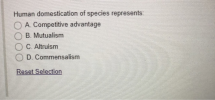 Human domestication of species represents: A. Competitive advantage B. Mutualism C. Altruism D. Commensalism Reset Selection
(A) Parasitism (B) Mutualism (C) Competition (D) Allelopathy (E) Mimicry 85. Two species of orange butterflies...
 (A) Parasitism
(B) Mutualism
(C) Competition
(D) Allelopathy
(E) Mimicry
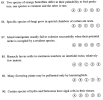
85. Two species of orange butterflies differ in their palatability to bird preda- tors; one species is common and the other is rare. 86. Specific species of fungi grow in special chambers of certain ant nests. 87. Island immigrants usually fail to colonize successfully when their potential niche is occupied by a resident species. 88. Barnacle larvae settle in enormous numbers on intertidal rocks; relatively few mature. 89. Many flowering...
(A) Parasitism
(B) Mutualism
(C) Competition
(D) Allelopathy
(E) Mimicry
85. Two species of orange butterflies differ in their palatability to bird preda- tors; one species is common and the other is rare. 86. Specific species of fungi grow in special chambers of certain ant nests. 87. Island immigrants usually fail to colonize successfully when their potential niche is occupied by a resident species. 88. Barnacle larvae settle in enormous numbers on intertidal rocks; relatively few mature. 89. Many flowering...
Questions 85-90 (A) Parasitism (B) Mutualism (C) Competition (D) Allelopathy (E) Mimicry 85. Two species of...
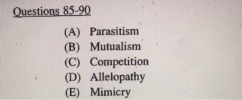 Questions 85-90 (A) Parasitism (B) Mutualism (C) Competition (D) Allelopathy (E) Mimicry 85. Two species of orange butterflies differ in their palatability to bird preda- tors; one species is common and the other is rare. 86. Specific species of fungi grow in special chambers of certain ant nests. 87. Island immigrants usually fail to colonize successfully when their potential niche is occupied by a resident species. 88. Barnacle larvae settle in enormous numbers on intertidal rocks; relatively few mature. 89....
 2. Pkovide an example of a K-selected and an r-selected species. How does each species type contribute to 30. With intermediate levels of disturbance, who gets the advantage (K-or r-selected)? -think of what happens after biodiversity? a low fuel burning fire.
 1. Would you expect early
successional species to be r-selected or K-selected?
2. Why?
3. ?What about species that dominate later in succession? Would
you expect them to be r-selected or K-selected?
You cannot see the individual modules in these photos. You may encounter some unitary organisms. Tube-dwelling worms collect particles on a retractable crown of tentacles. The mouth is in the center of the tentacle crown. The animal on the left has a flexible tube (sec arrow on left)...
1. Would you expect early
successional species to be r-selected or K-selected?
2. Why?
3. ?What about species that dominate later in succession? Would
you expect them to be r-selected or K-selected?
You cannot see the individual modules in these photos. You may encounter some unitary organisms. Tube-dwelling worms collect particles on a retractable crown of tentacles. The mouth is in the center of the tentacle crown. The animal on the left has a flexible tube (sec arrow on left)...
 specie crangonyx
C. Comment on possible interaction of these on your species: Mutualism (page 352 in your textbook) ii. Predation (page 352 in your textbook) Competition (page 353 in your textbook)
specie crangonyx
C. Comment on possible interaction of these on your species: Mutualism (page 352 in your textbook) ii. Predation (page 352 in your textbook) Competition (page 353 in your textbook)
 Human domestication of species represents: A. Competitive advantage B. Mutualism C. Altruism D. Commensalism Reset Selection
 (A) Parasitism
(B) Mutualism
(C) Competition
(D) Allelopathy
(E) Mimicry
85. Two species of orange butterflies differ in their palatability to bird preda- tors; one species is common and the other is rare. 86. Specific species of fungi grow in special chambers of certain ant nests. 87. Island immigrants usually fail to colonize successfully when their potential niche is occupied by a resident species. 88. Barnacle larvae settle in enormous numbers on intertidal rocks; relatively few mature. 89. Many flowering...
(A) Parasitism
(B) Mutualism
(C) Competition
(D) Allelopathy
(E) Mimicry
85. Two species of orange butterflies differ in their palatability to bird preda- tors; one species is common and the other is rare. 86. Specific species of fungi grow in special chambers of certain ant nests. 87. Island immigrants usually fail to colonize successfully when their potential niche is occupied by a resident species. 88. Barnacle larvae settle in enormous numbers on intertidal rocks; relatively few mature. 89. Many flowering...
 Questions 85-90 (A) Parasitism (B) Mutualism (C) Competition (D) Allelopathy (E) Mimicry 85. Two species of orange butterflies differ in their palatability to bird preda- tors; one species is common and the other is rare. 86. Specific species of fungi grow in special chambers of certain ant nests. 87. Island immigrants usually fail to colonize successfully when their potential niche is occupied by a resident species. 88. Barnacle larvae settle in enormous numbers on intertidal rocks; relatively few mature. 89....
Most questions answered within 3 hours.
-
Where is the error in this code sequence?
String s1 = "Hello";
String s2 = "ello";...
asked 10 months ago -
Financial data for Joel de Paris, Inc., for last year
follow:
Joel de Paris, Inc.
Balance...
asked 10 months ago -
Consider this reaction:
Al2(SO4)3 (aq)+ BaCl3
(aq) Al2Cl6 (aq)- +
3BaSO4(s) . What is the...
asked 10 months ago -
Suppose that Savneet is considering increasing her
recent random sample from 20 car rentals to 40...
asked 10 months ago -
Trucks arrive at an unloading terminal at an average rate of 120
per hour.
Trucks arrive...
asked 11 months ago -
Why are methanol and ethanol completely soluble in water while
octanol is not very little soluble....
asked 10 months ago -
A facilities manager at a university reads in a research report
that the mean amount of...
asked 11 months ago -
When the CuSO4 is rehydrated by adding water to the anhydrous
compound, is this an endothermic...
asked 11 months ago -
A ray of sunlight is passing from diamond into crown glass; the
angle of incidence is...
asked 11 months ago -
A block of mass 0.249 kg is placed on top of a light, vertical
spring of...
asked 11 months ago -
how do the kidneys compensate in the presences of acidosis
a) trigger hyperventilate
b) reserve acid...
asked 11 months ago -
Question 501 pts
The rental rate of capital to the firm increases. Which of the
following...
asked 11 months ago