
Homework Answers


Add Answer to:
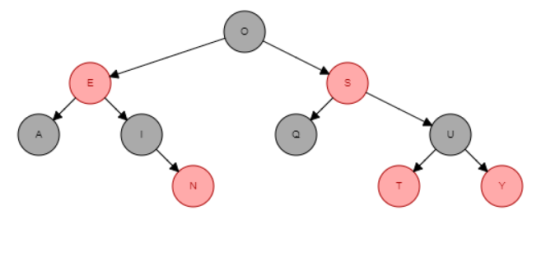
Draw the red-black BST that results when you insert items with the keys EASYQUTION in that...
Draw the BST that results when you insert items with keys: 2 4 6 8 10...
Draw the BST that results when you insert items with keys: 2 4 6 8 10 in that order, into an initially empty tree. What will be the Big O for the search operation?
1a) Draw the 2-3 tree that results when you insert the keys S E A R...
1a) Draw the 2-3 tree that results when you insert the keys S E A R C H X M P L Y in that order into an initially empty tree. 1b) Construct the corresponding left leaning red-black tree from part a. 1c) Find a sequence of keys to insert into a BST and a left leaning red-black BST such that the height of the BST is less than the height of the left leaning red-black BST, or prove that...
Draw the perfect skip list that results when you insert items with the keys 19, 6,...
Draw the perfect skip list that results when you insert items with the keys 19, 6, 26, 9, 2, 12, 25, 7, 21 and 17 in that order into an initially empty perfect skip list. Draw the randomized skip list that results when you insert items with the keys 19, 6, 26, 9, 2, 12, 25, 7, 21 and 17 in that order into an initially empty randomized skip list. Compare the binary search tree with the perfect skip list...
describe or draw the BST that results when you insert the keys E A S Y...
describe or draw the BST that results when you insert the keys E A S Y Q in that order using root insertion
1. Draw the 2-3 trees that result when you insert the keys Y L P M...
 1. Draw the 2-3 trees that result when you insert the keys Y L P M X H C R A E S İn that order into an initially empty tree. There should be 11 trees in all. Use the final tree to construct the corresponding red-black tree. 2. Draw all the structurally different red-black trees (i.e. no specific keys) with n keys for n from 2 to 8.
Show each red-black tree that results after successively inserting the keys 4 7 12 15 3...
Show each red-black tree that results after successively inserting the keys 4 7 12 15 3 5 14 18 into an initially empty red-black tree. At the steps were a red-black tree rule is violated, explain how it is corrected Now delete these keys in this order and show each resultant red-black tree 18 15 7 14. At the steps were a red-black tree rule is violated, explain how it is corrected
(a) On an initially empty red-black tree, perform the following operations in this order: insert(1), insert(3),...
 (a) On an initially empty red-black tree, perform the following operations in this order: insert(1), insert(3), insert(5), insert(6), insert(7), delete(1) Show all the intermediate steps of your work (b) We can get another sorting algorithm by first inserting all the keys into a red-black tree, and then performing an in-order traversal of the tree. What's the time complexity of this algorithm? (As always, use O or Θ notation.)
R-11.22 Consider the sequence of keys (5, 16, 22,45,2, 10, 18,30,50, 12,1. Draw the result of inserting entries with these keys (in the given order) into a. An initially empty (2,4) tree. b. An i...
 R-11.22 Consider the sequence of keys (5, 16, 22,45,2, 10, 18,30,50, 12,1. Draw the result of inserting entries with these keys (in the given order) into a. An initially empty (2,4) tree. b. An initially empty red-black tree
R-11.22 Consider the sequence of keys (5, 16, 22,45,2, 10, 18,30,50, 12,1. Draw the result of inserting entries with these keys (in the given order) into a. An initially empty (2,4) tree. b. An initially empty red-black tree
R-11.22 Consider the sequence of keys (5, 16, 22,45,2, 10, 18,30,50, 12,1. Draw the result of inserting entries with these keys (in the given order) into a. An initially empty (2,4) tree. b. An initially empty red-black tree
Red-Black Tree: Show the sequence of red-black trees that result after successively inserting the keys into...
Red-Black Tree: Show the sequence of red-black trees that result after successively inserting the keys into an initially empty red-black tree in the order given: K = < 20, 5, 1, 12, 7 >. (Show at least one tree resulting from each insertion). State which case from the textbook (Introduction to Algorithms, 3rd Edition by Thomas H. Cormen et al) applies. Assume that the root is always colored black.)
Starting with an empty binary search tree, insert each of the following keys and rotate it...
Starting with an empty binary search tree, insert each of the following keys and rotate it to the root in the specified order: 6 1 18 7 15 Starting with an empty red-black binary search tree, insert the following keys in order:: 12 5 23 9 19 2 21 18 7 Show the tree immediately after you insert each key, and after each time you deal with one of the book's cases 1, 2, or 3 (that is, if dealing with one case leads to another, show the additional case as a...
 1. Draw the 2-3 trees that result when you insert the keys Y L P M X H C R A E S İn that order into an initially empty tree. There should be 11 trees in all. Use the final tree to construct the corresponding red-black tree. 2. Draw all the structurally different red-black trees (i.e. no specific keys) with n keys for n from 2 to 8.
 (a) On an initially empty red-black tree, perform the following operations in this order: insert(1), insert(3), insert(5), insert(6), insert(7), delete(1) Show all the intermediate steps of your work (b) We can get another sorting algorithm by first inserting all the keys into a red-black tree, and then performing an in-order traversal of the tree. What's the time complexity of this algorithm? (As always, use O or Θ notation.)
 R-11.22 Consider the sequence of keys (5, 16, 22,45,2, 10, 18,30,50, 12,1. Draw the result of inserting entries with these keys (in the given order) into a. An initially empty (2,4) tree. b. An initially empty red-black tree
R-11.22 Consider the sequence of keys (5, 16, 22,45,2, 10, 18,30,50, 12,1. Draw the result of inserting entries with these keys (in the given order) into a. An initially empty (2,4) tree. b. An initially empty red-black tree
R-11.22 Consider the sequence of keys (5, 16, 22,45,2, 10, 18,30,50, 12,1. Draw the result of inserting entries with these keys (in the given order) into a. An initially empty (2,4) tree. b. An initially empty red-black tree
Most questions answered within 3 hours.
-
Where is the error in this code sequence?
String s1 = "Hello";
String s2 = "ello";...
asked 10 months ago -
Financial data for Joel de Paris, Inc., for last year
follow:
Joel de Paris, Inc.
Balance...
asked 10 months ago -
Consider this reaction:
Al2(SO4)3 (aq)+ BaCl3
(aq) Al2Cl6 (aq)- +
3BaSO4(s) . What is the...
asked 10 months ago -
Suppose that Savneet is considering increasing her
recent random sample from 20 car rentals to 40...
asked 10 months ago -
Trucks arrive at an unloading terminal at an average rate of 120
per hour.
Trucks arrive...
asked 10 months ago -
Why are methanol and ethanol completely soluble in water while
octanol is not very little soluble....
asked 10 months ago -
A facilities manager at a university reads in a research report
that the mean amount of...
asked 10 months ago -
When the CuSO4 is rehydrated by adding water to the anhydrous
compound, is this an endothermic...
asked 10 months ago -
A ray of sunlight is passing from diamond into crown glass; the
angle of incidence is...
asked 10 months ago -
A block of mass 0.249 kg is placed on top of a light, vertical
spring of...
asked 10 months ago -
how do the kidneys compensate in the presences of acidosis
a) trigger hyperventilate
b) reserve acid...
asked 10 months ago -
Question 501 pts
The rental rate of capital to the firm increases. Which of the
following...
asked 10 months ago