
Homework Answers
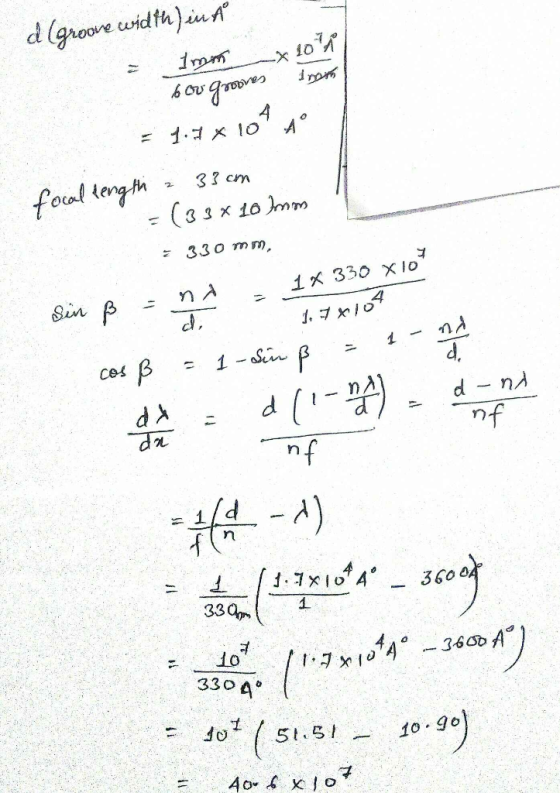
(a) The wavelength dispersion at the exit slit of a spectroscopic instrument is usually specified as reciprocal linear dispersion, given in nm/mm. Reciprocal linear dispersion is given by: [f = focal length]
dλ/dx=-(dcosβ/nf)
where d =groove width in Angestrom.
n = order
β = differaction angle
If the incident light ray is perpendicular to the grating, you can use the following diffraction grating equation to find the directions in which the rays are diffracted:
n * λ = d * sin(β)
(b)The resolving power of a grating is a measure of its ability to spatially separate two wavelengths. It is determined by applying the Rayleigh criteria to the diffraction maxima; two wavelengths are resolvable when the maxima of one wavelength coincides with the minima of the second wavelength.
The chromatic resolving power (R) is defined by
R = λ/∆λ = nN
= 1*600grooves/mm*50mm
= 30,000
where ∆λ is the resolvable wavelength difference,
n is the diffraction order, and N is the number of grooves illuminated.
Add Answer to:
5) A spectrometer equips a diffraction grating with 600 grooves/mm and focal length of 33 cm....
I JUST NEED #4. I’m supplying my answer for #3 as it is needed. 3. You...
 I
JUST NEED #4. I’m supplying my answer for #3 as it is needed.
3. You have access to two diffraction gratins, on with 600 groves/mm and a length of 50 mm and one with 1,200 grooves/mm and a length of 25 mm. Calculate the linear dispersion and resolving power for both. You also plan to use the first-order diffracted beam and use a configuration where B is around 10 degrees and the focal length of the system is 0.3...
I
JUST NEED #4. I’m supplying my answer for #3 as it is needed.
3. You have access to two diffraction gratins, on with 600 groves/mm and a length of 50 mm and one with 1,200 grooves/mm and a length of 25 mm. Calculate the linear dispersion and resolving power for both. You also plan to use the first-order diffracted beam and use a configuration where B is around 10 degrees and the focal length of the system is 0.3...
A miniature spectrometer used for chemical analysis has a diffraction grating with 800 slits/mm set 25.0...
A miniature spectrometer used for chemical analysis has a diffraction grating with 800 slits/mm set 25.0 mm in front of the detector "screen." The detector can barely distinguish two bright lines that are 30 μm apart in the first-order spectrum. A miniature spectrometer used for chemical analysis has a diffraction grating with 800 slits/mm set 25.0 mm in front of the detector "screen." The detector can barely distinguish two bright lines that are 30 μm apart in the first-order spectrum.
Calculate the resolution of a 3 cm long grating with 845 grooves/mm for n = 3...
Calculate the resolution of a 3 cm long grating with 845 grooves/mm for n = 3 order radiation. Thanks!
Please show work for the answer! Thanks in advance ---------------------------------------------------------------------------- 1) V and Al have emission...
Please show work for the answer! Thanks in advance ---------------------------------------------------------------------------- 1) V and Al have emission lines at 308.211nm and 308.215nm respectively. What resolving power would a grating require in order to resolve these emission lines? 2) 25.7mm of an echellette grating is illuminated in order to achieve the resolving power you calculated above. How many lines/mm does this echellette grating have (if n=1st order)? 3) A monochromator has a focal length of 1.6m and a collimating mirror with a...
A physicist is calibrating a spectrometer that uses a diffraction grating to separate light in order...
A physicist is calibrating a spectrometer that uses a diffraction grating to separate light in order of increasing wavelength (λA, λB, and λC). She observes three distinct first-order spectral lines at the following respective angles θm(where m denotes order). θ1 = 13.0°, θ1 = 14.2°, θ1 = 14.9° (a) If the grating has 3,680 grooves per centimeter, what wavelength (in nm) describes each of these spectral lines? at θ1 = 13.0° λA= nm at θ1 = 14.2° λB = nm...
A diffraction grating with an unknown number of lines per mm, is illuminated by light at...
A diffraction grating with an unknown number of lines per mm, is illuminated by light at a wavelength l = 633 mm, and the first order diffraction pattern is seen at an angle β= 45.OO. Light of a second wavelength is shone on to the grating, whose second order diffraction pattern is seen at l = 62.00. What is the wavelength of the second beam?
Light from a laser strikes a diffraction grating that has 5 312 grooves per centimeter. The...
Light from a laser strikes a diffraction grating that has 5 312 grooves per centimeter. The central and first-order principal maxima are separated by 0.488 m on a wall 1.56 m from the grating. Determine the wavelength of the laser light. (In this problem, assume that the light is incident normally on the gratings.) ________nm 5.6128 and 56204 ARE NOT CORRECT
The atomic emission spectrum of a light source is analyzed with a diffraction grating. A thick...
 The atomic emission spectrum of a light source is analyzed with a diffraction grating. A thick line near 589.0 nm is observed. In order to resolve the thick line into two fine lines in first order, you replace with a 2.450 cm long diffraction grating, and you barely observed two distinct first order spectral lines at 589.0 and 589.6 nm on a screen 5.000 m away. a. What is the resolving power of the grating? b. What is the slit...
A diffraction grating with 600 lines/mm is illuminated with light of wavelength 510 nm. A very...
A diffraction grating with 600 lines/mm is illuminated with light of wavelength 510 nm. A very wide viewing screen is 4.2 m behind the grating. Part A What is the distance between the two m = 1 bright fringes? Express your answer with the appropriate units. Δy = SubmitMy AnswersGive Up Part B How many bright fringes can be seen on the screen? N = SubmitMy AnswersGive Up
3. (20 points) A monochromator is a popular choice of wavelength selector in optical instruments. Answer...
 3. (20 points) A monochromator is a popular choice of wavelength selector in optical instruments. Answer the following question regarding a monochromator that has a focal length of 0.78 m and a grating of 2500 lines/mm. (a) (b) Draw a schematic diagram to show key elements in any monochromator, including slits, reflectors and grating. Describe briefly how each element affects the resolution in wavelength at the output of monochromator. Calculate the reciprocal linear dispersion (D-1) of the monochromator for the...
 I
JUST NEED #4. I’m supplying my answer for #3 as it is needed.
3. You have access to two diffraction gratins, on with 600 groves/mm and a length of 50 mm and one with 1,200 grooves/mm and a length of 25 mm. Calculate the linear dispersion and resolving power for both. You also plan to use the first-order diffracted beam and use a configuration where B is around 10 degrees and the focal length of the system is 0.3...
I
JUST NEED #4. I’m supplying my answer for #3 as it is needed.
3. You have access to two diffraction gratins, on with 600 groves/mm and a length of 50 mm and one with 1,200 grooves/mm and a length of 25 mm. Calculate the linear dispersion and resolving power for both. You also plan to use the first-order diffracted beam and use a configuration where B is around 10 degrees and the focal length of the system is 0.3...
 The atomic emission spectrum of a light source is analyzed with a diffraction grating. A thick line near 589.0 nm is observed. In order to resolve the thick line into two fine lines in first order, you replace with a 2.450 cm long diffraction grating, and you barely observed two distinct first order spectral lines at 589.0 and 589.6 nm on a screen 5.000 m away. a. What is the resolving power of the grating? b. What is the slit...
 3. (20 points) A monochromator is a popular choice of wavelength selector in optical instruments. Answer the following question regarding a monochromator that has a focal length of 0.78 m and a grating of 2500 lines/mm. (a) (b) Draw a schematic diagram to show key elements in any monochromator, including slits, reflectors and grating. Describe briefly how each element affects the resolution in wavelength at the output of monochromator. Calculate the reciprocal linear dispersion (D-1) of the monochromator for the...
Most questions answered within 3 hours.
-
Where is the error in this code sequence?
String s1 = "Hello";
String s2 = "ello";...
asked 10 months ago -
Financial data for Joel de Paris, Inc., for last year
follow:
Joel de Paris, Inc.
Balance...
asked 10 months ago -
Consider this reaction:
Al2(SO4)3 (aq)+ BaCl3
(aq) Al2Cl6 (aq)- +
3BaSO4(s) . What is the...
asked 10 months ago -
Suppose that Savneet is considering increasing her
recent random sample from 20 car rentals to 40...
asked 10 months ago -
Trucks arrive at an unloading terminal at an average rate of 120
per hour.
Trucks arrive...
asked 10 months ago -
Why are methanol and ethanol completely soluble in water while
octanol is not very little soluble....
asked 10 months ago -
A facilities manager at a university reads in a research report
that the mean amount of...
asked 10 months ago -
When the CuSO4 is rehydrated by adding water to the anhydrous
compound, is this an endothermic...
asked 10 months ago -
A ray of sunlight is passing from diamond into crown glass; the
angle of incidence is...
asked 10 months ago -
A block of mass 0.249 kg is placed on top of a light, vertical
spring of...
asked 10 months ago -
how do the kidneys compensate in the presences of acidosis
a) trigger hyperventilate
b) reserve acid...
asked 10 months ago -
Question 501 pts
The rental rate of capital to the firm increases. Which of the
following...
asked 10 months ago