
Homework Answers

Add Answer to:
For the following questions, assume the wavelengths of visible light range from 380 nm to 760...
If the visible wavelengths of light range from 400 nm to 750 nm, what is the...
If the visible wavelengths of light range from 400 nm to 750 nm, what is the highest frequency associated with visible light? a. 2.3 × 10²⁰ Hz b. 3.0 × 10⁸ Hz c. 7.5 × 10¹⁴ Hz d. 5.0 × 10⁸ Hz
Sunlight, whose visible wavelengths range from 380 to 750 nm, is incident on a sodium surface....
Sunlight, whose visible wavelengths range from 380 to 750 nm, is incident on a sodium surface. The work function for sodium is W0 = 2.28 eV. Find (a) the maximum kinetic energy KEmax of the photoelectrons emitted from the surface and (b) the longest wavelength that will cause photoelectrons to be emitted.
A light source emits visible light of two wavelengths: 600 nm and al-450 nm). The source...
 A light source emits visible light of two wavelengths: 600 nm and al-450 nm). The source is used in a double-slit interference experiment in which L-1.5 m and d-0.030 mm. Find the separation distance between the 3 -order bright fringes for the two wavelengths.) (Show step by step solution)
A) Young's double-slit experiment is performed with 595-nm light and a distance of 2.00 m between...
a) Young's double-slit experiment is performed with 595-nm light and a distance of 2.00 m between the slits and the screen. The tenth interference minimum is observed 7.40 mm from the central maximum. Determine the spacing of the slits (in mm). Answer: 1.5277 mm (b) What If? What are the smallest and largest wavelengths of visible light that will also produce interference minima at this location? (Give your answers, in nm, to at least three significant figures. Assume the visible...
White light (ranging in wavelengths from 380 to 750 nm) is incident on a metal with...
 White light (ranging in wavelengths from 380 to 750 nm) is incident on a metal with work function W_o = 2.42 eV. (a) What is the maximum kinetic energy of the electrons emitted from the surface? (b) For what range of wavelengths (from l_min to l_max) will NO electrons be emitted?
A beam of light consisting of two wavelengths, 546.0 nm and 409.5 nm, is used to...
A beam of light consisting of two wavelengths, 546.0 nm and 409.5 nm, is used to illuminate two slits. The separation between the slits is 0.400 mm and the resulting interference patterns are observed on a screen that is 1.00 m from the slits. Calculate the minimum distance from the central maximum at which bright fringes from both patterns coincide
At what angle is the first-order maximum for 450-nm wavelength blue light falling on double slits...
 At what angle is the first-order maximum for 450-nm wavelength blue light falling on double slits separated by 0.0500 mm? Answer: 0 What is the smallest separation between two slits that will produce a second-order maximum for 720-nm red light? Answer: nm
Q6) Give a commonly accepted range in nm of visible wavelengths of light (1 mark)
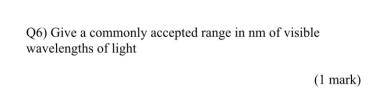 Q6) Give a commonly accepted range in nm of visible wavelengths of light (1 mark)
A double slit with a separation of 0.25 mm is illuminated with light that contains two wavelengths of 450 nm and 600 nm....
A double slit with a separation of 0.25 mm is illuminated with light that contains two wavelengths of 450 nm and 600 nm. What is the smallest distance measured from the zero order for which a maximum of one wavelength falls exactly over a minimum of the other?
need help with these physics problems
1a. Two narrow slits are illuminated by a laser with a wavelength of 544 nm. The interference pattern on a screen located x = 4.70 m away shows that the fourth-order bright fringe is located y = 6.20 cm away from the central bright fringe. Calculate the distance between the two slits. First you have to calculate the angle of the maximum. Then you can use the formula for bright fringes of double slits.1b. The screen is now moved 1.1...
 A light source emits visible light of two wavelengths: 600 nm and al-450 nm). The source is used in a double-slit interference experiment in which L-1.5 m and d-0.030 mm. Find the separation distance between the 3 -order bright fringes for the two wavelengths.) (Show step by step solution)
 White light (ranging in wavelengths from 380 to 750 nm) is incident on a metal with work function W_o = 2.42 eV. (a) What is the maximum kinetic energy of the electrons emitted from the surface? (b) For what range of wavelengths (from l_min to l_max) will NO electrons be emitted?
 At what angle is the first-order maximum for 450-nm wavelength blue light falling on double slits separated by 0.0500 mm? Answer: 0 What is the smallest separation between two slits that will produce a second-order maximum for 720-nm red light? Answer: nm
 Q6) Give a commonly accepted range in nm of visible wavelengths of light (1 mark)
Most questions answered within 3 hours.
-
Where is the error in this code sequence?
String s1 = "Hello";
String s2 = "ello";...
asked 10 months ago -
Financial data for Joel de Paris, Inc., for last year
follow:
Joel de Paris, Inc.
Balance...
asked 10 months ago -
Consider this reaction:
Al2(SO4)3 (aq)+ BaCl3
(aq) Al2Cl6 (aq)- +
3BaSO4(s) . What is the...
asked 10 months ago -
Suppose that Savneet is considering increasing her
recent random sample from 20 car rentals to 40...
asked 10 months ago -
Trucks arrive at an unloading terminal at an average rate of 120
per hour.
Trucks arrive...
asked 10 months ago -
Why are methanol and ethanol completely soluble in water while
octanol is not very little soluble....
asked 10 months ago -
A facilities manager at a university reads in a research report
that the mean amount of...
asked 10 months ago -
When the CuSO4 is rehydrated by adding water to the anhydrous
compound, is this an endothermic...
asked 10 months ago -
A ray of sunlight is passing from diamond into crown glass; the
angle of incidence is...
asked 10 months ago -
A block of mass 0.249 kg is placed on top of a light, vertical
spring of...
asked 10 months ago -
how do the kidneys compensate in the presences of acidosis
a) trigger hyperventilate
b) reserve acid...
asked 10 months ago -
Question 501 pts
The rental rate of capital to the firm increases. Which of the
following...
asked 10 months ago