
Homework Answers
Answer: -200 kJ/kg
For process 1-2, heat transferred is Q1 = area enclosed by the trapezium from 1 to 2 with x-axis
= 0.5(100+400)*(5-1) = 1000 kJ/kg
For process 2-3, heat transferred is Q2 = area enclosed by the rectangle from 2 to 3 with x-axis
= 400*(5-3) = 1200 kJ/kg
So, net heat transfer in process 1-2-3 = Q1 - Q2 = 1000-1200 = -200 kJ/kg.
Add Answer to:
the heat transfer
The heat transfer to the system, in kJ/kg. for the reversible process 1-2-3...
The heat transfer to the system, in kJ/kg, for the reversible process 1-2-3 shown in the...
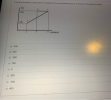 The heat transfer to the system, in kJ/kg, for the reversible process 1-2-3 shown in the figure is closer T(K) 400 100 2 5 s (kl/kg.K) -400 200 -300 100 300 -200 400
Question 17 The heat transfer to the system, InkJ/kg. for the reversible process 1-2-3 shown in...
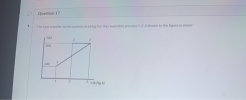 Question 17 The heat transfer to the system, InkJ/kg. for the reversible process 1-2-3 shown in the gure is closer тік) 3 2 400 100 1 2 5 ski/kg)
straight line system is 7 kg. Compute the beat transfer for the process. -s coordinates below...
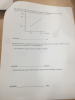 straight line system is 7 kg. Compute the beat transfer for the process. -s coordinates below shows a reversible process. The mass in the T(K) (5 points) 750 300 1.77 3.15 S(kJ/K) kJ ANSWER Nitrogen undergoes a constant pressure process in a closed system from 140 psi, 300 F to 120 F For nitrogen op 0.249 and cy 0.178 Btu/lbm R (a) Compute the change in specific enthalpy. (5 points) Btu/lbm ANSWER (b) Find the heat transfer if the system...
A gas in a cylinder piston system occupies V, - 15 mºat P. = 220 kPa...
 A gas in a cylinder piston system occupies V, - 15 mºat P. = 220 kPa and T, -20°C. Then, the gas undergoes a polytropic compression process until its temperature becomes T, 300'C. The entropy change of the gas during this process is AS - -1.7626 kJ/K, (AS-S.-5.). By assuming ideal gas (R = 0.3 kJ/kg.K. cp = 0.8 kJ/kg.K. cv = 0.5 kJ/kg.K), determine: 3pt) the mass of the gas, m (kg) = (9pt) the work transfer, W (kl)...
A professor has developed a complicated process for making heat continuously available at an elevated temperature....
A professor has developed a complicated process for making heat continuously available at an elevated temperature. Saturated steam at 1000 C is the only source of energy. Assuming that there is plenty of cooling water available at 00 C, what is the maximum temperature level at which heat in the amount of 200 kJ can be made available for each kilogram of steam flowing through the process? Physical properties of saturated steam at 100 C: H= 2676 kJ/kg V= 1.673...
Calculate the total work, in kJ, for process 1–3 shown in the figure when the system...
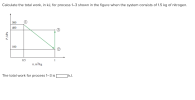 Calculate the total work, in kJ, for process 1–3 shown in the figure when the system consists of 1.5 kg of nitrogen. 5000 400 P, kPa 100 0.5 0, m?/kg The total work for process 1–3 is D k J.
Problem 4 – Entropy transfer in a control volume (18 pts) An adiabatic reversible steam turbine...
 Problem 4 – Entropy transfer in a control volume (18 pts) An
adiabatic reversible steam turbine steadily processes 2 kg/s of
steam at 5 MPa and 450°C, which is exhausted at 100 kPa and 100°C.
The turbine exhibits an isentropic efficiency of 0.85. a) Draw a
schematic representation of the system with all the energy
interactions involved. (2pts) b) Determine the h (kJ/kg) and s
(kJ/kg-K) at the inlet. (2 pts) c) Determine the actual h (kJ/kg)
and s (kJ/kg-K)...
Problem 4 – Entropy transfer in a control volume (18 pts) An
adiabatic reversible steam turbine steadily processes 2 kg/s of
steam at 5 MPa and 450°C, which is exhausted at 100 kPa and 100°C.
The turbine exhibits an isentropic efficiency of 0.85. a) Draw a
schematic representation of the system with all the energy
interactions involved. (2pts) b) Determine the h (kJ/kg) and s
(kJ/kg-K) at the inlet. (2 pts) c) Determine the actual h (kJ/kg)
and s (kJ/kg-K)...
5. (15) A closed system undergoes a process where heat transfer is allowed along the system...
 5. (15) A closed system undergoes a process where heat transfer is allowed along the system boundary at constant temperature. For each case below, determine whether the change in entropy of the system is positive, negative, zero, or indeterminate. Explain your answer. a. Internally reversible process with heat transfer from the system to the surroundings b. Internally reversible process with heat transfer to the system from the surroundings; Internally reversible and adiabatic process; c. d. Internal irreversibilities present with heat...
Problems 1-3 are based on the following description Electrical energy is applied to a system enclosed...
 Problems 1-3 are based on the following description Electrical energy is applied to a system enclosed inside the piston-cylinder device shown below. The voltage is 10 volts and the current is 2 amps for 20 seconds. During this time there is a heat transfer from the system to the outside equal to 90J, the system expands 0.2 m at a constant pressure of 200 kPa. 1 The amount of electrical energy in J applied to the system is closer to:...
Air as an idcal gas in a closed system undergoes a reversible process between temperatures of...
 Air as an idcal gas in a closed system undergoes a reversible process between temperatures of 1000 K and 400 K. The beginning pressure is 200 bar Determine the highest possible ending pressure for this process. If the ending pressurc is 3 bar, determine the heat transfer and work per unit mass, if the boundary of the system is in constant contact with a reservoir at 400 K.
 The heat transfer to the system, in kJ/kg, for the reversible process 1-2-3 shown in the figure is closer T(K) 400 100 2 5 s (kl/kg.K) -400 200 -300 100 300 -200 400
 Question 17 The heat transfer to the system, InkJ/kg. for the reversible process 1-2-3 shown in the gure is closer тік) 3 2 400 100 1 2 5 ski/kg)
 straight line system is 7 kg. Compute the beat transfer for the process. -s coordinates below shows a reversible process. The mass in the T(K) (5 points) 750 300 1.77 3.15 S(kJ/K) kJ ANSWER Nitrogen undergoes a constant pressure process in a closed system from 140 psi, 300 F to 120 F For nitrogen op 0.249 and cy 0.178 Btu/lbm R (a) Compute the change in specific enthalpy. (5 points) Btu/lbm ANSWER (b) Find the heat transfer if the system...
 A gas in a cylinder piston system occupies V, - 15 mºat P. = 220 kPa and T, -20°C. Then, the gas undergoes a polytropic compression process until its temperature becomes T, 300'C. The entropy change of the gas during this process is AS - -1.7626 kJ/K, (AS-S.-5.). By assuming ideal gas (R = 0.3 kJ/kg.K. cp = 0.8 kJ/kg.K. cv = 0.5 kJ/kg.K), determine: 3pt) the mass of the gas, m (kg) = (9pt) the work transfer, W (kl)...
 Calculate the total work, in kJ, for process 1–3 shown in the figure when the system consists of 1.5 kg of nitrogen. 5000 400 P, kPa 100 0.5 0, m?/kg The total work for process 1–3 is D k J.
 Problem 4 – Entropy transfer in a control volume (18 pts) An
adiabatic reversible steam turbine steadily processes 2 kg/s of
steam at 5 MPa and 450°C, which is exhausted at 100 kPa and 100°C.
The turbine exhibits an isentropic efficiency of 0.85. a) Draw a
schematic representation of the system with all the energy
interactions involved. (2pts) b) Determine the h (kJ/kg) and s
(kJ/kg-K) at the inlet. (2 pts) c) Determine the actual h (kJ/kg)
and s (kJ/kg-K)...
Problem 4 – Entropy transfer in a control volume (18 pts) An
adiabatic reversible steam turbine steadily processes 2 kg/s of
steam at 5 MPa and 450°C, which is exhausted at 100 kPa and 100°C.
The turbine exhibits an isentropic efficiency of 0.85. a) Draw a
schematic representation of the system with all the energy
interactions involved. (2pts) b) Determine the h (kJ/kg) and s
(kJ/kg-K) at the inlet. (2 pts) c) Determine the actual h (kJ/kg)
and s (kJ/kg-K)...
 5. (15) A closed system undergoes a process where heat transfer is allowed along the system boundary at constant temperature. For each case below, determine whether the change in entropy of the system is positive, negative, zero, or indeterminate. Explain your answer. a. Internally reversible process with heat transfer from the system to the surroundings b. Internally reversible process with heat transfer to the system from the surroundings; Internally reversible and adiabatic process; c. d. Internal irreversibilities present with heat...
 Problems 1-3 are based on the following description Electrical energy is applied to a system enclosed inside the piston-cylinder device shown below. The voltage is 10 volts and the current is 2 amps for 20 seconds. During this time there is a heat transfer from the system to the outside equal to 90J, the system expands 0.2 m at a constant pressure of 200 kPa. 1 The amount of electrical energy in J applied to the system is closer to:...
 Air as an idcal gas in a closed system undergoes a reversible process between temperatures of 1000 K and 400 K. The beginning pressure is 200 bar Determine the highest possible ending pressure for this process. If the ending pressurc is 3 bar, determine the heat transfer and work per unit mass, if the boundary of the system is in constant contact with a reservoir at 400 K.
Most questions answered within 3 hours.
-
Where is the error in this code sequence?
String s1 = "Hello";
String s2 = "ello";...
asked 11 months ago -
Financial data for Joel de Paris, Inc., for last year
follow:
Joel de Paris, Inc.
Balance...
asked 11 months ago -
Consider this reaction:
Al2(SO4)3 (aq)+ BaCl3
(aq) Al2Cl6 (aq)- +
3BaSO4(s) . What is the...
asked 11 months ago -
Suppose that Savneet is considering increasing her
recent random sample from 20 car rentals to 40...
asked 11 months ago -
Trucks arrive at an unloading terminal at an average rate of 120
per hour.
Trucks arrive...
asked 11 months ago -
Why are methanol and ethanol completely soluble in water while
octanol is not very little soluble....
asked 11 months ago -
A facilities manager at a university reads in a research report
that the mean amount of...
asked 11 months ago -
When the CuSO4 is rehydrated by adding water to the anhydrous
compound, is this an endothermic...
asked 11 months ago -
A ray of sunlight is passing from diamond into crown glass; the
angle of incidence is...
asked 11 months ago -
A block of mass 0.249 kg is placed on top of a light, vertical
spring of...
asked 11 months ago -
how do the kidneys compensate in the presences of acidosis
a) trigger hyperventilate
b) reserve acid...
asked 11 months ago -
Question 501 pts
The rental rate of capital to the firm increases. Which of the
following...
asked 11 months ago