
Homework Answers
 Please give it a like. Thank you
Add Answer to:
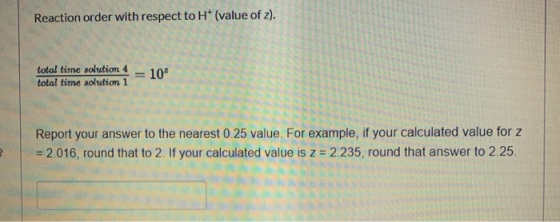
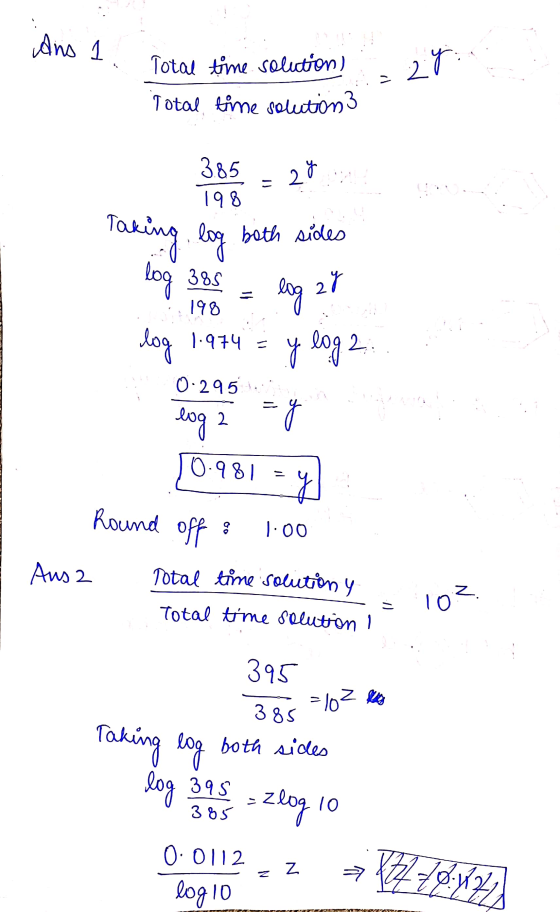
Total time solution 1: 385, Total Time solution 3: 198, Total
time solution 4: 395
Reaction...
total time solution of 1= 385 , Total time of solution of 2= 766 Reaction order...
 total time solution of 1= 385 , Total time of solution of 2=
766
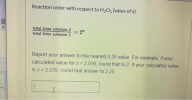
Reaction order with respect to H2O2 (value of x). total time solution 2 total time solution 1 2* Report your answer to the nearest 0.25 value. For example, if your calculated value for x = 2.016, round that to 2. If your calculated value is x = 2.235, round that answer to 2.25. I
total time solution of 1= 385 , Total time of solution of 2=
766
Reaction order with respect to H2O2 (value of x). total time solution 2 total time solution 1 2* Report your answer to the nearest 0.25 value. For example, if your calculated value for x = 2.016, round that to 2. If your calculated value is x = 2.235, round that answer to 2.25. I
X= 1, Y=1, Z= .01 S2O3^-2 =.002 Reaction Time: 436 Average value for the rate constant...
 X=
1, Y=1, Z= .01
S2O3^-2 =.002
Reaction Time: 436
Average value for the rate constant (Krate) based on the initial concentrations in Table 13.2 in your lab manual and the calculated values for x, y, and z that you determined earlier. Report your answer to 1 significant figure. -0.5 = krate (H2O2)" [1 -1 [H +)* total time Table 13.1. Preparation of Reaction Mixtures to be Studied Solution Water Buffer 0.3 M CH,COOH 0.05 MKI 1 5. Search 0.8...
X=
1, Y=1, Z= .01
S2O3^-2 =.002
Reaction Time: 436
Average value for the rate constant (Krate) based on the initial concentrations in Table 13.2 in your lab manual and the calculated values for x, y, and z that you determined earlier. Report your answer to 1 significant figure. -0.5 = krate (H2O2)" [1 -1 [H +)* total time Table 13.1. Preparation of Reaction Mixtures to be Studied Solution Water Buffer 0.3 M CH,COOH 0.05 MKI 1 5. Search 0.8...
Need help with these problems What would be the total order for the following reaction: 2H,...
 Need help with these problems
What would be the total order for the following reaction: 2H, + 0, → 2H,0 Zero Order First Order Second Order Third Order Not enough information O 5 Using the data in the table below, determine what the total order of reaction is for the following reaction: SO2 + 03 --> SO3 + O2 ENTER YOUR ANSWER AS A DIGIT, FOR EXAMPLE: 1 Initial Rate, mol/(L ) 0.118 (SO2), mol/L 0.25 0.25 0.75 (O3), mol/L...
Need help with these problems
What would be the total order for the following reaction: 2H, + 0, → 2H,0 Zero Order First Order Second Order Third Order Not enough information O 5 Using the data in the table below, determine what the total order of reaction is for the following reaction: SO2 + 03 --> SO3 + O2 ENTER YOUR ANSWER AS A DIGIT, FOR EXAMPLE: 1 Initial Rate, mol/(L ) 0.118 (SO2), mol/L 0.25 0.25 0.75 (O3), mol/L...
Consider the reaction below: N2O4 (g) → 2 NO2 (g) Which of the following techniques be...
 Consider the reaction below: N2O4 (g) → 2 NO2 (g) Which of the following techniques be used to determine the rate law is second order with respect to the concentration of dinitrogen tetroxide? O A graph of In([N204]) versus time will produce a straight line. A graph of [N204] versus time will produce a curved line. A graph of (N2O.) versus time will produce a straight line. The balanced chemical equation tells us that the reaction is first order with...
I am not sure if the graph on number 1 would be a 0 order reaction....
 I am not sure if the graph on number 1 would be a 0
order reaction. Also on number 3 I am not sure how to do the rate
law and find k
Post-Lab Report (Use the In-lab observations to complete the laboratory report. Turn in to your Instructor when you have completed the report.) PART A. KIO, SOLUTION (SOLUTION A). Molarity of KIO, stock solution - 02_M Total volume of reaction 100 m l Initial conc. Time Mixture mL...
I am not sure if the graph on number 1 would be a 0
order reaction. Also on number 3 I am not sure how to do the rate
law and find k
Post-Lab Report (Use the In-lab observations to complete the laboratory report. Turn in to your Instructor when you have completed the report.) PART A. KIO, SOLUTION (SOLUTION A). Molarity of KIO, stock solution - 02_M Total volume of reaction 100 m l Initial conc. Time Mixture mL...
Question 4 (1 point) Given the following reaction, what is the AG for the spontaneous reaction...
 Question 4 (1 point) Given the following reaction, what is the AG for the spontaneous reaction in KJ/mol? Faraday's constant 96500 Coulomb/mol (96.5 kJ/V mol) Round your answer to the nearest whole number (i.e. if you calculated 52.02, input your answer as 52). IF YOUR ANSWER IS A NEGATIVE VALUE MAKE SURE TO INCLUDE THE NEGATIVE SIGN. IF IT IS POSITIVE YOU CAN LEAVE IT AS IS. O2+ 2Ht+2e NO3+2H*+ 2e NO2+ E'o 0.295 V H2O2 H20 E'o 0.421 V
Reaction 1 (10 mL undiluted 1.0% IKI and 5 mL undiluted 3% H2O2) Reaction 2 (10...
Reaction 1 (10 mL undiluted 1.0% IKI and 5 mL undiluted 3% H2O2) Reaction 2 (10 mL diluted 0.5% IKI and 5 ml undiluted 3% H2O2) Reaction 3 (10 mL undiluted 1.0% IKI and 5 mL diluted 2.25% H2O2) 13. Answer the following. ( a) How many moles of H2O2 are present in Reactions 1 and 2? Show your work (include units). Hint: The initial H2O2 solution is 3% m/v (mass/volume) hydrogen peroxide in water. That means that 3 g...
Question 3 Sample Data and Graphs Solution A Reaction Time Reaction Rate (sec) Experiment 0.1 M...
 Question 3
Sample Data and Graphs Solution A Reaction Time Reaction Rate (sec) Experiment 0.1 M KIO, (sec) Water 1 50 mL 150 mL 17 0.0606 7 100 mL 100 mL 0.125 3 25 mL 175 mL 33 0.0303 4 20 mL 180 mL 45 0.0222 80 mL 120 mL 10 0.100 25 sec (predicted) 26 sec (actual) Challenge! 33 mL. 167 mI. 50 40 30 20 10 C 50 100 150 C Volume of KIO, (mL) 0.16 0.12 R...
Question 3
Sample Data and Graphs Solution A Reaction Time Reaction Rate (sec) Experiment 0.1 M KIO, (sec) Water 1 50 mL 150 mL 17 0.0606 7 100 mL 100 mL 0.125 3 25 mL 175 mL 33 0.0303 4 20 mL 180 mL 45 0.0222 80 mL 120 mL 10 0.100 25 sec (predicted) 26 sec (actual) Challenge! 33 mL. 167 mI. 50 40 30 20 10 C 50 100 150 C Volume of KIO, (mL) 0.16 0.12 R...
Solution 3. Initial [S, 0,2-) =0.050 M; initial [T"]=0.10 M. Time experiment started Time (s) between...
 Solution 3. Initial [S, 0,2-) =0.050 M; initial [T"]=0.10 M. Time experiment started Time (s) between Total moles of Aliquor no. appearances of color Cumulative times (8) $20,2-consumed 12.0 2.0x10-- 4.0x10 134 6.0x10⁴ 8.0x10 10.x10- 12x10- 12 14x10 3 6 Solution 4. Initial [3,0,?'1-0.10 M; initial [T"]=0.025 M. Time experiment started Aliquot no Time (s) between appearances of color 189 Cumulative times (8) 189 1 2 3 Total moles of 5,92-consumed 2.0x10-- 4.0x10+ 6.0x10 8.0x10- 10.x10+ 12x10- 14x10- 208 209...
solution. Remember that all problems in exams, including graphs, can be hand-calculated and the use of...
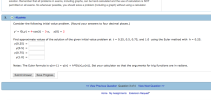 solution. Remember that all problems in exams, including graphs, can be hand-calculated and the use of calculators is NOT permitted on all exams. So whenever possible, you should solve a problem (including a graph) without using a calculator 3. -6 points Consider the following initial value problem. (Round your answers to four decimal places.) y-t,y)-4.cos(t)-3.y, y(O)-2 Find approximate values of the solution of the given initial value problem at t = 0.25, 0.5, 0.75, and 1.0 using the Euler method...
 total time solution of 1= 385 , Total time of solution of 2=
766
Reaction order with respect to H2O2 (value of x). total time solution 2 total time solution 1 2* Report your answer to the nearest 0.25 value. For example, if your calculated value for x = 2.016, round that to 2. If your calculated value is x = 2.235, round that answer to 2.25. I
total time solution of 1= 385 , Total time of solution of 2=
766
Reaction order with respect to H2O2 (value of x). total time solution 2 total time solution 1 2* Report your answer to the nearest 0.25 value. For example, if your calculated value for x = 2.016, round that to 2. If your calculated value is x = 2.235, round that answer to 2.25. I
 X=
1, Y=1, Z= .01
S2O3^-2 =.002
Reaction Time: 436
Average value for the rate constant (Krate) based on the initial concentrations in Table 13.2 in your lab manual and the calculated values for x, y, and z that you determined earlier. Report your answer to 1 significant figure. -0.5 = krate (H2O2)" [1 -1 [H +)* total time Table 13.1. Preparation of Reaction Mixtures to be Studied Solution Water Buffer 0.3 M CH,COOH 0.05 MKI 1 5. Search 0.8...
X=
1, Y=1, Z= .01
S2O3^-2 =.002
Reaction Time: 436
Average value for the rate constant (Krate) based on the initial concentrations in Table 13.2 in your lab manual and the calculated values for x, y, and z that you determined earlier. Report your answer to 1 significant figure. -0.5 = krate (H2O2)" [1 -1 [H +)* total time Table 13.1. Preparation of Reaction Mixtures to be Studied Solution Water Buffer 0.3 M CH,COOH 0.05 MKI 1 5. Search 0.8...
 Need help with these problems
What would be the total order for the following reaction: 2H, + 0, → 2H,0 Zero Order First Order Second Order Third Order Not enough information O 5 Using the data in the table below, determine what the total order of reaction is for the following reaction: SO2 + 03 --> SO3 + O2 ENTER YOUR ANSWER AS A DIGIT, FOR EXAMPLE: 1 Initial Rate, mol/(L ) 0.118 (SO2), mol/L 0.25 0.25 0.75 (O3), mol/L...
Need help with these problems
What would be the total order for the following reaction: 2H, + 0, → 2H,0 Zero Order First Order Second Order Third Order Not enough information O 5 Using the data in the table below, determine what the total order of reaction is for the following reaction: SO2 + 03 --> SO3 + O2 ENTER YOUR ANSWER AS A DIGIT, FOR EXAMPLE: 1 Initial Rate, mol/(L ) 0.118 (SO2), mol/L 0.25 0.25 0.75 (O3), mol/L...
 Consider the reaction below: N2O4 (g) → 2 NO2 (g) Which of the following techniques be used to determine the rate law is second order with respect to the concentration of dinitrogen tetroxide? O A graph of In([N204]) versus time will produce a straight line. A graph of [N204] versus time will produce a curved line. A graph of (N2O.) versus time will produce a straight line. The balanced chemical equation tells us that the reaction is first order with...
 I am not sure if the graph on number 1 would be a 0
order reaction. Also on number 3 I am not sure how to do the rate
law and find k
Post-Lab Report (Use the In-lab observations to complete the laboratory report. Turn in to your Instructor when you have completed the report.) PART A. KIO, SOLUTION (SOLUTION A). Molarity of KIO, stock solution - 02_M Total volume of reaction 100 m l Initial conc. Time Mixture mL...
I am not sure if the graph on number 1 would be a 0
order reaction. Also on number 3 I am not sure how to do the rate
law and find k
Post-Lab Report (Use the In-lab observations to complete the laboratory report. Turn in to your Instructor when you have completed the report.) PART A. KIO, SOLUTION (SOLUTION A). Molarity of KIO, stock solution - 02_M Total volume of reaction 100 m l Initial conc. Time Mixture mL...
 Question 4 (1 point) Given the following reaction, what is the AG for the spontaneous reaction in KJ/mol? Faraday's constant 96500 Coulomb/mol (96.5 kJ/V mol) Round your answer to the nearest whole number (i.e. if you calculated 52.02, input your answer as 52). IF YOUR ANSWER IS A NEGATIVE VALUE MAKE SURE TO INCLUDE THE NEGATIVE SIGN. IF IT IS POSITIVE YOU CAN LEAVE IT AS IS. O2+ 2Ht+2e NO3+2H*+ 2e NO2+ E'o 0.295 V H2O2 H20 E'o 0.421 V
 Question 3
Sample Data and Graphs Solution A Reaction Time Reaction Rate (sec) Experiment 0.1 M KIO, (sec) Water 1 50 mL 150 mL 17 0.0606 7 100 mL 100 mL 0.125 3 25 mL 175 mL 33 0.0303 4 20 mL 180 mL 45 0.0222 80 mL 120 mL 10 0.100 25 sec (predicted) 26 sec (actual) Challenge! 33 mL. 167 mI. 50 40 30 20 10 C 50 100 150 C Volume of KIO, (mL) 0.16 0.12 R...
Question 3
Sample Data and Graphs Solution A Reaction Time Reaction Rate (sec) Experiment 0.1 M KIO, (sec) Water 1 50 mL 150 mL 17 0.0606 7 100 mL 100 mL 0.125 3 25 mL 175 mL 33 0.0303 4 20 mL 180 mL 45 0.0222 80 mL 120 mL 10 0.100 25 sec (predicted) 26 sec (actual) Challenge! 33 mL. 167 mI. 50 40 30 20 10 C 50 100 150 C Volume of KIO, (mL) 0.16 0.12 R...
 Solution 3. Initial [S, 0,2-) =0.050 M; initial [T"]=0.10 M. Time experiment started Time (s) between Total moles of Aliquor no. appearances of color Cumulative times (8) $20,2-consumed 12.0 2.0x10-- 4.0x10 134 6.0x10⁴ 8.0x10 10.x10- 12x10- 12 14x10 3 6 Solution 4. Initial [3,0,?'1-0.10 M; initial [T"]=0.025 M. Time experiment started Aliquot no Time (s) between appearances of color 189 Cumulative times (8) 189 1 2 3 Total moles of 5,92-consumed 2.0x10-- 4.0x10+ 6.0x10 8.0x10- 10.x10+ 12x10- 14x10- 208 209...
 solution. Remember that all problems in exams, including graphs, can be hand-calculated and the use of calculators is NOT permitted on all exams. So whenever possible, you should solve a problem (including a graph) without using a calculator 3. -6 points Consider the following initial value problem. (Round your answers to four decimal places.) y-t,y)-4.cos(t)-3.y, y(O)-2 Find approximate values of the solution of the given initial value problem at t = 0.25, 0.5, 0.75, and 1.0 using the Euler method...
Most questions answered within 3 hours.
-
Where is the error in this code sequence?
String s1 = "Hello";
String s2 = "ello";...
asked 11 months ago -
Financial data for Joel de Paris, Inc., for last year
follow:
Joel de Paris, Inc.
Balance...
asked 11 months ago -
Consider this reaction:
Al2(SO4)3 (aq)+ BaCl3
(aq) Al2Cl6 (aq)- +
3BaSO4(s) . What is the...
asked 11 months ago -
Suppose that Savneet is considering increasing her
recent random sample from 20 car rentals to 40...
asked 11 months ago -
Trucks arrive at an unloading terminal at an average rate of 120
per hour.
Trucks arrive...
asked 11 months ago -
Why are methanol and ethanol completely soluble in water while
octanol is not very little soluble....
asked 11 months ago -
A facilities manager at a university reads in a research report
that the mean amount of...
asked 11 months ago -
When the CuSO4 is rehydrated by adding water to the anhydrous
compound, is this an endothermic...
asked 11 months ago -
A ray of sunlight is passing from diamond into crown glass; the
angle of incidence is...
asked 11 months ago -
A block of mass 0.249 kg is placed on top of a light, vertical
spring of...
asked 11 months ago -
how do the kidneys compensate in the presences of acidosis
a) trigger hyperventilate
b) reserve acid...
asked 11 months ago -
Question 501 pts
The rental rate of capital to the firm increases. Which of the
following...
asked 11 months ago