
Homework Answers
Answer : The correct option is C (Drecreases, Hyperbolic and Sigmoidal)
Explanation : Phosphofructokinase is the most important regulatory enzyme in glycolysis which catalyzes the rate limiting step, phosphorylation of fructose-6-phosphate to fructose-1, 6-bisphosphate. It is an allosteric enzyme which is inhibited by ATP, citrate & H(+) ions and activated by fructose-2,6-bisphosphate, AMP & Pi.
Add Answer to:
When ATP binds to a regulatory site in phosphofructokinase (PFK), how does the activity change? What...
Why is the activity of Phosphofructokinase (PFK-1) high at moderate concentrations of ATP and low at...
Why is the activity of Phosphofructokinase (PFK-1) high at moderate concentrations of ATP and low at high concentrations of ATP? When there is a lot of ATP, it gets consumed more rapidly in other processes, which decreases the ability of PFK-1 to use it. ATP is a competitive inhibitor of PFK-1. At high concentrations ATP is an allosteric inhibitor of PFK-1. ATP phosphorylates PFK-1, inactivating it. What is required for fermentation? O2 ATP NADH Pyruvate Both NADH and pyruvate
How does the binding of a regulatory molecule to the allosteric site affect the activity of...
How does the binding of a regulatory molecule to the allosteric site affect the activity of an enzyme? Group of answer choices A. It may decrease the activity of the enzyme. B. It may change the shape of the substrate. C. It may change the affinity of the enzyme for its substrate. All of the above A and C
0.01 M A PFK-1 wity 2 mM ATT 02 M AMT -2 MATT 0 1.0 20...
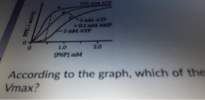 0.01 M A PFK-1 wity 2 mM ATT 02 M AMT -2 MATT 0 1.0 20 (RSP) MM According to the graph, which of the Vmax? According to the graph, which of the following best explains why curve C reaches AMP has a weak affinity for the regulatory site so ATP does not interfere with the reaction. ATP has a better affinity for the catalytic domain than the regulatory domain, thus binds in active site when concentrations of ATP are...
PART A OPTIONS FOR BLANKS: 1- inhibits, does not affect, stimulates 2- fructose-1,6-biphosphatase-1, pyruvate kinase, phosphofructokinase-1...
 PART A OPTIONS FOR BLANKS:
1- inhibits, does not affect, stimulates
2- fructose-1,6-biphosphatase-1, pyruvate kinase,
phosphofructokinase-1
3- phosphofructokinase-1, fructose-1,6-biphosphatase-1,
phosphoenolpyruvate carboxylate
PART B OPTIONS FOR BLANK:
Activity Curve A, Neither, Activity Curve B
Part 1 (3 points) See Hint High levels of fructose-2,6-BP reciprocally regulate glycolysis and gluconeogenesis. Fructose-2,6-BP flux through the glycolytic pathway by increasing the activity of Flux through the gluconeogenic pathway is inhibited by fructose-2,6- BP, which decreases the activity of Part 2 (1 point) See Hint...
PART A OPTIONS FOR BLANKS:
1- inhibits, does not affect, stimulates
2- fructose-1,6-biphosphatase-1, pyruvate kinase,
phosphofructokinase-1
3- phosphofructokinase-1, fructose-1,6-biphosphatase-1,
phosphoenolpyruvate carboxylate
PART B OPTIONS FOR BLANK:
Activity Curve A, Neither, Activity Curve B
Part 1 (3 points) See Hint High levels of fructose-2,6-BP reciprocally regulate glycolysis and gluconeogenesis. Fructose-2,6-BP flux through the glycolytic pathway by increasing the activity of Flux through the gluconeogenic pathway is inhibited by fructose-2,6- BP, which decreases the activity of Part 2 (1 point) See Hint...
Evce Monobran.UUUU 4. Phosphofructokinase is the rate-limiting enzyme that controls the rate on decreases its activity...
 Evce Monobran.UUUU 4. Phosphofructokinase is the rate-limiting enzyme that controls the rate on decreases its activity upon binding ATP. ATP concentrations mus y upon binding ATP. ATP concentrations must be relatively high for this to happen. This type of control of a biochemical pathway is called There are other ways to control the rate of biochemical pathways w ntrol the rate of biochemical pathways within cells. List three other typical ways cells would control rates of biochemical pathways. of relatie...
Question 1 2 pts How does a noncompetitive inhibitor decrease the rate of an enzyme-catalyzed reaction?...
 Question 1 2 pts How does a noncompetitive inhibitor decrease the rate of an enzyme-catalyzed reaction? by decreasing the free-energy change of the reaction catalyzed by the enzyme by binding to an allosteric site, thus changing the shape of the active site of the enzyme by binding to the active site of the enzyme, thus preventing binding of the normal substrate by binding to the substrate, thus changing its shape so that it no longer binds to the active site...
When binding with oxygen, what type of binding curve does hemoglobin have? Linear Sigmodial Hyperbolic it...
When binding with oxygen, what type of binding curve does hemoglobin have? Linear Sigmodial Hyperbolic it has none
What occurs when a drug binds to a receptor in the body? A. It alters the...
What occurs when a drug binds to a receptor in the body? A. It alters the receptor to become nonresponsive to its usual endogenous molecules. B. It gives the receptor a new function. C. It prevents the action of the receptor by altering its response to chemical mediators. D. It increases or decreases the activity of that receptor.
Why does demand not change when the price of a good changes with no change in...
 Why does demand not change when the price of a good changes with no change in the other influences on buying plans? Consider the demand for gym memberships The demand for gym memberships does not change when a change in occurs O A. the price of a gym membership O B. the population ° C, the expected future price of a gym membership O D. the price of bottled water (bottled water is a complement of a gym membership) An...
a. What is the Km and Vmax for PFK1 when treated with OmM (represents control for...
 a. What is the Km and Vmax for PFK1 when treated with OmM (represents control for enzymatic activity) or with 5mM AMP Show work on the graph draw lines for Vmax and Km. Control: Vmax (AMP), 0.32 0.28 0.2 Km 0.24 0.20 (s)-FTY20 (20LM): 0.18 Vmax 0.12 0.08 0.04 Km 0.00 Fructose-6-phosphate (mM) b. Fructose-6-phosphate is the substrate of the reaction. Based on answer in "a", what type of regulation occurs with and what site on PFK1 is AMP likely...
 0.01 M A PFK-1 wity 2 mM ATT 02 M AMT -2 MATT 0 1.0 20 (RSP) MM According to the graph, which of the Vmax? According to the graph, which of the following best explains why curve C reaches AMP has a weak affinity for the regulatory site so ATP does not interfere with the reaction. ATP has a better affinity for the catalytic domain than the regulatory domain, thus binds in active site when concentrations of ATP are...
 PART A OPTIONS FOR BLANKS:
1- inhibits, does not affect, stimulates
2- fructose-1,6-biphosphatase-1, pyruvate kinase,
phosphofructokinase-1
3- phosphofructokinase-1, fructose-1,6-biphosphatase-1,
phosphoenolpyruvate carboxylate
PART B OPTIONS FOR BLANK:
Activity Curve A, Neither, Activity Curve B
Part 1 (3 points) See Hint High levels of fructose-2,6-BP reciprocally regulate glycolysis and gluconeogenesis. Fructose-2,6-BP flux through the glycolytic pathway by increasing the activity of Flux through the gluconeogenic pathway is inhibited by fructose-2,6- BP, which decreases the activity of Part 2 (1 point) See Hint...
PART A OPTIONS FOR BLANKS:
1- inhibits, does not affect, stimulates
2- fructose-1,6-biphosphatase-1, pyruvate kinase,
phosphofructokinase-1
3- phosphofructokinase-1, fructose-1,6-biphosphatase-1,
phosphoenolpyruvate carboxylate
PART B OPTIONS FOR BLANK:
Activity Curve A, Neither, Activity Curve B
Part 1 (3 points) See Hint High levels of fructose-2,6-BP reciprocally regulate glycolysis and gluconeogenesis. Fructose-2,6-BP flux through the glycolytic pathway by increasing the activity of Flux through the gluconeogenic pathway is inhibited by fructose-2,6- BP, which decreases the activity of Part 2 (1 point) See Hint...
 Evce Monobran.UUUU 4. Phosphofructokinase is the rate-limiting enzyme that controls the rate on decreases its activity upon binding ATP. ATP concentrations mus y upon binding ATP. ATP concentrations must be relatively high for this to happen. This type of control of a biochemical pathway is called There are other ways to control the rate of biochemical pathways w ntrol the rate of biochemical pathways within cells. List three other typical ways cells would control rates of biochemical pathways. of relatie...
 Question 1 2 pts How does a noncompetitive inhibitor decrease the rate of an enzyme-catalyzed reaction? by decreasing the free-energy change of the reaction catalyzed by the enzyme by binding to an allosteric site, thus changing the shape of the active site of the enzyme by binding to the active site of the enzyme, thus preventing binding of the normal substrate by binding to the substrate, thus changing its shape so that it no longer binds to the active site...
 Why does demand not change when the price of a good changes with no change in the other influences on buying plans? Consider the demand for gym memberships The demand for gym memberships does not change when a change in occurs O A. the price of a gym membership O B. the population ° C, the expected future price of a gym membership O D. the price of bottled water (bottled water is a complement of a gym membership) An...
 a. What is the Km and Vmax for PFK1 when treated with OmM (represents control for enzymatic activity) or with 5mM AMP Show work on the graph draw lines for Vmax and Km. Control: Vmax (AMP), 0.32 0.28 0.2 Km 0.24 0.20 (s)-FTY20 (20LM): 0.18 Vmax 0.12 0.08 0.04 Km 0.00 Fructose-6-phosphate (mM) b. Fructose-6-phosphate is the substrate of the reaction. Based on answer in "a", what type of regulation occurs with and what site on PFK1 is AMP likely...
Most questions answered within 3 hours.
-
Where is the error in this code sequence?
String s1 = "Hello";
String s2 = "ello";...
asked 10 months ago -
Financial data for Joel de Paris, Inc., for last year
follow:
Joel de Paris, Inc.
Balance...
asked 10 months ago -
Consider this reaction:
Al2(SO4)3 (aq)+ BaCl3
(aq) Al2Cl6 (aq)- +
3BaSO4(s) . What is the...
asked 10 months ago -
Suppose that Savneet is considering increasing her
recent random sample from 20 car rentals to 40...
asked 10 months ago -
Trucks arrive at an unloading terminal at an average rate of 120
per hour.
Trucks arrive...
asked 10 months ago -
Why are methanol and ethanol completely soluble in water while
octanol is not very little soluble....
asked 10 months ago -
A facilities manager at a university reads in a research report
that the mean amount of...
asked 10 months ago -
When the CuSO4 is rehydrated by adding water to the anhydrous
compound, is this an endothermic...
asked 10 months ago -
A ray of sunlight is passing from diamond into crown glass; the
angle of incidence is...
asked 10 months ago -
A block of mass 0.249 kg is placed on top of a light, vertical
spring of...
asked 10 months ago -
how do the kidneys compensate in the presences of acidosis
a) trigger hyperventilate
b) reserve acid...
asked 10 months ago -
Question 501 pts
The rental rate of capital to the firm increases. Which of the
following...
asked 10 months ago