How does the binding of a regulatory molecule to the allosteric site affect the activity of...
How does the binding of a regulatory molecule to the allosteric site affect the activity of an enzyme?
Group of answer choices
A. It may decrease the activity of the enzyme.
B. It may change the shape of the substrate.
C. It may change the affinity of the enzyme for its substrate.
All of the above
A and C
Homework Answers
Answer: Allosteric regulation is a process that control enzyme activity. Regulatory molecules such as effectors or inhibitors binds to a site other than active site called as allosteric site and change the conformation (shape) of the enzyme. This leads to change in affinity of the enzyme to its substrate. When a effector binds to allosteric site, enzyme activity will be increased. When a inhibitor binds to allosteric site, enzyme activity is decreased. Hence, all the options are correct. Answer is All the above.
Add Answer to:
How does the binding of a regulatory molecule to the allosteric
site affect the activity of...
2. How do allosteric regulators affect their target enzymes? o By binding to the enzyme's active...
 2. How do allosteric regulators affect their target enzymes? o By binding to the enzyme's active site and causing a conformational change in the enzyme By binding to a site other than the active site and causing a conformational change in the enzyme C) By inducing amino acid side chain substitutions at a site other than the attive site, causing a conformational change in the en By binding to the enzyme's active site and blocking the binding of substrate molecules...
Please answer all.... Thank you! 57) An enzyme binding site with a specific shape can bind...
 Please answer all.... Thank you!
57) An enzyme binding site with a specific shape can bind only those having a complementary shape; thus, the shape of the protein molecule determines the specificity of the binding site the affinity of the binding site the saturation of the binding site the counding strength of the binding site Two of the above are correct. 58) A cell is what it is because of the instructions it receives concerning the types of proteins (enzymes...
Please answer all.... Thank you!
57) An enzyme binding site with a specific shape can bind only those having a complementary shape; thus, the shape of the protein molecule determines the specificity of the binding site the affinity of the binding site the saturation of the binding site the counding strength of the binding site Two of the above are correct. 58) A cell is what it is because of the instructions it receives concerning the types of proteins (enzymes...
a molecule that regulates an enzyme by binding to its regulatory site is called: A. Coenzyme...
a molecule that regulates an enzyme by binding to its regulatory site is called: A. Coenzyme B. Modifier C. Regulator D. Modulator
When ATP binds to a regulatory site in phosphofructokinase (PFK), how does the activity change? What...
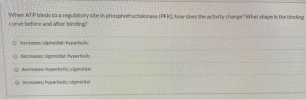 When ATP binds to a regulatory site in phosphofructokinase (PFK), how does the activity change? What shape is the binding curve before and after binding? increases; sigmoidal: hyperbolic decreases; sigmoidal: hyperbolic decreases: hyperbolic, sigmoidal increases; hyperbolic; sigmoidal
The substrate of an enzyme binds at the Group of answer choices affinity site. active site....
The substrate of an enzyme binds at the Group of answer choices affinity site. active site. completion site. reaction site. allosteric site.
All of the following apply to enzyme structure and function EXCEPT: (choose what does not apply...
All of the following apply to enzyme structure and function EXCEPT: (choose what does not apply to the question) A. enzyme active sites function to lower the activation energy of substrate molecules B. enzymes may require coenzymes that change the shape of the active site C. enzymes increase the speed of chemical reactions D. enzymes may have allosteric sites that are used to regulate substrate-active site binding E. enzymes may require cofactors such as Ca++ that improve the binding of...
Question 28: A system in which a regulatory protein binding to a co-regulatory molecule causes it...
Question 28: A system in which a regulatory protein binding to a co-regulatory molecule causes it to leave the operator, thereby inhibiting transcription of target genes, an example of: Group of answer choices a. Inducible negative control b. Repressible positive control c. Inducible positive control d. Repressible negative control Question 29: MEK, a MAP kinase kinase, is activated by phosphorylation. You create a mutant MEK in which the amino acids that are normally phosphorylated is replaced with aspartate. Predict the...
Which of the following statements about allosteric control of enzymatic activity is false. A. Allosteric enzymes...
Which of the following statements about allosteric control of enzymatic activity is false. A. Allosteric enzymes show strict Michaelis-Menten Kinetics B. Allosteric modulators give rise to sigmoidal V) vs. [S] kinetic plots C. A modular may either inhibit or activate an enzyme D. Binding of the modular changes the conformation of the enzyme molecule
Question 1 2 pts How does a noncompetitive inhibitor decrease the rate of an enzyme-catalyzed reaction?...
 Question 1 2 pts How does a noncompetitive inhibitor decrease the rate of an enzyme-catalyzed reaction? by decreasing the free-energy change of the reaction catalyzed by the enzyme by binding to an allosteric site, thus changing the shape of the active site of the enzyme by binding to the active site of the enzyme, thus preventing binding of the normal substrate by binding to the substrate, thus changing its shape so that it no longer binds to the active site...
Chapter 8. Enzyme Regulation and Inhibition 1. Competitive inhibitors are always of which type? a) allosteric...
 Chapter 8. Enzyme Regulation and Inhibition 1. Competitive inhibitors are always of which type? a) allosteric b) irreversible c) reversible d) suicide 2. DIFP is: a) a competitive inhibitor b) an allosteric inhibitor c) a noncompetitive inhibitor d) a suicide inhibitor 3. Competitive inhibitors: a) bind to the active site b) bind to the enzyme-substrate complex c) bind outside the active site and decrease substrate binding d) bind outside the active site and decrease rate of catalysis.
 2. How do allosteric regulators affect their target enzymes? o By binding to the enzyme's active site and causing a conformational change in the enzyme By binding to a site other than the active site and causing a conformational change in the enzyme C) By inducing amino acid side chain substitutions at a site other than the attive site, causing a conformational change in the en By binding to the enzyme's active site and blocking the binding of substrate molecules...
 Please answer all.... Thank you!
57) An enzyme binding site with a specific shape can bind only those having a complementary shape; thus, the shape of the protein molecule determines the specificity of the binding site the affinity of the binding site the saturation of the binding site the counding strength of the binding site Two of the above are correct. 58) A cell is what it is because of the instructions it receives concerning the types of proteins (enzymes...
Please answer all.... Thank you!
57) An enzyme binding site with a specific shape can bind only those having a complementary shape; thus, the shape of the protein molecule determines the specificity of the binding site the affinity of the binding site the saturation of the binding site the counding strength of the binding site Two of the above are correct. 58) A cell is what it is because of the instructions it receives concerning the types of proteins (enzymes...
 When ATP binds to a regulatory site in phosphofructokinase (PFK), how does the activity change? What shape is the binding curve before and after binding? increases; sigmoidal: hyperbolic decreases; sigmoidal: hyperbolic decreases: hyperbolic, sigmoidal increases; hyperbolic; sigmoidal
 Question 1 2 pts How does a noncompetitive inhibitor decrease the rate of an enzyme-catalyzed reaction? by decreasing the free-energy change of the reaction catalyzed by the enzyme by binding to an allosteric site, thus changing the shape of the active site of the enzyme by binding to the active site of the enzyme, thus preventing binding of the normal substrate by binding to the substrate, thus changing its shape so that it no longer binds to the active site...
 Chapter 8. Enzyme Regulation and Inhibition 1. Competitive inhibitors are always of which type? a) allosteric b) irreversible c) reversible d) suicide 2. DIFP is: a) a competitive inhibitor b) an allosteric inhibitor c) a noncompetitive inhibitor d) a suicide inhibitor 3. Competitive inhibitors: a) bind to the active site b) bind to the enzyme-substrate complex c) bind outside the active site and decrease substrate binding d) bind outside the active site and decrease rate of catalysis.
Most questions answered within 3 hours.
-
Where is the error in this code sequence?
String s1 = "Hello";
String s2 = "ello";...
asked 10 months ago -
Financial data for Joel de Paris, Inc., for last year
follow:
Joel de Paris, Inc.
Balance...
asked 10 months ago -
Consider this reaction:
Al2(SO4)3 (aq)+ BaCl3
(aq) Al2Cl6 (aq)- +
3BaSO4(s) . What is the...
asked 10 months ago -
Suppose that Savneet is considering increasing her
recent random sample from 20 car rentals to 40...
asked 10 months ago -
Trucks arrive at an unloading terminal at an average rate of 120
per hour.
Trucks arrive...
asked 10 months ago -
Why are methanol and ethanol completely soluble in water while
octanol is not very little soluble....
asked 10 months ago -
A facilities manager at a university reads in a research report
that the mean amount of...
asked 10 months ago -
When the CuSO4 is rehydrated by adding water to the anhydrous
compound, is this an endothermic...
asked 10 months ago -
A ray of sunlight is passing from diamond into crown glass; the
angle of incidence is...
asked 10 months ago -
A block of mass 0.249 kg is placed on top of a light, vertical
spring of...
asked 10 months ago -
how do the kidneys compensate in the presences of acidosis
a) trigger hyperventilate
b) reserve acid...
asked 10 months ago -
Question 501 pts
The rental rate of capital to the firm increases. Which of the
following...
asked 10 months ago