
Homework Answers
Out of the given options, The correct response is Synthesis of hexose sugar for nucleotide biosynthesis.
Pentose phosphate pathway involves the synthesis of pentose sugars for nucleotide biosynthesis. It also metabolizes the dietary pentoses as well as synthesizes/catabolizes the less common 4 and 7 carbon sugars like Erythrose-4 phosphate and sedoheptulose-7-phosphate.
Thank you
Add Answer to:
Which is NOT an additional function of the pentose phosphate pathway? catabolism of less common four-...
The reversible interconversion reactions of the pentose phosphate pathway can operate either to converi Map pentoses...
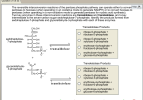 The reversible interconversion reactions of the pentose phosphate pathway can operate either to converi Map pentoses to hexoses (when operating in an oxidative mode to generate NADPH) or to convert hexoses to pentoses (when operating in a non-oxidative mode to generate pentoses for nucleic acid synthesis). Two key enzymes in these interconversion reactions are transaldolase and transketolase, and a key intermediate is the seven-carbon sugar sedoheptulose-7-phosphate. Identify the products formed from sedoheptulose-7-phosphate and glyceraldehyde-3-phosphate with each of these enzymes.
Which Calvin cycle steps are similar to those of the pentose phosphate pathway? Please list all...
Which Calvin cycle steps are similar to those of the pentose phosphate pathway? Please list all the reactions that are common ( reactants, enzymes, and products ) between the pentose phosphate pathway and the Calvin cycle.
There are 3 parts to this question (AC) 5. Concerning the pentose phosphate pathway. A In...
 There are 3 parts to this question (AC) 5. Concerning the pentose phosphate pathway. A In the nonoxidative phase of the pentose phosphate pathway, from where does the xylulose-5-phosphate come? B. At the end of the nonoxidative portion of the pentose phosphate pathway the result is 2 molecules of fructose-6-phosphate and 1 molecule of glyceraldehyde-3-phosphate Toget this, how many times did the oxidative phase have to run lie, how many glucose-6-phosphate molecules were used? C. How many total NADPH will...
______________ generated during the pentose phosphate pathway is essential for making ___________ which is the precursor...
______________ generated during the pentose phosphate pathway is essential for making ___________ which is the precursor for the aromatic amino acids. Ribose 5-phosphate; glutamate Phosphoenolpyruvate; chorismate Erythrose 4-phosphate; pyruvate Citrate; oxaloacetate Erythrose 4-phosphate; chorismate
Which of the following is the electron carrier produced in the pentose phosphate pathway? NADH NADPH...
 Which of the following is the electron carrier produced in the pentose phosphate pathway? NADH NADPH ubiquinone cytochrome C FADH2
TalA is a gene that encodes for transaldolase, which is an enzyme in the pentose-phosphate pathway....
TalA is a gene that encodes for transaldolase, which is an enzyme in the pentose-phosphate pathway. TalA is a member of the CRP regulon and CRP represses expression of talA. Would talA be expressed when there is a high glucose concentration? Explain your answer.
Which pathway will eventually receive carbon atons from catabolism of every one of these substrates: 10...
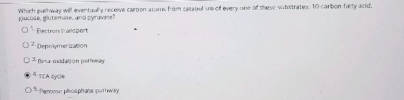 Which pathway will eventually receive carbon atons from catabolism of every one of these substrates: 10 carbon fatty acid. glucose, glutamate, and pyruvate? Electron transport 2. Depolymerization 3. Beta oxidation pathway •4 ТСА сусе O S.Pentose phosphate pattway
14. Which of the following sugars could be transformed into fructose 6-phosphate if glucose and glucose...
 14. Which of the following sugars could be transformed into fructose 6-phosphate if glucose and glucose phosphates were no longer available? A. Galactose B. Mannose C. Lactose D. Amylose E. Trehalose 15. Which pathway leads to a loss of carbon, which is undesirable in organisms that cannot fix carbon? A. Glycolysis B. Gluconeogenesis C. Pentose phosphate, nonoxidative phase D. Pentose phosphate, oxidative phase E. None of the above.
help me please 4 Glycolysis, the Emden-Meyerhoff pathway, and the pentose-phosphate pathway can all function: only...
 help me please
4 Glycolysis, the Emden-Meyerhoff pathway, and the pentose-phosphate pathway can all function: only in the presence of oxygen. only in the absence of oxygen. both in the presence or absence of oxygen. none of the above D. A reduced molecule: has lost electrons. has become more positive in charge. has gained electrons. is an electron donor. The br into sr trappir molecu 10. Bacillus and Lactobacillus are not in the same family. This indicates that which of...
help me please
4 Glycolysis, the Emden-Meyerhoff pathway, and the pentose-phosphate pathway can all function: only in the presence of oxygen. only in the absence of oxygen. both in the presence or absence of oxygen. none of the above D. A reduced molecule: has lost electrons. has become more positive in charge. has gained electrons. is an electron donor. The br into sr trappir molecu 10. Bacillus and Lactobacillus are not in the same family. This indicates that which of...
Please help me with Metabolism 25 marks question. Thank you very much. (a) The pentose phosphate...
 Please help me with Metabolism 25 marks question. Thank
you very much.
(a) The pentose phosphate pathway seems like a biologically
wasteful process.
(i) Explain how the pathway might be wasteful compared to other
carbon metabolic pathways. (2 marks)
(ii) Explain the importance of the pentose phosphate pathway. (4
marks)
(b) Excessive nitrogen needs to be excreted from the body.
Describe the biochemical pathway(s) for nitrogen elimination. (8
marks)
(c) The following are two glycogen molecules from two different
individuals,...
Please help me with Metabolism 25 marks question. Thank
you very much.
(a) The pentose phosphate pathway seems like a biologically
wasteful process.
(i) Explain how the pathway might be wasteful compared to other
carbon metabolic pathways. (2 marks)
(ii) Explain the importance of the pentose phosphate pathway. (4
marks)
(b) Excessive nitrogen needs to be excreted from the body.
Describe the biochemical pathway(s) for nitrogen elimination. (8
marks)
(c) The following are two glycogen molecules from two different
individuals,...
 The reversible interconversion reactions of the pentose phosphate pathway can operate either to converi Map pentoses to hexoses (when operating in an oxidative mode to generate NADPH) or to convert hexoses to pentoses (when operating in a non-oxidative mode to generate pentoses for nucleic acid synthesis). Two key enzymes in these interconversion reactions are transaldolase and transketolase, and a key intermediate is the seven-carbon sugar sedoheptulose-7-phosphate. Identify the products formed from sedoheptulose-7-phosphate and glyceraldehyde-3-phosphate with each of these enzymes.
 There are 3 parts to this question (AC) 5. Concerning the pentose phosphate pathway. A In the nonoxidative phase of the pentose phosphate pathway, from where does the xylulose-5-phosphate come? B. At the end of the nonoxidative portion of the pentose phosphate pathway the result is 2 molecules of fructose-6-phosphate and 1 molecule of glyceraldehyde-3-phosphate Toget this, how many times did the oxidative phase have to run lie, how many glucose-6-phosphate molecules were used? C. How many total NADPH will...
 Which of the following is the electron carrier produced in the pentose phosphate pathway? NADH NADPH ubiquinone cytochrome C FADH2
 Which pathway will eventually receive carbon atons from catabolism of every one of these substrates: 10 carbon fatty acid. glucose, glutamate, and pyruvate? Electron transport 2. Depolymerization 3. Beta oxidation pathway •4 ТСА сусе O S.Pentose phosphate pattway
 14. Which of the following sugars could be transformed into fructose 6-phosphate if glucose and glucose phosphates were no longer available? A. Galactose B. Mannose C. Lactose D. Amylose E. Trehalose 15. Which pathway leads to a loss of carbon, which is undesirable in organisms that cannot fix carbon? A. Glycolysis B. Gluconeogenesis C. Pentose phosphate, nonoxidative phase D. Pentose phosphate, oxidative phase E. None of the above.
 help me please
4 Glycolysis, the Emden-Meyerhoff pathway, and the pentose-phosphate pathway can all function: only in the presence of oxygen. only in the absence of oxygen. both in the presence or absence of oxygen. none of the above D. A reduced molecule: has lost electrons. has become more positive in charge. has gained electrons. is an electron donor. The br into sr trappir molecu 10. Bacillus and Lactobacillus are not in the same family. This indicates that which of...
help me please
4 Glycolysis, the Emden-Meyerhoff pathway, and the pentose-phosphate pathway can all function: only in the presence of oxygen. only in the absence of oxygen. both in the presence or absence of oxygen. none of the above D. A reduced molecule: has lost electrons. has become more positive in charge. has gained electrons. is an electron donor. The br into sr trappir molecu 10. Bacillus and Lactobacillus are not in the same family. This indicates that which of...
 Please help me with Metabolism 25 marks question. Thank
you very much.
(a) The pentose phosphate pathway seems like a biologically
wasteful process.
(i) Explain how the pathway might be wasteful compared to other
carbon metabolic pathways. (2 marks)
(ii) Explain the importance of the pentose phosphate pathway. (4
marks)
(b) Excessive nitrogen needs to be excreted from the body.
Describe the biochemical pathway(s) for nitrogen elimination. (8
marks)
(c) The following are two glycogen molecules from two different
individuals,...
Please help me with Metabolism 25 marks question. Thank
you very much.
(a) The pentose phosphate pathway seems like a biologically
wasteful process.
(i) Explain how the pathway might be wasteful compared to other
carbon metabolic pathways. (2 marks)
(ii) Explain the importance of the pentose phosphate pathway. (4
marks)
(b) Excessive nitrogen needs to be excreted from the body.
Describe the biochemical pathway(s) for nitrogen elimination. (8
marks)
(c) The following are two glycogen molecules from two different
individuals,...
Most questions answered within 3 hours.
-
Where is the error in this code sequence?
String s1 = "Hello";
String s2 = "ello";...
asked 10 months ago -
Financial data for Joel de Paris, Inc., for last year
follow:
Joel de Paris, Inc.
Balance...
asked 10 months ago -
Consider this reaction:
Al2(SO4)3 (aq)+ BaCl3
(aq) Al2Cl6 (aq)- +
3BaSO4(s) . What is the...
asked 10 months ago -
Suppose that Savneet is considering increasing her
recent random sample from 20 car rentals to 40...
asked 10 months ago -
Trucks arrive at an unloading terminal at an average rate of 120
per hour.
Trucks arrive...
asked 10 months ago -
Why are methanol and ethanol completely soluble in water while
octanol is not very little soluble....
asked 10 months ago -
A facilities manager at a university reads in a research report
that the mean amount of...
asked 10 months ago -
When the CuSO4 is rehydrated by adding water to the anhydrous
compound, is this an endothermic...
asked 10 months ago -
A ray of sunlight is passing from diamond into crown glass; the
angle of incidence is...
asked 10 months ago -
A block of mass 0.249 kg is placed on top of a light, vertical
spring of...
asked 10 months ago -
how do the kidneys compensate in the presences of acidosis
a) trigger hyperventilate
b) reserve acid...
asked 10 months ago -
Question 501 pts
The rental rate of capital to the firm increases. Which of the
following...
asked 10 months ago