For the cam mechanism the following is true LOW DWELL in 45° Elevation 3 mm...
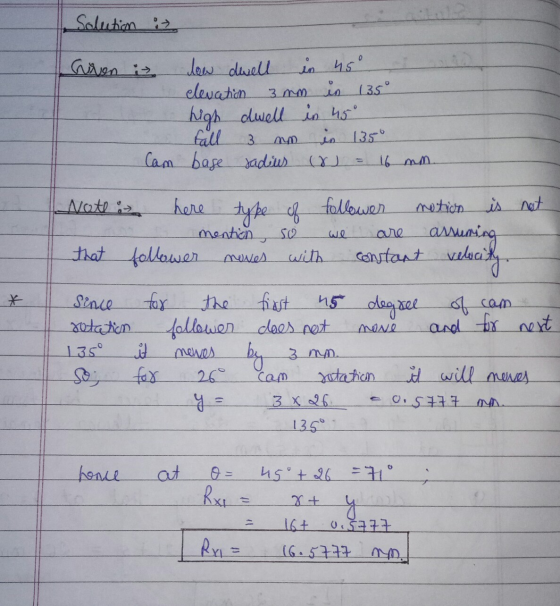
For the cam mechanism the following is true
- LOW DWELL in 45°
- Elevation 3 mm in 135°
- HIGH DWELL in 45°
- Fall 3 mm in 135°
if the base radius is 16mm what is the coordinate RX1 in mm of
the cam if  = 71 degrees, use all decimals, the follower is the knife edge
type.
= 71 degrees, use all decimals, the follower is the knife edge
type.
Homework Answers
Here the type of follower motion is not mention hence i have considered it as constant velocity motion. So by analyzing the given data we can find the required value as follows :
Add Answer to:
For the cam mechanism the following is true
LOW DWELL in 45°
Elevation 3 mm...
For the cam mechanism the following is true LOW DWELL in 45° Elevation 3 mm...
 For the cam mechanism
the following is true
LOW DWELL in 45°
Elevation 3 mm in 135°
HIGH DWELL in
45°
Fall 3 mm in 135°
if the base radius is
16mm what is the coordinate RX1 in mm of the cam if
= 71 degrees, use all decimals, the follower is the knife edge
type.
Ꮎ1 L₃ х 03 01 41 02 L
For the cam mechanism
the following is true
LOW DWELL in 45°
Elevation 3 mm in 135°
HIGH DWELL in
45°
Fall 3 mm in 135°
if the base radius is
16mm what is the coordinate RX1 in mm of the cam if
= 71 degrees, use all decimals, the follower is the knife edge
type.
Ꮎ1 L₃ х 03 01 41 02 L
For the cam-follower mechanism in the figure, the cycloidal movement program is shown below: LOW DWELL...
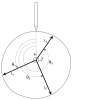 For the cam-follower mechanism in the figure, the cycloidal movement program is shown below:
LOW DWELL (Rest or Stop) for 45 °
3 mm rise at 135 °
HIGH DWELL (Rest or stop) for 45 °
Drop or drop 3mm at 135 °
If the base radius is 21 mm, what is the coordinate RX1 in mm of the cam profile if θ1 = 153 degrees? Use as many decimal places as you can. The follower is of the wedge...
For the cam-follower mechanism in the figure, the cycloidal movement program is shown below:
LOW DWELL (Rest or Stop) for 45 °
3 mm rise at 135 °
HIGH DWELL (Rest or stop) for 45 °
Drop or drop 3mm at 135 °
If the base radius is 21 mm, what is the coordinate RX1 in mm of the cam profile if θ1 = 153 degrees? Use as many decimal places as you can. The follower is of the wedge...
For the cam mechanism the following its true, LOW DWELL in 45° Elevation of ...
 For the cam mechanism
the following its true,
LOW DWELL
in 45°
Elevation of
5 mm in 135°
HIGH DWELL in
45°
Fall of 5
mm en 135°
If the Base radius is
34mm , how much is L2 in mm if
=209 degrees
Ꮎ2 L3 х 03 0 L1 02 L2
For the cam mechanism
the following its true,
LOW DWELL
in 45°
Elevation of
5 mm in 135°
HIGH DWELL in
45°
Fall of 5
mm en 135°
If the Base radius is
34mm , how much is L2 in mm if
=209 degrees
Ꮎ2 L3 х 03 0 L1 02 L2
For the cam mechanism the following its true, LOW DWELL in 45° Elevation of ...
 For the cam mechanism the following its true,
LOW DWELL in 45°
Elevation of 5 mm in 135°
HIGH DWELL in 45°
Fall of 5 mm en 135°
If the Base radius is 34mm , how much is L2 in mm if
=209 degress
Ꮎ2 L₃ х 03 01 41 02 L
For the cam mechanism the following its true,
LOW DWELL in 45°
Elevation of 5 mm in 135°
HIGH DWELL in 45°
Fall of 5 mm en 135°
If the Base radius is 34mm , how much is L2 in mm if
=209 degress
Ꮎ2 L₃ х 03 01 41 02 L
For the cam-follower type mechanism in the figure, the movement program is as follows: LOW DWELL...
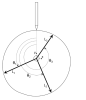 For the cam-follower type mechanism in the figure, the movement program is as follows:
LOW DWELL (Rest or Stop) for 45 °
Elevation 4mm at 135 °
HIGH DWELL (Rest or stop) for 45 °
Drop or drop 4mm at 135 °
If the base radius is 27 mm, how much is L2 in mm if θ2 = 201 degrees?
وا YA Х 03 ON O2 L2
For the cam-follower type mechanism in the figure, the movement program is as follows:
LOW DWELL (Rest or Stop) for 45 °
Elevation 4mm at 135 °
HIGH DWELL (Rest or stop) for 45 °
Drop or drop 4mm at 135 °
If the base radius is 27 mm, how much is L2 in mm if θ2 = 201 degrees?
وا YA Х 03 ON O2 L2
For the cam-follower type mechanism in the figure, the movement program is as follows: LOW DWELL...
 For the cam-follower type mechanism in the figure, the
movement program is as follows:
LOW DWELL (Rest or Stop) for 45 °
Elevation 5mm at 135 °
HIGH DWELL (rest or stop) for 45 °
Drop or drop 5mm by 135 °
If the base radius is 21 mm, how much is L2 in mm if θ2 = 221
degrees?
Para el mecanismo del tipo leva-seguidor en la figura, el programa de movimiento es como sigue: • LOW DWELL (Descanso...
For the cam-follower type mechanism in the figure, the
movement program is as follows:
LOW DWELL (Rest or Stop) for 45 °
Elevation 5mm at 135 °
HIGH DWELL (rest or stop) for 45 °
Drop or drop 5mm by 135 °
If the base radius is 21 mm, how much is L2 in mm if θ2 = 221
degrees?
Para el mecanismo del tipo leva-seguidor en la figura, el programa de movimiento es como sigue: • LOW DWELL (Descanso...
A cam with a knife-edge follower has a motion with the following characteristics:
A cam with a knife-edge follower has a motion with the following characteristics: lift = 50 mm base circle radius = 25 mm outstroke = 110 degrees cam rotation with cycloidal motion first dwell = 80 degrees return stroke = 90 degrees with simple harmonic motion Cam rotates at 550 rpm in CCW direction Determine the maximum velocity and acceleration of the follower during outstroke and return stroke.
Cam Design ProblemDesign a double-dwell cam to move a follower (roller-type) from 0 to 150 mm...
Cam Design ProblemDesign a double-dwell cam to move a follower (roller-type) from 0 to 150 mm in 80◦, dwell for 90◦, fall 150 mm in 80◦, and dwell for the reminder of the cycle. The total cam cycle takes 10 sec. Consider an application in which vibrations must be minimized. Assume that the pitch radius, Rp = 500 mm, the cam-follower has zero eccentricity, ε = 0, and the roller raduis is Rf =50 mm. Any other parameters may be...
2. (8 points) A cam with a knife-edge follower has a motion with the following characteristics:...
 2. (8 points) A cam with a knife-edge follower has a motion with the following characteristics: lift = 50 mm base circle radius = 25 mm outstroke = 110 degrees cam rotation with cycloidal motion first dwell = 80 degrees return stroke = 90 degrees with simple harmonic motion Cam rotates at 550 rpm in CCW direction Determine the maximum velocity and acceleration of the follower during outstroke and return stroke.
A disc cam is to be designed for a knife edge follower with the following...
A disc cam is to be designed for a knife edge follower with the following data :Cam lift = 60 mm during 120° of cam rotation with simple harmonic motion. Dwell for the next 30°.During the next 90° of cam rotation, the follower returns to its original position with simple harmonic motion.Dwell during the remaining 120°.Draw the profile of the cam when the line of stroke of the follower passes through the axis of the cam shaft. The radius of...
 For the cam mechanism
the following is true
LOW DWELL in 45°
Elevation 3 mm in 135°
HIGH DWELL in
45°
Fall 3 mm in 135°
if the base radius is
16mm what is the coordinate RX1 in mm of the cam if
= 71 degrees, use all decimals, the follower is the knife edge
type.
Ꮎ1 L₃ х 03 01 41 02 L
For the cam mechanism
the following is true
LOW DWELL in 45°
Elevation 3 mm in 135°
HIGH DWELL in
45°
Fall 3 mm in 135°
if the base radius is
16mm what is the coordinate RX1 in mm of the cam if
= 71 degrees, use all decimals, the follower is the knife edge
type.
Ꮎ1 L₃ х 03 01 41 02 L
 For the cam-follower mechanism in the figure, the cycloidal movement program is shown below:
LOW DWELL (Rest or Stop) for 45 °
3 mm rise at 135 °
HIGH DWELL (Rest or stop) for 45 °
Drop or drop 3mm at 135 °
If the base radius is 21 mm, what is the coordinate RX1 in mm of the cam profile if θ1 = 153 degrees? Use as many decimal places as you can. The follower is of the wedge...
For the cam-follower mechanism in the figure, the cycloidal movement program is shown below:
LOW DWELL (Rest or Stop) for 45 °
3 mm rise at 135 °
HIGH DWELL (Rest or stop) for 45 °
Drop or drop 3mm at 135 °
If the base radius is 21 mm, what is the coordinate RX1 in mm of the cam profile if θ1 = 153 degrees? Use as many decimal places as you can. The follower is of the wedge...
 For the cam mechanism
the following its true,
LOW DWELL
in 45°
Elevation of
5 mm in 135°
HIGH DWELL in
45°
Fall of 5
mm en 135°
If the Base radius is
34mm , how much is L2 in mm if
=209 degrees
Ꮎ2 L3 х 03 0 L1 02 L2
For the cam mechanism
the following its true,
LOW DWELL
in 45°
Elevation of
5 mm in 135°
HIGH DWELL in
45°
Fall of 5
mm en 135°
If the Base radius is
34mm , how much is L2 in mm if
=209 degrees
Ꮎ2 L3 х 03 0 L1 02 L2
 For the cam mechanism the following its true,
LOW DWELL in 45°
Elevation of 5 mm in 135°
HIGH DWELL in 45°
Fall of 5 mm en 135°
If the Base radius is 34mm , how much is L2 in mm if
=209 degress
Ꮎ2 L₃ х 03 01 41 02 L
For the cam mechanism the following its true,
LOW DWELL in 45°
Elevation of 5 mm in 135°
HIGH DWELL in 45°
Fall of 5 mm en 135°
If the Base radius is 34mm , how much is L2 in mm if
=209 degress
Ꮎ2 L₃ х 03 01 41 02 L
 For the cam-follower type mechanism in the figure, the movement program is as follows:
LOW DWELL (Rest or Stop) for 45 °
Elevation 4mm at 135 °
HIGH DWELL (Rest or stop) for 45 °
Drop or drop 4mm at 135 °
If the base radius is 27 mm, how much is L2 in mm if θ2 = 201 degrees?
وا YA Х 03 ON O2 L2
For the cam-follower type mechanism in the figure, the movement program is as follows:
LOW DWELL (Rest or Stop) for 45 °
Elevation 4mm at 135 °
HIGH DWELL (Rest or stop) for 45 °
Drop or drop 4mm at 135 °
If the base radius is 27 mm, how much is L2 in mm if θ2 = 201 degrees?
وا YA Х 03 ON O2 L2
 For the cam-follower type mechanism in the figure, the
movement program is as follows:
LOW DWELL (Rest or Stop) for 45 °
Elevation 5mm at 135 °
HIGH DWELL (rest or stop) for 45 °
Drop or drop 5mm by 135 °
If the base radius is 21 mm, how much is L2 in mm if θ2 = 221
degrees?
Para el mecanismo del tipo leva-seguidor en la figura, el programa de movimiento es como sigue: • LOW DWELL (Descanso...
For the cam-follower type mechanism in the figure, the
movement program is as follows:
LOW DWELL (Rest or Stop) for 45 °
Elevation 5mm at 135 °
HIGH DWELL (rest or stop) for 45 °
Drop or drop 5mm by 135 °
If the base radius is 21 mm, how much is L2 in mm if θ2 = 221
degrees?
Para el mecanismo del tipo leva-seguidor en la figura, el programa de movimiento es como sigue: • LOW DWELL (Descanso...
 2. (8 points) A cam with a knife-edge follower has a motion with the following characteristics: lift = 50 mm base circle radius = 25 mm outstroke = 110 degrees cam rotation with cycloidal motion first dwell = 80 degrees return stroke = 90 degrees with simple harmonic motion Cam rotates at 550 rpm in CCW direction Determine the maximum velocity and acceleration of the follower during outstroke and return stroke.
Most questions answered within 3 hours.
-
Where is the error in this code sequence?
String s1 = "Hello";
String s2 = "ello";...
asked 11 months ago -
Financial data for Joel de Paris, Inc., for last year
follow:
Joel de Paris, Inc.
Balance...
asked 11 months ago -
Consider this reaction:
Al2(SO4)3 (aq)+ BaCl3
(aq) Al2Cl6 (aq)- +
3BaSO4(s) . What is the...
asked 11 months ago -
Suppose that Savneet is considering increasing her
recent random sample from 20 car rentals to 40...
asked 11 months ago -
Trucks arrive at an unloading terminal at an average rate of 120
per hour.
Trucks arrive...
asked 11 months ago -
Why are methanol and ethanol completely soluble in water while
octanol is not very little soluble....
asked 11 months ago -
A facilities manager at a university reads in a research report
that the mean amount of...
asked 11 months ago -
When the CuSO4 is rehydrated by adding water to the anhydrous
compound, is this an endothermic...
asked 11 months ago -
A ray of sunlight is passing from diamond into crown glass; the
angle of incidence is...
asked 11 months ago -
A block of mass 0.249 kg is placed on top of a light, vertical
spring of...
asked 11 months ago -
how do the kidneys compensate in the presences of acidosis
a) trigger hyperventilate
b) reserve acid...
asked 11 months ago -
Question 501 pts
The rental rate of capital to the firm increases. Which of the
following...
asked 11 months ago