What are the sequences found in the origin of replication in a bacterial DNA? Explain briefly...
- What are the sequences found in the origin of replication in a bacterial DNA?
- Explain briefly how DNA polymerases lessen errors in DNA replication.
- Why are there Okazaki fragments in the lagging strand during replication?
Homework Answers
Origins in bacteria are either continuous or bipartite and contain three functional elements that control origin activity: conserved DNA repeats that are specifically recognized by DnaA, an AT-rich DNA unwinding element (DUE), and binding sites for proteins that help regulate replication initiation.
DNA polymerases have proofreading activity that reduces the errors in replication of DNA. Polymerase uses 3' to 5' exonuclease activity to remove the incorrect bases from the 3' end of the new strand. In bacteria, all three DNA polymerases (I, II and III) have the ability to proofread, using 3' → 5' exonuclease activity. When an incorrect base pair is recognized, DNA polymerase reverses its direction by one base pair of DNA and excises the mismatched base.
Okazaki fragments are formed on the lagging strand so that DNA can be synthesized in the essential 5' to 3' manner on the lagging strand. Because these are synthesized in fragments so these fragments lag behind in comparison to leading strand hence its name lagging strand.
Add Answer to:
What are the sequences found in the origin of replication in a
bacterial DNA?
Explain briefly...
For DNA replication, primases: A) Create short pieces of DNA to provide 3'ends for DNA polymerases...
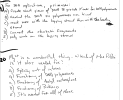 For DNA replication, primases: A) Create short pieces of DNA to provide 3'ends for DNA polymerases Unwind the DNA so polymerases can bind react more with the lagging strand than with the leading strand connect the okazaki fragments E) only work on the lagging strand is a wonderful thing, which michal is it not needed for? 20 Mg at the follow B) Functioning of splicing out of introns DNA polymerases Functioning of Acetyl carboxylase Functioning of Rubisco E) It's needed...
1. DNA is coiled around what type of proteins to form nucleosomes A. Polymerases DNA replication...
 1. DNA is coiled around what type of proteins to form nucleosomes A. Polymerases DNA replication of the lagging strand is discontinuous B. Transcription factors DNA replication of the lagging strand is continuous C. Helicases D. Histones E. DICER 2. Which of the following statements is true? A. DNA replication of the leading strand is discontinuous B. DNA replication of the lagging strand is discontinuous C. DNA replication of the leading strand is dispersive D. DNA replication of the lagging...
Vocabulary: DNA Replication
Vocabulary: DNA Replication A. Helicase B. Primase C. Single Strand Binding Protein (SSB) D. Topoisomerase E. Origin of Replication F. DNA Polymerase G. Leading Strand H. Lagging strand I. DNA Ligase J. Okazaki Fragment K. Replication Fork L. RNA Primer M. Topoisomerase .1. Site where the replication of a DNA molecule begins. 2. The new continuous complementary DNA strand synthesized in the direction for the replication fork. 3. A discontinuously synthesized DNA strand that elongates in a direction away from the replication fork 4. Relaxes...
QUESTION 3 Replication Now DNA Origin of replication DOC Replication fork B CON RO Unreplicated DNA...
 QUESTION 3 Replication Now DNA Origin of replication DOC Replication fork B CON RO Unreplicated DNA Prokaryotic DNA The above diagram shows DNA replication in bacterial cells. An antibody specific only to DNA polymerase I was added to DNA undergoing replication in bacterial cells. Which of the following statements are CORRECT? a. There would be a higher concentration of antibodies on the leading strands of replication foris A and B and a lower concentration of antibodies on the lagging strands...
DNA Replication. Sketch a replication fork of bacterial DNA in which one strand is being replicated...
 DNA Replication. Sketch a replication fork of bacterial DNA in which one strand is being replicated discontinuously and the other is being replicated continuously. List six different enzyme activities associated with the replication process, identity the function of each activity, and show where each would be located on the replication fork. In addition, identify the following features on your sketch: DNA template, RNA primer, Okazaki fragments, and single-stranded DNA binding protein.
2) (2 pts) The diagram below depicts two Okazaki fragments synthesized during lagging strand DNA replication....
 2) (2 pts) The diagram below depicts two Okazaki fragments synthesized during lagging strand DNA replication. Which arrow indicates the position at which the synthesis of the next RNA primer will be initiated? Circle the correct letter 3 5 Template strand 3) (2 pts) The E. coli genome encodes 3 different DNA polymerases, namely, L,II and II. a) Which one has 5' to 3' exonuclease activity? Why? b) Which one is most abundant?
Which of the following is true regarding DNA replication (see Chapter 16 in the textbook). Check...
Which of the following is true regarding DNA replication (see Chapter 16 in the textbook). Check all that are correct. Question options: A) DNA ligase joins Okazaki fragments on the lagging strand. B) DNA replication results in one double helix with all parental strand and one double helix with completely newly synthesized DNA. C) Nucleases add RNA primers to start replication. D) DNA replication starts at multiple points along the eukaryotic genome. E) Helicases prevent separation of the DNA strands...
The lagging strand in DNA replication?: (A) is synthesized after the leading strand. (B) causes the...
The lagging strand in DNA replication?: (A) is synthesized after the leading strand. (B) causes the formation of Okazaki fragments in the leading strand. (C) is a consequence of replicating both strands of template DNA at a single replication fork. (D) requires its own replisome.
Test 3*, 10-point Question Illustrate and label a model of DNA (bacterial) replication, and an offset...
 Test 3*, 10-point Question Illustrate and label a model of DNA (bacterial) replication, and an offset overview of the replication bubble. Labels must include: DNA strands (parental, leading, lagging, 2 or more Okazaki fragments), polarities (5' or 3'), all replication enzymes, binding proteins, primers, distinguishing nucleotides of primers and DNA, plus vectors to show overall direction of replication. (10 points)
DNA Replication - Describe the process of DNA replication in a well-organized manner. Start with the...
DNA Replication - Describe the process of DNA replication in a well-organized manner. Start with the helicase and go through the entire process, step by step. Use these terms correctly: Helicase, DNA primase, single stranded binding proteins, DNA polymerase I, DNA Polymerase III, leading strand, lagging strand, okazaki fragments, ligase, topoisomerase, sliding clamp, clamp loader. Please use correct descriptions of the enzyme function. For example, do not say, “seals nicks.” Tell me what “seals nicks” means.
 For DNA replication, primases: A) Create short pieces of DNA to provide 3'ends for DNA polymerases Unwind the DNA so polymerases can bind react more with the lagging strand than with the leading strand connect the okazaki fragments E) only work on the lagging strand is a wonderful thing, which michal is it not needed for? 20 Mg at the follow B) Functioning of splicing out of introns DNA polymerases Functioning of Acetyl carboxylase Functioning of Rubisco E) It's needed...
 1. DNA is coiled around what type of proteins to form nucleosomes A. Polymerases DNA replication of the lagging strand is discontinuous B. Transcription factors DNA replication of the lagging strand is continuous C. Helicases D. Histones E. DICER 2. Which of the following statements is true? A. DNA replication of the leading strand is discontinuous B. DNA replication of the lagging strand is discontinuous C. DNA replication of the leading strand is dispersive D. DNA replication of the lagging...
 QUESTION 3 Replication Now DNA Origin of replication DOC Replication fork B CON RO Unreplicated DNA Prokaryotic DNA The above diagram shows DNA replication in bacterial cells. An antibody specific only to DNA polymerase I was added to DNA undergoing replication in bacterial cells. Which of the following statements are CORRECT? a. There would be a higher concentration of antibodies on the leading strands of replication foris A and B and a lower concentration of antibodies on the lagging strands...
 DNA Replication. Sketch a replication fork of bacterial DNA in which one strand is being replicated discontinuously and the other is being replicated continuously. List six different enzyme activities associated with the replication process, identity the function of each activity, and show where each would be located on the replication fork. In addition, identify the following features on your sketch: DNA template, RNA primer, Okazaki fragments, and single-stranded DNA binding protein.
 2) (2 pts) The diagram below depicts two Okazaki fragments synthesized during lagging strand DNA replication. Which arrow indicates the position at which the synthesis of the next RNA primer will be initiated? Circle the correct letter 3 5 Template strand 3) (2 pts) The E. coli genome encodes 3 different DNA polymerases, namely, L,II and II. a) Which one has 5' to 3' exonuclease activity? Why? b) Which one is most abundant?
 Test 3*, 10-point Question Illustrate and label a model of DNA (bacterial) replication, and an offset overview of the replication bubble. Labels must include: DNA strands (parental, leading, lagging, 2 or more Okazaki fragments), polarities (5' or 3'), all replication enzymes, binding proteins, primers, distinguishing nucleotides of primers and DNA, plus vectors to show overall direction of replication. (10 points)
Most questions answered within 3 hours.
-
Where is the error in this code sequence?
String s1 = "Hello";
String s2 = "ello";...
asked 10 months ago -
Financial data for Joel de Paris, Inc., for last year
follow:
Joel de Paris, Inc.
Balance...
asked 10 months ago -
Consider this reaction:
Al2(SO4)3 (aq)+ BaCl3
(aq) Al2Cl6 (aq)- +
3BaSO4(s) . What is the...
asked 10 months ago -
Suppose that Savneet is considering increasing her
recent random sample from 20 car rentals to 40...
asked 10 months ago -
Trucks arrive at an unloading terminal at an average rate of 120
per hour.
Trucks arrive...
asked 10 months ago -
Why are methanol and ethanol completely soluble in water while
octanol is not very little soluble....
asked 10 months ago -
A facilities manager at a university reads in a research report
that the mean amount of...
asked 10 months ago -
When the CuSO4 is rehydrated by adding water to the anhydrous
compound, is this an endothermic...
asked 10 months ago -
A ray of sunlight is passing from diamond into crown glass; the
angle of incidence is...
asked 10 months ago -
A block of mass 0.249 kg is placed on top of a light, vertical
spring of...
asked 10 months ago -
how do the kidneys compensate in the presences of acidosis
a) trigger hyperventilate
b) reserve acid...
asked 10 months ago -
Question 501 pts
The rental rate of capital to the firm increases. Which of the
following...
asked 10 months ago