
Homework Answers
Request Answer!
We need at least 10 more requests to produce the answer.
0 / 10 have requested this problem solution
The more requests, the faster the answer.
Add Answer to:
8 15. A 218Po nucleus decays by successive B, a, a, ß emissions. Write the isotope...
Question 20 4 pts If californium-253 (Cf, atomic # = 98) decays by successive ß, a,...
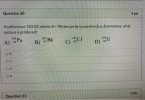 Question 20 4 pts If californium-253 (Cf, atomic # = 98) decays by successive ß, a, ß emissions, what nucleus is produced? 249 Pu 247 Bk 249 Cf 253 U A) 94 B) 97 C) 98 D) OD OC ΟΑ OB 4 pts Question 21
The radioactive isotope 242Cm decays by a series of a-particle and B-particle productions, taking 242Cm through...
 The radioactive isotope 242Cm decays by a series of a-particle and B-particle productions, taking 242Cm through many trans- formations to end up as 206Pb. In the complete decay series, how many a and ß particles are produced?
Beryllium-8 is an unstable isotope and decays into two α particles, which are helium nuclei with...
Beryllium-8 is an unstable isotope and decays into two α particles, which are helium nuclei with mass 6.68×10⁻²⁷kg. This decay process releases 1.5×10⁻¹⁴J of energy. For this problem, let's assume that the mass of the Beryllium-8 nucleus is just twice the mass of an α particle and that all the energy released in the decay becomes kinetic energy of the α particles. If the Beryllium-8 nucleus is moving in the positive x-direction with a speed of 1.0×10⁶ m/s when it...
Ruthenium-106 (106Ru) is used to treat melanoma in the eye. This isotope decays by B- emission...
 Ruthenium-106 (106Ru) is used to treat melanoma in the eye. This isotope decays by B- emission with a half-life of 373.59 days. One source of the isotope is reprocessed nuclear reactor fuel. How many protons and how many neutrons does the 106Ru nucleus contain? protons: neutrons: Identify the missing daughter nucleus in the B- emission decay of 106Ru. 106Ru - ?? + e + Te How many years after 106Ru is implanted in the eye does it take for its...
Problem 7.45 13 of 15 Constants A radioactive nucleus at rest decays into a second nucleus,...
 Problem 7.45 13 of 15 Constants A radioactive nucleus at rest decays into a second nucleus, an electron, and a neutrino. The electron and neutrino are emitted at right angles and have momenta of Pe = 9.43x10⁻²³ kg.m/s and p = 8.47x10⁻²³ kg-m/s, respectively. (Figure 1) Part A Determine the magnitude of the momentum of the second (recoling) nucleus. Express your answer to three significant figures and include the appropriate units. Figure < 1 of 1 НА ? +y Рас...
6. The isotope plutonium- 239 undergoes alpha decay. Write the reaction equation and determine the identity of the daughter nucleus.
6. The isotope plutonium- 239 undergoes alpha decay. Write the reaction equation and determine the identity of the daughter nucleus.7. The isotope silver- 107^{*} undergoes gamma decay. Write the reaction equation, and determine the identity of the daughter nucleus.14. Iodine-131, a beta emitter, has a half-life of 8 days. A 2-gram sample of initially pure iodine-131 is stored for 32 days. How much iodine-131 remains in the sample afterward?15. An accident in a laboratory results in a room being contaminated...
The isotope helium-8 undergoes beta decay. Write the reaction equation and determine the identity of the...
The isotope helium-8 undergoes beta decay. Write the reaction equation and determine the identity of the daughter nucleus.
There are two radioactive elements, elements A and B. Element A decays into element B with...
 There are two radioactive elements, elements A and B. Element A decays into element B with a decay constant of 2/yr, and element B decays into the nonradioactive isotope of element C with a decay constant of 1/yr. An initial mass of 3 kg of element A is put into a nonradioactive container, with no other source of elements A, B, and C. How much of each of the three elements is in the container after t yr? (The decay...
Consider the radioactive decay of nucleus A into nucleus B, A −→ B. Let nA and...
Consider the radioactive decay of nucleus A into nucleus B, A −→ B. Let nA and nB denote the numbers of nuclei A and B at a given time. Let λ the the probability that an A nucleus will decay in unit time. In other words, λnA is the number decays per unit time. Assume that B is stable. i. Write down the differential equations for the rates of change of the numbers of each nuclei, i.e., express dnA/dt and...
QUESTION 2 (a) A radioactive isotope, Pb-209, decays at a rate proportional to amount present at...
 QUESTION 2 (a) A radioactive isotope, Pb-209, decays at a rate proportional to amount present at time t and has a half-life of 3.3 hours. If 1 gram of the isotope is present initially, how long will it take for 95% of the lead to decay?| (8 marks) (b) Form the differential equation associated with the given primitive y = Ae*' -1, by eliminating the arbitrary constants A. (4 marks) (C) Write the differential equation (1+ y2)dy + x =...
 Question 20 4 pts If californium-253 (Cf, atomic # = 98) decays by successive ß, a, ß emissions, what nucleus is produced? 249 Pu 247 Bk 249 Cf 253 U A) 94 B) 97 C) 98 D) OD OC ΟΑ OB 4 pts Question 21
 The radioactive isotope 242Cm decays by a series of a-particle and B-particle productions, taking 242Cm through many trans- formations to end up as 206Pb. In the complete decay series, how many a and ß particles are produced?
 Ruthenium-106 (106Ru) is used to treat melanoma in the eye. This isotope decays by B- emission with a half-life of 373.59 days. One source of the isotope is reprocessed nuclear reactor fuel. How many protons and how many neutrons does the 106Ru nucleus contain? protons: neutrons: Identify the missing daughter nucleus in the B- emission decay of 106Ru. 106Ru - ?? + e + Te How many years after 106Ru is implanted in the eye does it take for its...
 Problem 7.45 13 of 15 Constants A radioactive nucleus at rest decays into a second nucleus, an electron, and a neutrino. The electron and neutrino are emitted at right angles and have momenta of Pe = 9.43x10⁻²³ kg.m/s and p = 8.47x10⁻²³ kg-m/s, respectively. (Figure 1) Part A Determine the magnitude of the momentum of the second (recoling) nucleus. Express your answer to three significant figures and include the appropriate units. Figure < 1 of 1 НА ? +y Рас...
 There are two radioactive elements, elements A and B. Element A decays into element B with a decay constant of 2/yr, and element B decays into the nonradioactive isotope of element C with a decay constant of 1/yr. An initial mass of 3 kg of element A is put into a nonradioactive container, with no other source of elements A, B, and C. How much of each of the three elements is in the container after t yr? (The decay...
 QUESTION 2 (a) A radioactive isotope, Pb-209, decays at a rate proportional to amount present at time t and has a half-life of 3.3 hours. If 1 gram of the isotope is present initially, how long will it take for 95% of the lead to decay?| (8 marks) (b) Form the differential equation associated with the given primitive y = Ae*' -1, by eliminating the arbitrary constants A. (4 marks) (C) Write the differential equation (1+ y2)dy + x =...
Most questions answered within 3 hours.
-
Where is the error in this code sequence?
String s1 = "Hello";
String s2 = "ello";...
asked 11 months ago -
Financial data for Joel de Paris, Inc., for last year
follow:
Joel de Paris, Inc.
Balance...
asked 11 months ago -
Consider this reaction:
Al2(SO4)3 (aq)+ BaCl3
(aq) Al2Cl6 (aq)- +
3BaSO4(s) . What is the...
asked 11 months ago -
Suppose that Savneet is considering increasing her
recent random sample from 20 car rentals to 40...
asked 11 months ago -
Trucks arrive at an unloading terminal at an average rate of 120
per hour.
Trucks arrive...
asked 11 months ago -
Why are methanol and ethanol completely soluble in water while
octanol is not very little soluble....
asked 11 months ago -
A facilities manager at a university reads in a research report
that the mean amount of...
asked 11 months ago -
When the CuSO4 is rehydrated by adding water to the anhydrous
compound, is this an endothermic...
asked 11 months ago -
A ray of sunlight is passing from diamond into crown glass; the
angle of incidence is...
asked 11 months ago -
A block of mass 0.249 kg is placed on top of a light, vertical
spring of...
asked 11 months ago -
how do the kidneys compensate in the presences of acidosis
a) trigger hyperventilate
b) reserve acid...
asked 11 months ago -
Question 501 pts
The rental rate of capital to the firm increases. Which of the
following...
asked 11 months ago