
Homework Answers
Request Answer!
We need at least 10 more requests to produce the answer.
0 / 10 have requested this problem solution
The more requests, the faster the answer.
Add Answer to:
Atomic chlorine reconstitution may also occur via the single step mechanism shown below. CIO (g) +...
Atomic chlorine reconstitution may also occur via the single step mechanism shown below. CIO (g) +...
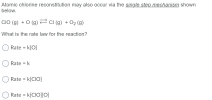 Atomic chlorine reconstitution may also occur via the single step mechanism shown below. CIO (g) + O (g) = CI (g) + O2 (g) What is the rate law for the reaction? O Rate = k[O] Rate = k Rate = k[CIO] Rate = k[CIO][O]
Atomic chlorine elimination may occur via the single step mechanism shown below. CI (g) + O2...
 Atomic chlorine elimination may occur via the single step mechanism shown below. CI (g) + O2 (g) ECIO (g) + 0 (9) Which of the following AG vs. T graphs corresponds to this reaction? O AG T Ο ΔG T AG
3. The chlorine monoxide (CIO) demonstrated three bimolecular self-reactions CIO(g) - CIO(g) → Ch(9) O(g) CIO(g)...
 3. The chlorine monoxide (CIO) demonstrated three bimolecular self-reactions CIO(g) - CIO(g) → Ch(9) O(g) CIO(g) CIO(g) → C (9) + CIOO(g) CIO(g) + CIO(g) > Cl(g) Ocio(9) The following table provides the Arrhenius parameters for these reaction Reaction Pre-Exponential Factor (M's!) Activation Energy (kJ mol') 6.08 x 10⁸ 114 178 x 1010 20.4 2.11 x 10² 132 Which of the following is TRUE about of enthalpy activation Hand entropy of activation AS: A) in reaction the enthalpy of activation...
The following process may take place in three steps: 2 CIO (g) =2 Cl (g) +...
 The following process may take place in three steps: 2 CIO (g) =2 Cl (g) + O2 (g) S1: 2 CIO (g) = CIOOCI (g) S2: CIOOCI (g) = CIOO (g) + Cl (g) S3: CIOO (g) + Cl (g) + O2 (g) The rate law for this process has been experimentally determined to be Rate = k[CIO]?. Based off this information, which of the following statements is TRUE? O The reaction is first order overall O The rate law...
1) 2) 3) C3H8(g) + 5 O2(g) = 3 CO2(g) + 4H2O(1) AH = -2220 kJ...
 1)
2)
3)
C3H8(g) + 5 O2(g) = 3 CO2(g) + 4H2O(1) AH = -2220 kJ Decreasing the temperature will result in shift the equilibrium to the right shift the equilibrium to the left Keq is decreased O no effect in shifting the equilibrium more information is needed Which of the following expressions is the correct equilibrium-constant expression for the reaction below? P4010(s) = P4(s) + 5 O2(g) [02]-5 O [0215 [P4010] [Pd][02] [P][0215 O [P4010] [P4010) [P][0,1175 A proposed...
1)
2)
3)
C3H8(g) + 5 O2(g) = 3 CO2(g) + 4H2O(1) AH = -2220 kJ Decreasing the temperature will result in shift the equilibrium to the right shift the equilibrium to the left Keq is decreased O no effect in shifting the equilibrium more information is needed Which of the following expressions is the correct equilibrium-constant expression for the reaction below? P4010(s) = P4(s) + 5 O2(g) [02]-5 O [0215 [P4010] [Pd][02] [P][0215 O [P4010] [P4010) [P][0,1175 A proposed...
1) 2) 3) 4) C3H8(g) + 5 O2(g) = 3 CO2(g) + 4H2O(1) AH = -2220...
 1)
2)
3)
4)
C3H8(g) + 5 O2(g) = 3 CO2(g) + 4H2O(1) AH = -2220 kJ Decreasing the temperature will result in shift the equilibrium to the right shift the equilibrium to the left Keq is decreased O no effect in shifting the equilibrium more information is needed Which of the following expressions is the correct equilibrium-constant expression for the reaction below? P4010(s) = P4(s) + 5 O2(g) [02]-5 O [0215 [P4010] [Pd][02] [P][0215 O [P4010] [P4010) [P][0,1175 A...
1)
2)
3)
4)
C3H8(g) + 5 O2(g) = 3 CO2(g) + 4H2O(1) AH = -2220 kJ Decreasing the temperature will result in shift the equilibrium to the right shift the equilibrium to the left Keq is decreased O no effect in shifting the equilibrium more information is needed Which of the following expressions is the correct equilibrium-constant expression for the reaction below? P4010(s) = P4(s) + 5 O2(g) [02]-5 O [0215 [P4010] [Pd][02] [P][0215 O [P4010] [P4010) [P][0,1175 A...
8. In a reaction mechanism, a substance that is produced in one step, and consumed in...
8. In a reaction mechanism, a substance that is produced in one step, and consumed in a later step is a(n): Intermediate. Tranistion state. Catalyst. Starting material. 9. A substance that is present before and after the reaction takes place, and may increase the reaction rate by changing its mechanism is a(n): Catalyst. Intermediate. Starting material. Product. 12. An intermediate in an acid-catalyzed esterification has a partial _____ charge at its tetrahedral carbon center. positive negative 13. Water acts as...
Please make sure your answer is correct. I have gotten numerous wrong answers. Thanks. This one...
 Please make sure your answer is correct. I have gotten numerous
wrong answers. Thanks.
This one too:
And this one:
Again please make sure you are correct.
If you have time: This one was marked wrong too, so if you can
solve I give thumbs up thanks.
Consider the following reaction mechanism: Step 1 K 2A + B =D (fast equilibrium) Step 2 D+B *3 E+F (slow) Step 3 FKG (fast) c. What is the rate law that corresponds to...
Please make sure your answer is correct. I have gotten numerous
wrong answers. Thanks.
This one too:
And this one:
Again please make sure you are correct.
If you have time: This one was marked wrong too, so if you can
solve I give thumbs up thanks.
Consider the following reaction mechanism: Step 1 K 2A + B =D (fast equilibrium) Step 2 D+B *3 E+F (slow) Step 3 FKG (fast) c. What is the rate law that corresponds to...
22. The rate law for the chemical reaction shown below has been determined experimentally: Rate =...
 22. The rate law for the chemical reaction shown below has been determined experimentally: Rate = k[O3][CI]. What is the overall order of the reaction? 03(g) + Cl(g) → O2(g) + ClO(g) a. 3 b. 5 d. 2 8. The following data were obtained for the hypothetical reaction A+B → products. [A]o (M) 4.0 2.0 4.0 [B]. (M) 6.0 6.0 3.0 Initial Rate (M/s) 1.60 0.80 0.40 What is the overall order of this reaction? a. 3 b. 12 c....
2. Consider the reactions 1 and 2 shown below. Indicate how the reaction rate for each of the reactions will change...
 2. Consider the reactions 1 and 2 shown below. Indicate how the reaction rate for each of the reactions will change your options are: increase, decrease, does NOT change) when the following modifications to the reactions and conditions are introduced: reaction 1 reaction 2 Br CH30 Na CH3OH CH OH as solvent CH3OH is also solvent A. The reaction temperature for both reactions is increased. B. The concentration of the reagent shown above the arrow is increased. C. The concentration...
 Atomic chlorine reconstitution may also occur via the single step mechanism shown below. CIO (g) + O (g) = CI (g) + O2 (g) What is the rate law for the reaction? O Rate = k[O] Rate = k Rate = k[CIO] Rate = k[CIO][O]
 Atomic chlorine elimination may occur via the single step mechanism shown below. CI (g) + O2 (g) ECIO (g) + 0 (9) Which of the following AG vs. T graphs corresponds to this reaction? O AG T Ο ΔG T AG
 3. The chlorine monoxide (CIO) demonstrated three bimolecular self-reactions CIO(g) - CIO(g) → Ch(9) O(g) CIO(g) CIO(g) → C (9) + CIOO(g) CIO(g) + CIO(g) > Cl(g) Ocio(9) The following table provides the Arrhenius parameters for these reaction Reaction Pre-Exponential Factor (M's!) Activation Energy (kJ mol') 6.08 x 10⁸ 114 178 x 1010 20.4 2.11 x 10² 132 Which of the following is TRUE about of enthalpy activation Hand entropy of activation AS: A) in reaction the enthalpy of activation...
 The following process may take place in three steps: 2 CIO (g) =2 Cl (g) + O2 (g) S1: 2 CIO (g) = CIOOCI (g) S2: CIOOCI (g) = CIOO (g) + Cl (g) S3: CIOO (g) + Cl (g) + O2 (g) The rate law for this process has been experimentally determined to be Rate = k[CIO]?. Based off this information, which of the following statements is TRUE? O The reaction is first order overall O The rate law...
 1)
2)
3)
C3H8(g) + 5 O2(g) = 3 CO2(g) + 4H2O(1) AH = -2220 kJ Decreasing the temperature will result in shift the equilibrium to the right shift the equilibrium to the left Keq is decreased O no effect in shifting the equilibrium more information is needed Which of the following expressions is the correct equilibrium-constant expression for the reaction below? P4010(s) = P4(s) + 5 O2(g) [02]-5 O [0215 [P4010] [Pd][02] [P][0215 O [P4010] [P4010) [P][0,1175 A proposed...
1)
2)
3)
C3H8(g) + 5 O2(g) = 3 CO2(g) + 4H2O(1) AH = -2220 kJ Decreasing the temperature will result in shift the equilibrium to the right shift the equilibrium to the left Keq is decreased O no effect in shifting the equilibrium more information is needed Which of the following expressions is the correct equilibrium-constant expression for the reaction below? P4010(s) = P4(s) + 5 O2(g) [02]-5 O [0215 [P4010] [Pd][02] [P][0215 O [P4010] [P4010) [P][0,1175 A proposed...
 1)
2)
3)
4)
C3H8(g) + 5 O2(g) = 3 CO2(g) + 4H2O(1) AH = -2220 kJ Decreasing the temperature will result in shift the equilibrium to the right shift the equilibrium to the left Keq is decreased O no effect in shifting the equilibrium more information is needed Which of the following expressions is the correct equilibrium-constant expression for the reaction below? P4010(s) = P4(s) + 5 O2(g) [02]-5 O [0215 [P4010] [Pd][02] [P][0215 O [P4010] [P4010) [P][0,1175 A...
1)
2)
3)
4)
C3H8(g) + 5 O2(g) = 3 CO2(g) + 4H2O(1) AH = -2220 kJ Decreasing the temperature will result in shift the equilibrium to the right shift the equilibrium to the left Keq is decreased O no effect in shifting the equilibrium more information is needed Which of the following expressions is the correct equilibrium-constant expression for the reaction below? P4010(s) = P4(s) + 5 O2(g) [02]-5 O [0215 [P4010] [Pd][02] [P][0215 O [P4010] [P4010) [P][0,1175 A...
 Please make sure your answer is correct. I have gotten numerous
wrong answers. Thanks.
This one too:
And this one:
Again please make sure you are correct.
If you have time: This one was marked wrong too, so if you can
solve I give thumbs up thanks.
Consider the following reaction mechanism: Step 1 K 2A + B =D (fast equilibrium) Step 2 D+B *3 E+F (slow) Step 3 FKG (fast) c. What is the rate law that corresponds to...
Please make sure your answer is correct. I have gotten numerous
wrong answers. Thanks.
This one too:
And this one:
Again please make sure you are correct.
If you have time: This one was marked wrong too, so if you can
solve I give thumbs up thanks.
Consider the following reaction mechanism: Step 1 K 2A + B =D (fast equilibrium) Step 2 D+B *3 E+F (slow) Step 3 FKG (fast) c. What is the rate law that corresponds to...
 22. The rate law for the chemical reaction shown below has been determined experimentally: Rate = k[O3][CI]. What is the overall order of the reaction? 03(g) + Cl(g) → O2(g) + ClO(g) a. 3 b. 5 d. 2 8. The following data were obtained for the hypothetical reaction A+B → products. [A]o (M) 4.0 2.0 4.0 [B]. (M) 6.0 6.0 3.0 Initial Rate (M/s) 1.60 0.80 0.40 What is the overall order of this reaction? a. 3 b. 12 c....
 2. Consider the reactions 1 and 2 shown below. Indicate how the reaction rate for each of the reactions will change your options are: increase, decrease, does NOT change) when the following modifications to the reactions and conditions are introduced: reaction 1 reaction 2 Br CH30 Na CH3OH CH OH as solvent CH3OH is also solvent A. The reaction temperature for both reactions is increased. B. The concentration of the reagent shown above the arrow is increased. C. The concentration...
Most questions answered within 3 hours.
-
Where is the error in this code sequence?
String s1 = "Hello";
String s2 = "ello";...
asked 10 months ago -
Financial data for Joel de Paris, Inc., for last year
follow:
Joel de Paris, Inc.
Balance...
asked 10 months ago -
Consider this reaction:
Al2(SO4)3 (aq)+ BaCl3
(aq) Al2Cl6 (aq)- +
3BaSO4(s) . What is the...
asked 10 months ago -
Suppose that Savneet is considering increasing her
recent random sample from 20 car rentals to 40...
asked 10 months ago -
Trucks arrive at an unloading terminal at an average rate of 120
per hour.
Trucks arrive...
asked 10 months ago -
Why are methanol and ethanol completely soluble in water while
octanol is not very little soluble....
asked 10 months ago -
A facilities manager at a university reads in a research report
that the mean amount of...
asked 10 months ago -
When the CuSO4 is rehydrated by adding water to the anhydrous
compound, is this an endothermic...
asked 10 months ago -
A ray of sunlight is passing from diamond into crown glass; the
angle of incidence is...
asked 10 months ago -
A block of mass 0.249 kg is placed on top of a light, vertical
spring of...
asked 10 months ago -
how do the kidneys compensate in the presences of acidosis
a) trigger hyperventilate
b) reserve acid...
asked 10 months ago -
Question 501 pts
The rental rate of capital to the firm increases. Which of the
following...
asked 10 months ago