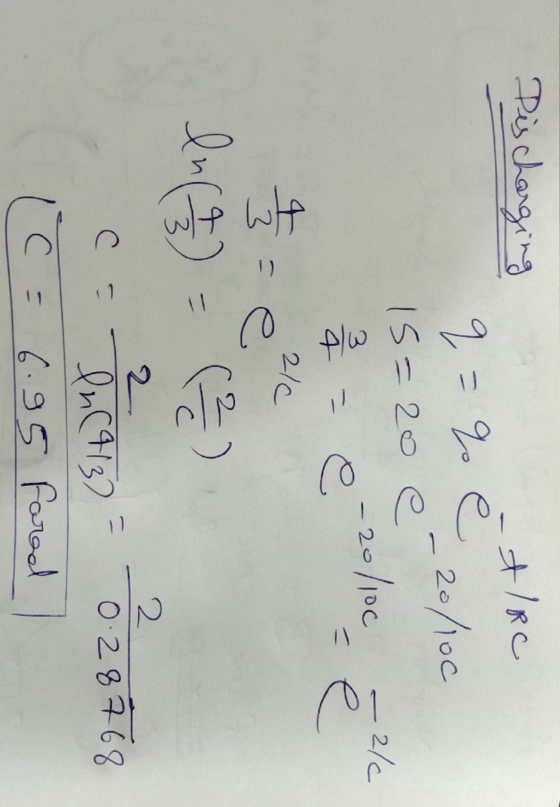
a discharging RC circuit has its charge reduced from 20C to 15C in 20 seconds. If...
a discharging RC circuit has its charge reduced from 20C to 15C in 20 seconds. If the resistance of the circuit is 10 ohms. What is the capacitance.
pls show work.
Homework Answers
Add Answer to:
a discharging RC circuit has its charge reduced from 20C to 15C
in 20 seconds. If...
Question 10 5 pts An RC has a resistor with a resistance of 12 and a...
 Question 10 5 pts An RC has a resistor with a resistance of 12 and a capacitor with a capacitance of 1.4 F. The capacitor is discharging. if the capacitor initially has a charge Q=11Cthen after how many seconds will it have a charge of 0.6875 C O 11.65 O 67.25 correct answer not shown 46.65 O 16.85 Question 11 5 pts A discharging RC circuit has its charge reduce from 20 C to 10 C in 22 s. If...
3 Capacitor Discharging Current The capacitor voltage versus time in a discharging series RC circuit, as...
 3 Capacitor Discharging Current The capacitor voltage versus time in a discharging series RC circuit, as shown in the Background Information Figure 2, is Vo(t) = V, expl-Roc), +20 (3) where V, is the source voltage in Volts, exp(x) is the exponential functione, Rp is the discharging resistance in Ohms (N), C is the capacitance in Farads. To = Rp is the discharging time constant in seconds. Derive an expression for the capacitor discharging current versus time, .(t), in terms...
a coil has a resistance of 18 ohms when its mean temperature is 20C and of...
a coil has a resistance of 18 ohms when its mean temperature is 20C and of 20 ohms when its mean temperature is 50C. find the mean temperature rise when its resistance is 21 ohms and the surrounding temperature is 15C.
RC Circuits If you have an RC circuit with a resistance of 200 ohms and a...
RC Circuits If you have an RC circuit with a resistance of 200 ohms and a capacitance of 35 microfarads, what is the time constant? Time Constant= ? s This time constant represents how much time it will take to reach 63% of maximum. If the RC circuit is connected to an EMF of 12.0 V, what will be its voltage after 5.0 ms? Voltage after 5.0 ms= ? V Draw what the voltage looks like in a charging RC...
Suppose that a particular RC series circuit has a time constant of 5.0 seconds. What does...
 Suppose that a particular RC series circuit has a time constant of 5.0 seconds. What does that mean in terms of the charging and discharging? How would this circuit compare to the ones you tried? Explain qualitatively and quantitatively. What could be a practical application of an RC circuit ?
The RC charging circuit in a camera flash unit has a voltage source of 295 V...
The RC charging circuit in a camera flash unit has a voltage source of 295 V and a capacitance of 116 µF. (a) Find its resistance R (in ohms) if the capacitor charges to 90.0% of its final value in 12.2 s. Ω (b) Find the average current (in A) delivered to the flash bulb if the capacitor discharges 90.0% of its full charge in 1.04 ms. A
A series RC circuit has a 12 volt battery connected in series to a resistor with...
 A series RC circuit has a 12 volt battery connected in series to a resistor with resistance 1 ?? and a capacitor wi capacitor. The switch is thrown at t-0 seconds. a) Write the differential equation for the circuit. b) Solve the equation for the charge q() and the current io). 8. th capacitance 1 pF. There is an initial charge of 10 nC on the
In a series resistance-capacitance DC circuit, the instantaneous charge Q on the capacitor as a... In...
In a series resistance-capacitance DC circuit, the instantaneous charge Q on the capacitor as a... In a series resistance-capacitance DC circuit, the instantaneous charge Q on the capacitor as a function of time (where t=0 is the moment the circuit is energized by closing a switch) is given by the equation Q(t)=CV(1-e-t/(RC), where C, V, and R are constants. Further, the instantaneous charging current Ic is the rate of change of charge on the capacitor, or Ic=dQ/dt a. Find the...
13. RC circuit A RC circuit has a resistor of 100k and a capacitor of 2004....
 13. RC circuit A RC circuit has a resistor of 100k and a capacitor of 2004. What is the time constant? (5) 2. Figure 3 shows the voltage across a capacitor versus time in a RC-circuit experiment. (5) The applied voltage to the capacitor is V-6. What is the estimated time constant for this capacitor? a) 1-50 b) 50-100s c) 100-150 d) 200-250 e)300-350s Figure 3: Voltage versus time for a capacitor. 3. Working Problem (show all your work!) Figure...
Thought Experiment: Explain what is physically happening to the charge in the RC circuit during charging and discharging cycles (i.e. Why does the capacitor charge/discharge quickly at first but slow...
 Thought Experiment: Explain what is physically happening to the charge in the RC circuit during charging and discharging cycles (i.e. Why does the capacitor charge/discharge quickly at first but slows down with more time? Where is the charge going?). In the DC Electrical Circuits lab, we used the analogy of water flowing through a pipe to visualize Ohm's law can you extend that analogy to the RC circuit? *
Thought Experiment: Explain what is physically happening to the charge in...
Thought Experiment: Explain what is physically happening to the charge in the RC circuit during charging and discharging cycles (i.e. Why does the capacitor charge/discharge quickly at first but slows down with more time? Where is the charge going?). In the DC Electrical Circuits lab, we used the analogy of water flowing through a pipe to visualize Ohm's law can you extend that analogy to the RC circuit? *
Thought Experiment: Explain what is physically happening to the charge in...
 Question 10 5 pts An RC has a resistor with a resistance of 12 and a capacitor with a capacitance of 1.4 F. The capacitor is discharging. if the capacitor initially has a charge Q=11Cthen after how many seconds will it have a charge of 0.6875 C O 11.65 O 67.25 correct answer not shown 46.65 O 16.85 Question 11 5 pts A discharging RC circuit has its charge reduce from 20 C to 10 C in 22 s. If...
 3 Capacitor Discharging Current The capacitor voltage versus time in a discharging series RC circuit, as shown in the Background Information Figure 2, is Vo(t) = V, expl-Roc), +20 (3) where V, is the source voltage in Volts, exp(x) is the exponential functione, Rp is the discharging resistance in Ohms (N), C is the capacitance in Farads. To = Rp is the discharging time constant in seconds. Derive an expression for the capacitor discharging current versus time, .(t), in terms...
 Suppose that a particular RC series circuit has a time constant of 5.0 seconds. What does that mean in terms of the charging and discharging? How would this circuit compare to the ones you tried? Explain qualitatively and quantitatively. What could be a practical application of an RC circuit ?
 A series RC circuit has a 12 volt battery connected in series to a resistor with resistance 1 ?? and a capacitor wi capacitor. The switch is thrown at t-0 seconds. a) Write the differential equation for the circuit. b) Solve the equation for the charge q() and the current io). 8. th capacitance 1 pF. There is an initial charge of 10 nC on the
 13. RC circuit A RC circuit has a resistor of 100k and a capacitor of 2004. What is the time constant? (5) 2. Figure 3 shows the voltage across a capacitor versus time in a RC-circuit experiment. (5) The applied voltage to the capacitor is V-6. What is the estimated time constant for this capacitor? a) 1-50 b) 50-100s c) 100-150 d) 200-250 e)300-350s Figure 3: Voltage versus time for a capacitor. 3. Working Problem (show all your work!) Figure...
 Thought Experiment: Explain what is physically happening to the charge in the RC circuit during charging and discharging cycles (i.e. Why does the capacitor charge/discharge quickly at first but slows down with more time? Where is the charge going?). In the DC Electrical Circuits lab, we used the analogy of water flowing through a pipe to visualize Ohm's law can you extend that analogy to the RC circuit? *
Thought Experiment: Explain what is physically happening to the charge in...
Thought Experiment: Explain what is physically happening to the charge in the RC circuit during charging and discharging cycles (i.e. Why does the capacitor charge/discharge quickly at first but slows down with more time? Where is the charge going?). In the DC Electrical Circuits lab, we used the analogy of water flowing through a pipe to visualize Ohm's law can you extend that analogy to the RC circuit? *
Thought Experiment: Explain what is physically happening to the charge in...
Most questions answered within 3 hours.
-
Where is the error in this code sequence?
String s1 = "Hello";
String s2 = "ello";...
asked 10 months ago -
Financial data for Joel de Paris, Inc., for last year
follow:
Joel de Paris, Inc.
Balance...
asked 10 months ago -
Consider this reaction:
Al2(SO4)3 (aq)+ BaCl3
(aq) Al2Cl6 (aq)- +
3BaSO4(s) . What is the...
asked 10 months ago -
Suppose that Savneet is considering increasing her
recent random sample from 20 car rentals to 40...
asked 10 months ago -
Trucks arrive at an unloading terminal at an average rate of 120
per hour.
Trucks arrive...
asked 10 months ago -
Why are methanol and ethanol completely soluble in water while
octanol is not very little soluble....
asked 10 months ago -
A facilities manager at a university reads in a research report
that the mean amount of...
asked 10 months ago -
When the CuSO4 is rehydrated by adding water to the anhydrous
compound, is this an endothermic...
asked 10 months ago -
A ray of sunlight is passing from diamond into crown glass; the
angle of incidence is...
asked 10 months ago -
A block of mass 0.249 kg is placed on top of a light, vertical
spring of...
asked 10 months ago -
how do the kidneys compensate in the presences of acidosis
a) trigger hyperventilate
b) reserve acid...
asked 10 months ago -
Question 501 pts
The rental rate of capital to the firm increases. Which of the
following...
asked 10 months ago