
Homework Answers
Add Answer to:
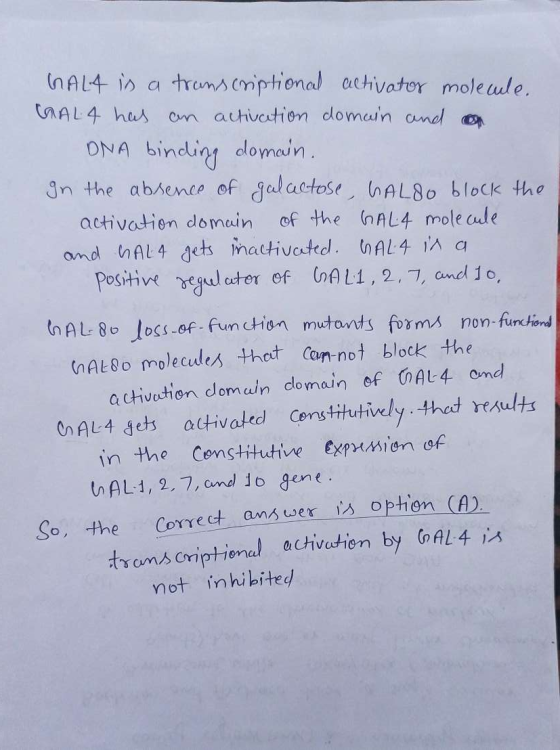
GAL80 loss-of-function mutants express the GAL1, 2, 7, 10 genes constitutively in the absence of galactose)...
Answer all questions and explain in detail. 1) GAL80 loss-of-function mutants express GAL1, 2, 7, 10,...
Answer all questions and explain in detail. 1) GAL80 loss-of-function mutants express GAL1, 2, 7, 10, genes constitutively (in the absence of galactose) because a transcriptional activation by GAL4 is not inhibited b GAL80 is not present to block GAL4 DNA-binding c GAL80 cannot respond to GAL3 signaling d A and B e B and C 2) Gal80-; GAL4- double mutants express the GAL1, 7, 10 genes a only In the presence of galactose b only in the absence of...
GAL4 null mutants express the GAL1, 2, 7 & 10 genes A. never whether galactose is...
 GAL4 null mutants express the GAL1, 2, 7 & 10 genes A. never whether galactose is absent or present B. constitutively whether galactose is absent or present C. only when galactose is present D. only when lactose is present E. only when galactose is absent 17 58
3. Assume presence of galactose and absence of glucose, and that mutants are loss of function....
3. Assume presence of galactose and absence of glucose, and that mutants are loss of function. In a Gal 80 mutant, gal genes will/will not _________________ be expressed. In a gal4 mutant, gal genes will/will not ________________ be expressed. In a gal80/gal4 double mutant, the gal genes will/will not _________________ be expressed. If a scientist replaced the activation domain of gal4 with a histone deactylase domain, the gal genes will/will not ______________ be expressed.
The yeast Saccharomyces cerevisiae can grow as haploid or diploid cells. You have two haploid yeast...
The yeast Saccharomyces cerevisiae can grow as haploid or diploid cells. You have two haploid yeast strains that each carry recessive mutations that affect regulation of the genes required for galactose metabolism. One strain has a deletion of the region of the genome on chromosome II that lies between the GAL1 and GAL10 genes (deltaUAS). The other strain carries a mutant allele of the GAL80 gene on chromosome XIII that produces no functional GAL80 protein. Which of the following correctly...
Yet, all the cells in your body contain the same genes (and same alleles). The difference...
 Yet, all the cells in your body contain the same
genes (and same alleles). The difference across cell types
is that genes get selectively expressed (turned on or off)
based on the proteins needed for cellular function given their
environment.
Select which statement explains the reason why hair does not
normally grow on your muscle cells.
a.
Muscle cells have the gene for keratin, but do not express
it
b.
Muscle cells do not have the gene for keratin and...
Yet, all the cells in your body contain the same
genes (and same alleles). The difference across cell types
is that genes get selectively expressed (turned on or off)
based on the proteins needed for cellular function given their
environment.
Select which statement explains the reason why hair does not
normally grow on your muscle cells.
a.
Muscle cells have the gene for keratin, but do not express
it
b.
Muscle cells do not have the gene for keratin and...
Question 10-12 10. During the mating process, yeast cells respond to pheromones secreted by other yeast...
 Question 10-12
10. During the mating process, yeast cells respond to pheromones secreted by other yeast cells. These pheromones bind GPCRs on the surface of the responding cell and lead to the activation of proteins inside the cell. When a wild-type yeast cell senses the pheromone, its physiology changes in preparation for mating: the cell stops growing until it finds a mating partner. If yeast cells do not undergo the appropriate response after sensing a pheromone, they are considered sterile....
Question 10-12
10. During the mating process, yeast cells respond to pheromones secreted by other yeast cells. These pheromones bind GPCRs on the surface of the responding cell and lead to the activation of proteins inside the cell. When a wild-type yeast cell senses the pheromone, its physiology changes in preparation for mating: the cell stops growing until it finds a mating partner. If yeast cells do not undergo the appropriate response after sensing a pheromone, they are considered sterile....
 GAL4 null mutants express the GAL1, 2, 7 & 10 genes A. never whether galactose is absent or present B. constitutively whether galactose is absent or present C. only when galactose is present D. only when lactose is present E. only when galactose is absent 17 58
 Yet, all the cells in your body contain the same
genes (and same alleles). The difference across cell types
is that genes get selectively expressed (turned on or off)
based on the proteins needed for cellular function given their
environment.
Select which statement explains the reason why hair does not
normally grow on your muscle cells.
a.
Muscle cells have the gene for keratin, but do not express
it
b.
Muscle cells do not have the gene for keratin and...
Yet, all the cells in your body contain the same
genes (and same alleles). The difference across cell types
is that genes get selectively expressed (turned on or off)
based on the proteins needed for cellular function given their
environment.
Select which statement explains the reason why hair does not
normally grow on your muscle cells.
a.
Muscle cells have the gene for keratin, but do not express
it
b.
Muscle cells do not have the gene for keratin and...
 Question 10-12
10. During the mating process, yeast cells respond to pheromones secreted by other yeast cells. These pheromones bind GPCRs on the surface of the responding cell and lead to the activation of proteins inside the cell. When a wild-type yeast cell senses the pheromone, its physiology changes in preparation for mating: the cell stops growing until it finds a mating partner. If yeast cells do not undergo the appropriate response after sensing a pheromone, they are considered sterile....
Question 10-12
10. During the mating process, yeast cells respond to pheromones secreted by other yeast cells. These pheromones bind GPCRs on the surface of the responding cell and lead to the activation of proteins inside the cell. When a wild-type yeast cell senses the pheromone, its physiology changes in preparation for mating: the cell stops growing until it finds a mating partner. If yeast cells do not undergo the appropriate response after sensing a pheromone, they are considered sterile....
Most questions answered within 3 hours.
-
Where is the error in this code sequence?
String s1 = "Hello";
String s2 = "ello";...
asked 10 months ago -
Financial data for Joel de Paris, Inc., for last year
follow:
Joel de Paris, Inc.
Balance...
asked 10 months ago -
Consider this reaction:
Al2(SO4)3 (aq)+ BaCl3
(aq) Al2Cl6 (aq)- +
3BaSO4(s) . What is the...
asked 10 months ago -
Suppose that Savneet is considering increasing her
recent random sample from 20 car rentals to 40...
asked 10 months ago -
Trucks arrive at an unloading terminal at an average rate of 120
per hour.
Trucks arrive...
asked 10 months ago -
Why are methanol and ethanol completely soluble in water while
octanol is not very little soluble....
asked 10 months ago -
A facilities manager at a university reads in a research report
that the mean amount of...
asked 10 months ago -
When the CuSO4 is rehydrated by adding water to the anhydrous
compound, is this an endothermic...
asked 10 months ago -
A ray of sunlight is passing from diamond into crown glass; the
angle of incidence is...
asked 10 months ago -
A block of mass 0.249 kg is placed on top of a light, vertical
spring of...
asked 10 months ago -
how do the kidneys compensate in the presences of acidosis
a) trigger hyperventilate
b) reserve acid...
asked 10 months ago -
Question 501 pts
The rental rate of capital to the firm increases. Which of the
following...
asked 10 months ago