


Homework Answers
Add Answer to:
QUESTION 1 The following finite state machine is designed to produce an output which toggles continuously...
Given that option 2 is correct for question 1, answer the proceeding questions.. QUESTION 1 The...
 Given that option 2 is correct for question 1, answer the
proceeding questions..
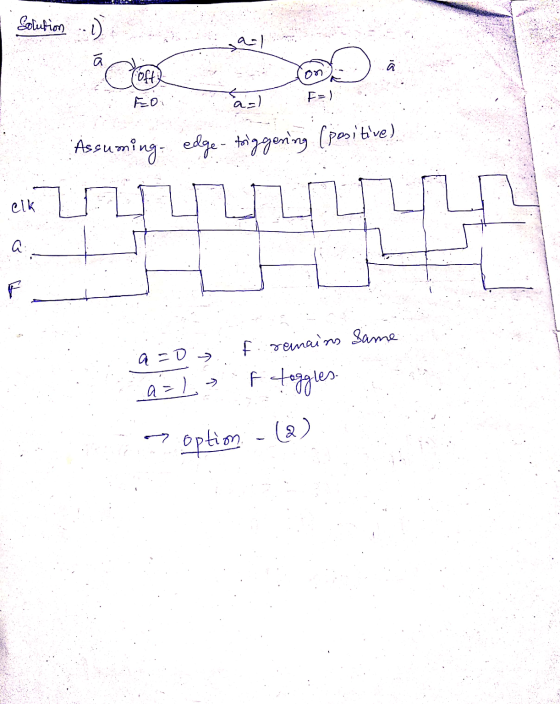
QUESTION 1 The following finite state machine is designed to produce an output which toggles continuously while its input a is high. A simple circuit implements this finite state machine using the controller model, but no additional hardware. a Off On F=0 F=1 Assuming that circuit starts off with F=0, as shown, fill out the timing diagram for its operation below. clk a F clk un a...
Given that option 2 is correct for question 1, answer the
proceeding questions..
QUESTION 1 The following finite state machine is designed to produce an output which toggles continuously while its input a is high. A simple circuit implements this finite state machine using the controller model, but no additional hardware. a Off On F=0 F=1 Assuming that circuit starts off with F=0, as shown, fill out the timing diagram for its operation below. clk a F clk un a...
Option 3 was incorrect. QUESTION 4 Suppose the same finite state machine was re-implemented with the...
 Option 3 was incorrect.
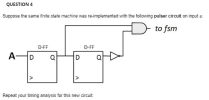
QUESTION 4 Suppose the same finite state machine was re-implemented with the following pulser circuit on input a: to fsm D-FF D-FF A- D D Repeat your timing analysis for this new circuit: clk a F clk 0 a F clk 0 a F
Option 3 was incorrect.
QUESTION 4 Suppose the same finite state machine was re-implemented with the following pulser circuit on input a: to fsm D-FF D-FF A- D D Repeat your timing analysis for this new circuit: clk a F clk 0 a F clk 0 a F
QUESTION 1 The following dice roll FSM is operated at a frequency of 1MHz, and features...
 QUESTION 1 The following dice roll FSM is operated at a frequency of 1MHz, and features a single with a single push-button input, b. Because human response time is much larger than the lus period of the system clock, any human press will result in b going high for a pseudo-random number of cycles. Since this FSM rapidly switches state when b=1, after the button is released the FSM will stop in a pseudo-random state. Side 1 Side 2 Side...
Table Q4.1 shows the state transition table for a finite state machine (FSM) with one input...
 Table Q4.1 shows the state transition table for a finite state
machine (FSM) with one input x, one output z and eight states.
(a) Copy the table of Table Q4.2 into your examination book and
determine the states and outputs for the input listed, assuming a
start current state of ‘1’. Determine what function the FSM is
performing.
(b) Using the implication chart method, determine the minimal
number of states. Show clearly your analysis.
(c) Draw the reduced state transition...
Table Q4.1 shows the state transition table for a finite state
machine (FSM) with one input x, one output z and eight states.
(a) Copy the table of Table Q4.2 into your examination book and
determine the states and outputs for the input listed, assuming a
start current state of ‘1’. Determine what function the FSM is
performing.
(b) Using the implication chart method, determine the minimal
number of states. Show clearly your analysis.
(c) Draw the reduced state transition...
Design a finite state machine with an input u. The state diagram do the FSM is...
 Design a finite state machine with an input u. The
state diagram do the FSM is given in the diagram below. Use only
D-Flipflops and NAND gates for your design.
So Sg s, s, s,
Design a finite state machine with an input u. The
state diagram do the FSM is given in the diagram below. Use only
D-Flipflops and NAND gates for your design.
So Sg s, s, s,
show work plz Consider the following finite state diagram. State 1 Output=1 State 0 Output=0 State...
 show work plz
Consider the following finite state diagram. State 1 Output=1 State 0 Output=0 State 2 Output=1 State 3 Output=0 The diagram has 4 states, 1 external input / (in additional to the CLK input), and 1 output bit Y. State 0 is represented by memory bits Qi Qo=00, State 1 is represented by memory bits Q.Qo=01, State 2 is represented by memory bits Q.Qo = 10, and State 3 is represented by memory bits Q.Qo = 11. The...
show work plz
Consider the following finite state diagram. State 1 Output=1 State 0 Output=0 State 2 Output=1 State 3 Output=0 The diagram has 4 states, 1 external input / (in additional to the CLK input), and 1 output bit Y. State 0 is represented by memory bits Qi Qo=00, State 1 is represented by memory bits Q.Qo=01, State 2 is represented by memory bits Q.Qo = 10, and State 3 is represented by memory bits Q.Qo = 11. The...
3. Finite State Machine. Using a ROM based finite state machine (FSM), design a bi-directional repetitive...
 3. Finite State Machine. Using a ROM based finite state machine (FSM), design a bi-directional repetitive 3-bit modulo-6 (0,1,2,3,4,5) counter (see Table 3). The design has one input named Dir and three outputs named B2, B1 and BO. The outputs (B2, B1 and BO) are dependent upon being in the present state only. After each clock pulse, when Dir is at logic "O', the outputs (B2, B1, BO) step through the count sequence in following order:- 0,1,2,3,4,5. After each clock...
Problem: Design a clocked synchronous state machine with two inputs A, and B, and a single...
 Problem: Design a clocked synchronous state machine with two inputs A, and B, and a single output Z that is 1 is: .A had the same value at each of the two previous clock ticks, or B has been 1 since the last time that the first condition was true. In-Lab 1. 2. 3. 4. For the finite state machine (FSM), identify the minimum number of states required Draw the state transition diagram Complete the state transition table Derive the...
Design and implement a MEALY finite state machine that would detect a sequence 0110 in the...
Design and implement a MEALY finite state machine that would detect a sequence 0110 in the input stream. Overlapping sequences are allowed. A) draw state diagram You would need no more than 4 states to implement the logic B) tabulate the state transition table C) show the implementation of the FSM using D-flip-flops
QUESTION 3 The following synchronizer circuit is composed of flip-flops with a setup time of 2...
 QUESTION 3 The following synchronizer circuit is composed of flip-flops with a setup time of 2 ns, a hold time of Ons, and a clock- to-Q delay of Ons B D-FF D-FF A Q S CLK Given the delays above, analyze the circuit above, and fill out the timing diagram below clk A B S clk A O B S. clk B S. QUESTION 4 Analyze the timing diagram from the previous problem. Assuming that A always changes at a...
 Given that option 2 is correct for question 1, answer the
proceeding questions..
QUESTION 1 The following finite state machine is designed to produce an output which toggles continuously while its input a is high. A simple circuit implements this finite state machine using the controller model, but no additional hardware. a Off On F=0 F=1 Assuming that circuit starts off with F=0, as shown, fill out the timing diagram for its operation below. clk a F clk un a...
Given that option 2 is correct for question 1, answer the
proceeding questions..
QUESTION 1 The following finite state machine is designed to produce an output which toggles continuously while its input a is high. A simple circuit implements this finite state machine using the controller model, but no additional hardware. a Off On F=0 F=1 Assuming that circuit starts off with F=0, as shown, fill out the timing diagram for its operation below. clk a F clk un a...
 Option 3 was incorrect.
QUESTION 4 Suppose the same finite state machine was re-implemented with the following pulser circuit on input a: to fsm D-FF D-FF A- D D Repeat your timing analysis for this new circuit: clk a F clk 0 a F clk 0 a F
Option 3 was incorrect.
QUESTION 4 Suppose the same finite state machine was re-implemented with the following pulser circuit on input a: to fsm D-FF D-FF A- D D Repeat your timing analysis for this new circuit: clk a F clk 0 a F clk 0 a F
 QUESTION 1 The following dice roll FSM is operated at a frequency of 1MHz, and features a single with a single push-button input, b. Because human response time is much larger than the lus period of the system clock, any human press will result in b going high for a pseudo-random number of cycles. Since this FSM rapidly switches state when b=1, after the button is released the FSM will stop in a pseudo-random state. Side 1 Side 2 Side...
 Table Q4.1 shows the state transition table for a finite state
machine (FSM) with one input x, one output z and eight states.
(a) Copy the table of Table Q4.2 into your examination book and
determine the states and outputs for the input listed, assuming a
start current state of ‘1’. Determine what function the FSM is
performing.
(b) Using the implication chart method, determine the minimal
number of states. Show clearly your analysis.
(c) Draw the reduced state transition...
Table Q4.1 shows the state transition table for a finite state
machine (FSM) with one input x, one output z and eight states.
(a) Copy the table of Table Q4.2 into your examination book and
determine the states and outputs for the input listed, assuming a
start current state of ‘1’. Determine what function the FSM is
performing.
(b) Using the implication chart method, determine the minimal
number of states. Show clearly your analysis.
(c) Draw the reduced state transition...
 Design a finite state machine with an input u. The
state diagram do the FSM is given in the diagram below. Use only
D-Flipflops and NAND gates for your design.
So Sg s, s, s,
Design a finite state machine with an input u. The
state diagram do the FSM is given in the diagram below. Use only
D-Flipflops and NAND gates for your design.
So Sg s, s, s,
 show work plz
Consider the following finite state diagram. State 1 Output=1 State 0 Output=0 State 2 Output=1 State 3 Output=0 The diagram has 4 states, 1 external input / (in additional to the CLK input), and 1 output bit Y. State 0 is represented by memory bits Qi Qo=00, State 1 is represented by memory bits Q.Qo=01, State 2 is represented by memory bits Q.Qo = 10, and State 3 is represented by memory bits Q.Qo = 11. The...
show work plz
Consider the following finite state diagram. State 1 Output=1 State 0 Output=0 State 2 Output=1 State 3 Output=0 The diagram has 4 states, 1 external input / (in additional to the CLK input), and 1 output bit Y. State 0 is represented by memory bits Qi Qo=00, State 1 is represented by memory bits Q.Qo=01, State 2 is represented by memory bits Q.Qo = 10, and State 3 is represented by memory bits Q.Qo = 11. The...
 3. Finite State Machine. Using a ROM based finite state machine (FSM), design a bi-directional repetitive 3-bit modulo-6 (0,1,2,3,4,5) counter (see Table 3). The design has one input named Dir and three outputs named B2, B1 and BO. The outputs (B2, B1 and BO) are dependent upon being in the present state only. After each clock pulse, when Dir is at logic "O', the outputs (B2, B1, BO) step through the count sequence in following order:- 0,1,2,3,4,5. After each clock...
 Problem: Design a clocked synchronous state machine with two inputs A, and B, and a single output Z that is 1 is: .A had the same value at each of the two previous clock ticks, or B has been 1 since the last time that the first condition was true. In-Lab 1. 2. 3. 4. For the finite state machine (FSM), identify the minimum number of states required Draw the state transition diagram Complete the state transition table Derive the...
 QUESTION 3 The following synchronizer circuit is composed of flip-flops with a setup time of 2 ns, a hold time of Ons, and a clock- to-Q delay of Ons B D-FF D-FF A Q S CLK Given the delays above, analyze the circuit above, and fill out the timing diagram below clk A B S clk A O B S. clk B S. QUESTION 4 Analyze the timing diagram from the previous problem. Assuming that A always changes at a...
Most questions answered within 3 hours.
-
Where is the error in this code sequence?
String s1 = "Hello";
String s2 = "ello";...
asked 10 months ago -
Financial data for Joel de Paris, Inc., for last year
follow:
Joel de Paris, Inc.
Balance...
asked 10 months ago -
Consider this reaction:
Al2(SO4)3 (aq)+ BaCl3
(aq) Al2Cl6 (aq)- +
3BaSO4(s) . What is the...
asked 10 months ago -
Suppose that Savneet is considering increasing her
recent random sample from 20 car rentals to 40...
asked 10 months ago -
Trucks arrive at an unloading terminal at an average rate of 120
per hour.
Trucks arrive...
asked 10 months ago -
Why are methanol and ethanol completely soluble in water while
octanol is not very little soluble....
asked 10 months ago -
A facilities manager at a university reads in a research report
that the mean amount of...
asked 10 months ago -
When the CuSO4 is rehydrated by adding water to the anhydrous
compound, is this an endothermic...
asked 10 months ago -
A ray of sunlight is passing from diamond into crown glass; the
angle of incidence is...
asked 10 months ago -
A block of mass 0.249 kg is placed on top of a light, vertical
spring of...
asked 10 months ago -
how do the kidneys compensate in the presences of acidosis
a) trigger hyperventilate
b) reserve acid...
asked 10 months ago -
Question 501 pts
The rental rate of capital to the firm increases. Which of the
following...
asked 10 months ago