An electron moves at 2.50*106 m/s through a region inwhich there is a magnetic field of...
Homework Answers
The concepts required to solve the given problem are magnetic field and magnetic force.
First calculate the largest and smallest possible magnitudes of the acceleration of the electrons due to the magnetic field and then the angle between the electron velocity and the magnetic field can be calculated.
Magnetic field is defined as the region around the permanent magnet where the effects of magnetic force can be experienced. Magnetic fields are produced by moving charges or current flowing in a conductor.
The SI unit of magnetic field is Tesla.
The magnitude of magnetic field is calculated by using the magnetic parts of the Lorentz force, which is given as follows:

Here, q is the charge, v is the velocity of the moving charge, and B is the magnitude of magnetic field.
(a)
The magnetic force exists on the electron is,
Here, q is the charge, v is the velocity of the moving charge, and B is the magnitude of magnetic field.
Rewrite the above expression as follows:

Here,  is the angle between velocity vector and magnetic field.
Substitute  for
for  and
and  for
for  in the expression as follows:


Here, amax is the maximum acceleration and m is the mass of electron. Maximum acceleration occurs when the force acting on the charge particle is maximum. When value of  is equal to 1.
Substitute  for q,
  for v,
  for B, and
  for m in expression as follows:
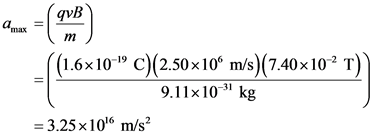
(b)
The magnitude of new acceleration is,

Here, q is the charge, v is the velocity of the moving charge, m is the mass of electron, a’ is the actual acceleration,  is the angle between velocity vector and magnetic field, and B is the magnitude of magnetic field
Substitute  for
for  and
and  for
for  in above expression:
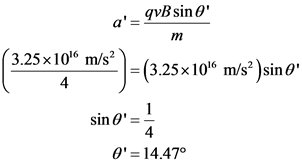
The magnitude of maximum and minimum acceleration is  and 0 m/s2.
The angle between the electron velocity and the magnetic field is  .
.
Add Answer to:
An electron moves at 2.50*106 m/s through a region
inwhich there is a magnetic field of...
An electron moves at 2.60×10⁶ m/s through a region in which there is a magnetic field...
An electron moves at 2.60×10⁶ m/s through a region in which there is a magnetic field of unspecified direction and magnitude 7.00×10⁻² T . Part A What is the largest possible magnitude of the acceleration of the electron due to the magnetic field? Part B What is the smallest possible magnitude of the acceleration of the electron due to the magnetic field? Part C If the actual acceleration of the electron is 14 of the largest magnitude in part (a),...
An electron moves at 3.00×10⁶ m/s through a region in which there is a magnetic field...
An electron moves at 3.00×10⁶ m/s through a region in which there is a magnetic field of unspecified direction and magnitude 7.90×10⁻² T . a- What is the largest possible magnitude of the acceleration of the electron due to the magnetic field? b- What is the smallest possible magnitude of the acceleration of the electron due to the magnetic field? c- If the actual acceleration of the electron is 14 of the largest magnitude in part (a), what is the...
PART A: An electron moves at 3.00×10⁶ m/s through a region in which there is a...
PART A: An electron moves at 3.00×10⁶ m/s through a region in which there is a magnetic field of unspecified direction and magnitude 7.50×10⁻² T . A1: An electron moves at 3.00×10⁶ m/s through a region in which there is a magnetic field of unspecified direction and magnitude 7.50×10⁻² T . A2: What is the smallest possible magnitude of the force on the electron due to the magnetic field? Express your answer in newtons to the nearest integer. A3: If...
Exercise 27.6 What is the largest possible magnitude of the acceleration of the electron due to...
 Exercise 27.6 What is the largest possible magnitude of the acceleration of the electron due to the magnetic field? An electron moves at 2.80*106 m/s through a region in which there is a magnetic field of unspecified direction and magnitude 7.60×10⁻² T m/s? Submit My Answers Give Up Part B What is the smallest possible magnitude of the acceleration of the electron due to the magnetic field? a" m/s Submit My Answers Give Up Part C "the actu" acceleration of...
An electron moves through a region with a uniform magnetic field of unknown magnitude directed in...
An electron moves through a region with a uniform magnetic field of unknown magnitude directed in the +y direction At the instant that the electron is moving in the +z direction with a velocity of 2.86e6 m/s, it experiences a magnetic force of 1.24 pN in the +x direction. Calculate the magnitude of the magnetic field
A charged particle moves along the x-axis through a region with a uniform magnetic field that...
A charged particle moves along the x-axis through a region with a uniform magnetic field that is oriented to lie in the x-y plane. Part a) Assume that the particle has a net charge of +669 μC and is moving with a velocity of 464 m/s in the +x direction at a particular instant. In that region of space, there is a uniform magnetic field of 1.91T directed in the x-y plane at an angle of +29.8 ∘ relative to...
A proton moving at 7.60 106 m/s through a magnetic field of magnitude 1.76 T experiences...
A proton moving at 7.60 106 m/s through a magnetic field of magnitude 1.76 T experiences a magnetic force of magnitude 7.40 10-13 N. What is the angle between the proton's velocity and the field? (Enter both possible answers from smallest to largest. Enter only positive values between 0 and 360.) smaller value ° larger value °
An electron in a TV camera tube is moving at 5.20×10⁶ m/s in a magnetic field...
An electron in a TV camera tube is moving at 5.20×10⁶ m/s in a magnetic field of strength 57 mT. Without knowing the direction of the field, what can you say about the greatest and least magnitude of the force acting on the electron due to the field? a) Maximum force? b) Minimum force? c) At one point the acceleration of the electron is 4.316×10¹⁶ m/s2. What is the angle between the electron velocity and the magnetic field? (deg)
A proton moving at 4.50 106 m/s through a magnetic field of magnitude 1.72 T experiences...
A proton moving at 4.50 106 m/s through a magnetic field of magnitude 1.72 T experiences a magnetic force of magnitude 8.80 10-13 N. What is the angle between the proton's velocity and the field? (Enter both possible answers from smallest to largest.) ? ° ? °
A proton moving at 4.50 106 m/s through a magnetic field of magnitude 1.80 T experiences...
A proton moving at 4.50 106 m/s through a magnetic field of magnitude 1.80 T experiences a magnetic force of magnitude 7.80 10-13 N. What is the angle between the proton's velocity and the field? (Enter both possible answers from smallest to largest.) a. in ° b. in °
 Exercise 27.6 What is the largest possible magnitude of the acceleration of the electron due to the magnetic field? An electron moves at 2.80*106 m/s through a region in which there is a magnetic field of unspecified direction and magnitude 7.60×10⁻² T m/s? Submit My Answers Give Up Part B What is the smallest possible magnitude of the acceleration of the electron due to the magnetic field? a" m/s Submit My Answers Give Up Part C "the actu" acceleration of...
Most questions answered within 3 hours.
-
Where is the error in this code sequence?
String s1 = "Hello";
String s2 = "ello";...
asked 10 months ago -
Financial data for Joel de Paris, Inc., for last year
follow:
Joel de Paris, Inc.
Balance...
asked 10 months ago -
Consider this reaction:
Al2(SO4)3 (aq)+ BaCl3
(aq) Al2Cl6 (aq)- +
3BaSO4(s) . What is the...
asked 10 months ago -
Suppose that Savneet is considering increasing her
recent random sample from 20 car rentals to 40...
asked 10 months ago -
Trucks arrive at an unloading terminal at an average rate of 120
per hour.
Trucks arrive...
asked 10 months ago -
Why are methanol and ethanol completely soluble in water while
octanol is not very little soluble....
asked 10 months ago -
A facilities manager at a university reads in a research report
that the mean amount of...
asked 10 months ago -
When the CuSO4 is rehydrated by adding water to the anhydrous
compound, is this an endothermic...
asked 10 months ago -
A ray of sunlight is passing from diamond into crown glass; the
angle of incidence is...
asked 10 months ago -
A block of mass 0.249 kg is placed on top of a light, vertical
spring of...
asked 10 months ago -
how do the kidneys compensate in the presences of acidosis
a) trigger hyperventilate
b) reserve acid...
asked 10 months ago -
Question 501 pts
The rental rate of capital to the firm increases. Which of the
following...
asked 10 months ago