

Homework Answers
Let A: Rains B: Umbrella and C: fashion
If it rains,then I take an Umbrella ==> A B
If I take an Umbrella,then I am not in fashion ==> B ~C
-----------------------------------------------------------------------------------
if it rains then I am not in fashion ==>A ~C
A B
B
~C
A
~C
Take A B
B
~C
(~A B)
(~B
~C )
( ~A B
~B )
( ~A
B
~C )
( ~A F )
( ~A
B
~C ) { We know that (
B
~B ) = F }
( ~A ) ( ~A
B
~C )
( ~A ~A
B
~C )
(~A B
~C ) { We Know that ~A
~A = ~A
}
~A B
~C { We Know that (
B
~B ) = F }
A ( B
~C )
if it rains then I take an Umbrella AND I am not in fashion
The Given argument is Invalid
TRuth Table:
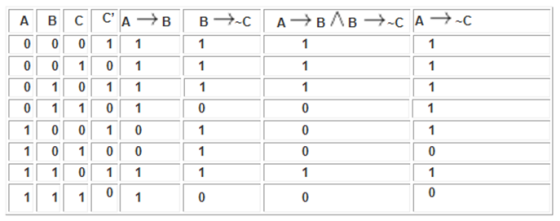
If we Observe the last two columns in above Truth table they are having different Truth values
So, The Given argument is Invalid
Add Answer to:
Write the following in symbolic notation (be sure to provide the dictionary) and determine whether the...
Write each of the parts A-C in symbolic form, and then decide whether it is a...
Write each of the parts A-C in symbolic form, and then decide whether it is a tautology or not. A. If roses are not red or violets are not blue, then it’s not true that roses are red and violets are blue. B. For me to bring my umbrella it’s sufficient that it rain. Therefore if it does not rain I will not bring my umbrella. C. I am either smart or athletic, and I am athletic, so I must...
a) Translate the argument into symbolic form b) Use a truth table to determine whether the...
 a) Translate the argument into symbolic form b) Use a truth table to determine whether the argumentis valid or invalid. (onore differences in past, present and future tense) If there is an ice storm, the roads are dangerous There is an ice storm -The roads are dangerous a) Leto be "There is an ice storm" and let be "The roads are dangerous." What is the argument in symbolic form?
QUESTION 2 Determine whether the following argument is valid using the long or short truth-table method....
 QUESTION 2 Determine whether the following argument is valid using the long or short truth-table method. Premise 1 If Angela is hungry, she eats pizza. Premise 2 Angela is not eating pizza. Therefore, Angela is not hungry. The above argument is a) valid b) invalid
QUESTION 3 Determine whether the following argument is valid using the long or short truth-table method....
 QUESTION 3 Determine whether the following argument is valid using the long or short truth-table method. P1 If Mary is hungry, she eats pizza. P2 If Bill is thirsty, he drinks water. P3 Mary is not eating pizza OR Bill is not drinking water. Therefore, Bill is not thirsty. The above argument is a) valid b) invalid
Valid and invalid arguments expressed in logical notation. Indicate whether the argument is valid or invalid. Prove usin...
Valid and invalid arguments expressed in logical notation. Indicate whether the argument is valid or invalid. Prove using a truth table. • p → q q → p —— ∴¬q • p → q ¬p —— ∴¬q
Question Number 1. Express the following statements symbolically. Use letters that stand for non-negated statements, and indicated what the letters represent. a) If global warming continues and Congre...
Question Number 1. Express the following statements symbolically. Use letters that stand for non-negated statements, and indicated what the letters represent. a) If global warming continues and Congress does not act, preventive measures will be needed or some coastal areas will eventually flood. b) Not having feathers is necessary for being human. Question Number 2. Write the following argument in symbolic form, choosing simple statements that are not negated. (Say what each letter represents). If I am at the beach,...
3. Convert Peter Griffin's argument into logical symbols, then use a truth table to determine whether...
 3. Convert Peter Griffin's argument into logical symbols, then use a truth table to determine whether or not the argument is valid. (Be sure to clearly indicate what each statement variable represents.) KEROSEN Kerosene is fuel, Brian. Red Bull is fuel. Kerosene is Red Bull
QUESTION 3 Symbolize the following argument using the variables p, q, and r. Then construct a...
 QUESTION 3 Symbolize the following argument using the variables p, q, and r. Then construct a complete truth table to show whether or not the argument is valid. Use 1 for T(true) and 0 for F(false). Valid or Invalid? Why? Prove. Explain what your truth table shows. 10 points Total: 3 points for correct symbolic form, 4 points for valid/invalid and reason, 3 points for correct truth table. If Max studies hard, then Max gets an 'A' or Max gets...
please answer just like the picture Exercise 4.1 For each of the following arguments, determine whether...
 please answer just like the picture
Exercise 4.1 For each of the following arguments, determine whether it is valid or invalid and indicate the argument pattern. *1. If the Pilgrims built that wall, there would be archeological evidence of that. But there is no such evidence. So the Pilgrims did not build that wall. 2. If the butler didn't kill the master, then the maid did. The butler didn't kill him. So the maid killed him. 3. Either John drove...
please answer just like the picture
Exercise 4.1 For each of the following arguments, determine whether it is valid or invalid and indicate the argument pattern. *1. If the Pilgrims built that wall, there would be archeological evidence of that. But there is no such evidence. So the Pilgrims did not build that wall. 2. If the butler didn't kill the master, then the maid did. The butler didn't kill him. So the maid killed him. 3. Either John drove...
1. Determine whether or not the following argument is valid or invalid. Show your work, clearly...
1. Determine whether or not the following argument is valid or invalid. Show your work, clearly explaining how you determined its validity or invalidity. You may justify your answer either by use of a truth table or by citing or known valid argument forms or fallacies. Justifications that appeal to common sense, which are based on opinion or perceptions, or which otherwise do not analyse the underlying logic will not be accepted. THE ARGUMENT: If you have just cause why...
 a) Translate the argument into symbolic form b) Use a truth table to determine whether the argumentis valid or invalid. (onore differences in past, present and future tense) If there is an ice storm, the roads are dangerous There is an ice storm -The roads are dangerous a) Leto be "There is an ice storm" and let be "The roads are dangerous." What is the argument in symbolic form?
 QUESTION 2 Determine whether the following argument is valid using the long or short truth-table method. Premise 1 If Angela is hungry, she eats pizza. Premise 2 Angela is not eating pizza. Therefore, Angela is not hungry. The above argument is a) valid b) invalid
 QUESTION 3 Determine whether the following argument is valid using the long or short truth-table method. P1 If Mary is hungry, she eats pizza. P2 If Bill is thirsty, he drinks water. P3 Mary is not eating pizza OR Bill is not drinking water. Therefore, Bill is not thirsty. The above argument is a) valid b) invalid
 3. Convert Peter Griffin's argument into logical symbols, then use a truth table to determine whether or not the argument is valid. (Be sure to clearly indicate what each statement variable represents.) KEROSEN Kerosene is fuel, Brian. Red Bull is fuel. Kerosene is Red Bull
 QUESTION 3 Symbolize the following argument using the variables p, q, and r. Then construct a complete truth table to show whether or not the argument is valid. Use 1 for T(true) and 0 for F(false). Valid or Invalid? Why? Prove. Explain what your truth table shows. 10 points Total: 3 points for correct symbolic form, 4 points for valid/invalid and reason, 3 points for correct truth table. If Max studies hard, then Max gets an 'A' or Max gets...
 please answer just like the picture
Exercise 4.1 For each of the following arguments, determine whether it is valid or invalid and indicate the argument pattern. *1. If the Pilgrims built that wall, there would be archeological evidence of that. But there is no such evidence. So the Pilgrims did not build that wall. 2. If the butler didn't kill the master, then the maid did. The butler didn't kill him. So the maid killed him. 3. Either John drove...
please answer just like the picture
Exercise 4.1 For each of the following arguments, determine whether it is valid or invalid and indicate the argument pattern. *1. If the Pilgrims built that wall, there would be archeological evidence of that. But there is no such evidence. So the Pilgrims did not build that wall. 2. If the butler didn't kill the master, then the maid did. The butler didn't kill him. So the maid killed him. 3. Either John drove...
Most questions answered within 3 hours.
-
Where is the error in this code sequence?
String s1 = "Hello";
String s2 = "ello";...
asked 11 months ago -
Financial data for Joel de Paris, Inc., for last year
follow:
Joel de Paris, Inc.
Balance...
asked 11 months ago -
Consider this reaction:
Al2(SO4)3 (aq)+ BaCl3
(aq) Al2Cl6 (aq)- +
3BaSO4(s) . What is the...
asked 11 months ago -
Suppose that Savneet is considering increasing her
recent random sample from 20 car rentals to 40...
asked 11 months ago -
Trucks arrive at an unloading terminal at an average rate of 120
per hour.
Trucks arrive...
asked 11 months ago -
Why are methanol and ethanol completely soluble in water while
octanol is not very little soluble....
asked 11 months ago -
A facilities manager at a university reads in a research report
that the mean amount of...
asked 11 months ago -
When the CuSO4 is rehydrated by adding water to the anhydrous
compound, is this an endothermic...
asked 11 months ago -
A ray of sunlight is passing from diamond into crown glass; the
angle of incidence is...
asked 11 months ago -
A block of mass 0.249 kg is placed on top of a light, vertical
spring of...
asked 11 months ago -
how do the kidneys compensate in the presences of acidosis
a) trigger hyperventilate
b) reserve acid...
asked 11 months ago -
Question 501 pts
The rental rate of capital to the firm increases. Which of the
following...
asked 11 months ago