Provide an example of a plant adaptation to minimize variation in leaf temperature.
Provide an example of a plant adaptation to minimize variation in leaf temperature.
Homework Answers
In areas that receive frequent snow and cold weather such as in the Arctic, plants can grow close to the ground, or grow in shapes that is responsible to help them shed heavy snow very easily. In addition, plants may hold onto dead leaves for insulation, or they can use deep snow as like a blanket to protect against the cold. Some of the evergreen plants have a special valve in their cells. This valve can automatically seals off individual frozen cells to eradicate a chain reaction of freezing.
Add Answer to:
Provide an example of a plant adaptation to minimize variation
in leaf temperature.
Total leaf conductance was measured on two plants. One plant was in Los Angeles where the...
Total leaf conductance was measured on two plants. One plant was in Los Angeles where the air temperature was 36 °C and relative humidity was 30%. The other plant was in Miami at an air temperature of 36 ° C and a relative humidity of 85%. If the leaf temperature was 38 ° C and if total leaf conductance was 400 mmol m-2 s-1, and assuming standard atmospheric pressure at sea level, calculate the transpiration rates (in units of mmol...
1. Compare the six processes of cellular adaptation and provide a clinical example of each one....
1. Compare the six processes of cellular adaptation and provide a clinical example of each one. 2. Discuss the water and fluid movements between plasma and interstitial fluid, including the topics of capillary hydrostatic pressure, capillary oncotic pressure, interstitial hydrostatic pressure, interstitial oncotic pressure, net filtration and Starling force.
Provide an example of a hypothesis using the method of concomitant variation (other than lung disease...
Provide an example of a hypothesis using the method of concomitant variation (other than lung disease and cigarette smoking). Concomitant variation is the frequency of a disease varies according to the potency of a factor.
Give an example of an organism and its adaptation to an extreme environmental condition (for example,...
Give an example of an organism and its adaptation to an extreme environmental condition (for example, extreme cold, heat, low water or nutrient availability, disturbance to its habitat). For full credit, describe how the adaptation allows the organism to survive in those conditions.
Assume the range of pupil variation during adaptation of a normal eye is from 2.0 to...
Assume the range of pupil variation during adaptation of a normal eye is from 2.0 to 7.1 mm. What is the corresponding range of distances over which it can detect the separation of objects 5 cm apart? Assume an average wavelength of 550nm.
why is homologoy important for understanding trait variation? Provide an example of both morpholigical and moleculsr...
why is homologoy important for understanding trait variation? Provide an example of both morpholigical and moleculsr traits that shows homology ?
1 A. Select a specific example of how a plant responds to environmental stimuli (e.g. light,...
1 A. Select a specific example of how a plant responds to environmental stimuli (e.g. light, gravity, and even touch). B. Describe the mechanism by which this occurs including a description of the specialized cells involved. C. How is this response an adaptation for the plant? Provide evidence from the literature to support your answer. *Please don't use an answer that has already been provided by someone else.
Give an example for each from everyday life: Gate-Control Theory of Pain Sensory Adaptation Dark/light adaptation
Give an example for each from everyday life: Gate-Control Theory of Pain Sensory Adaptation Dark/light adaptation
Please provide supplementary statement with an example for each bulletin point. Leaf-cutter ants collect leaves from...
Please provide supplementary statement with an example for each bulletin point. Leaf-cutter ants collect leaves from plants in the rainforest with the purpose to__Feed___ a fungus that in return provides ______Nutrients___ to the ants. Supplementary statement: Many harmless species appear to mimic noxious ones. For instance, non-poisonous king snakes resemble poisonous coral snakes, and syrphid flies look like the more aggressive wasps. This evolutionary adaptation is specifically called _____Bateson mimicry_____________. Supplementary statement: After a bird survey of the forest along North...
Name one adaptation that Plant 'B' has for successful survival, reproduction, or dispersal on land that...
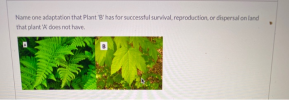 Name one adaptation that Plant 'B' has for successful survival, reproduction, or dispersal on land that plant 'A' does not have. B
 Name one adaptation that Plant 'B' has for successful survival, reproduction, or dispersal on land that plant 'A' does not have. B
Most questions answered within 3 hours.
-
Where is the error in this code sequence?
String s1 = "Hello";
String s2 = "ello";...
asked 10 months ago -
Financial data for Joel de Paris, Inc., for last year
follow:
Joel de Paris, Inc.
Balance...
asked 10 months ago -
Consider this reaction:
Al2(SO4)3 (aq)+ BaCl3
(aq) Al2Cl6 (aq)- +
3BaSO4(s) . What is the...
asked 10 months ago -
Suppose that Savneet is considering increasing her
recent random sample from 20 car rentals to 40...
asked 10 months ago -
Trucks arrive at an unloading terminal at an average rate of 120
per hour.
Trucks arrive...
asked 10 months ago -
Why are methanol and ethanol completely soluble in water while
octanol is not very little soluble....
asked 10 months ago -
A facilities manager at a university reads in a research report
that the mean amount of...
asked 10 months ago -
When the CuSO4 is rehydrated by adding water to the anhydrous
compound, is this an endothermic...
asked 10 months ago -
A ray of sunlight is passing from diamond into crown glass; the
angle of incidence is...
asked 10 months ago -
A block of mass 0.249 kg is placed on top of a light, vertical
spring of...
asked 10 months ago -
how do the kidneys compensate in the presences of acidosis
a) trigger hyperventilate
b) reserve acid...
asked 10 months ago -
Question 501 pts
The rental rate of capital to the firm increases. Which of the
following...
asked 10 months ago