
Homework Answers

Add Answer to:
A stream of protons (m = 1.67265 times 10^-27 kg; q = 1.602 times 10^-19 C)...
Consider the path of the proton (q = 1.602 × 10⁻¹⁹ C, m = 1.673 ×...
Consider the path of the proton (q = 1.602 × 10⁻¹⁹ C, m = 1.673 × 10⁻²⁷ kg) in a uniform electric and magnetic field. Both fields are in the z direction, B⃗ = B0k? and E⃗ = E0k?, where B0 = 55 mT and E0 = 180 V / m. At time t = 0, the proton moves at v⃗ = v0?ı, v0 = 150 km / s. Based on this information, what kind of orbit does the proton...
A beam of photons (q = +1.6 x 10^-19 C) is moving with various speeds in...
A beam of photons (q = +1.6 x 10^-19 C) is moving with various speeds in the positive x direction (to the right). It enters a region where there is a uniform magnetic field of magnitude 0.25T pointing in the negative z direction (into the page). a) The protons feel a force due to this magnetic field. Explain why, and indicate the direction of the force. b) Not all protons will feel a force of the same magnitude. Why? c)...
A proton with charge 1.602 x 10^-19 C moves at a speed of 300 m/s in...
A proton with charge 1.602 x 10^-19 C moves at a speed of 300 m/s in a magnetic field at an angle of 65 degrees. If the strength of the magnetic field is 19 T, what would be the magnitude of the force the charge experiences? 8.28 x 10^-16 N 13.78 x 10^-15 N 5.09 x 10^-14 N 7.75 x 10^-17 N An alpha particle travelling at 2155 m/s enters a magnetic field of strength 12.2 T. The particle is...
s. A proton, m 1.6726 x 1027 kg, q = 1.602 x 10¹⁹ [CI, moves in...
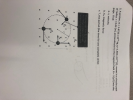 s. A proton, m 1.6726 x 1027 kg, q = 1.602 x 10¹⁹ [CI, moves in a circular path of radius r 0.03 [mi, perpendicular to the magnetic field B-5 [μη into the page. Find a. v, velocity b. Fa, magnetic force c. T, the period (the time for one complete circle) Bin
An electron (charge≈ 1.602 × 10⁻¹⁹ C; mass≈ 9.109 × 10⁻³¹ kg) moving at speed 200...
An electron (charge≈ 1.602 × 10⁻¹⁹ C; mass≈ 9.109 × 10⁻³¹ kg) moving at speed 200 m/s finds itself in a region of constant magnetic field. The magnetic field points perpendicular to the electron velocity and has strength 10−3 Tesla. (a) Find the magnitude of the magnetic force experienced by the electron. (b) The magnetic force causes cyclotron motion, so that the electron moves around a circular trajectory. Find the radius of the circular trajectory. (c) How long does it...
An electron (m_p = 9.1 times 10^-31 kg, q_p = -1.6 times 10^-19 C) travels at...
 An electron (m_p = 9.1 times 10^-31 kg, q_p = -1.6 times 10^-19 C) travels at 4 times 10^5 m/s in a direction perpendicular to a uniform 3.0 mT magnetic field. What is the diameter of its path? Two long straight wires each carrying a current of 200 A in the same directions are separated by a distance of 40 cm. Calculate the force on a 2m long section of wire. Is the force attractive or repulsive? An electron is...
(ex) The electric field is 1.20 times 10^6 N/C between plates 1 and 2, but is...
 (ex) The electric field is 1.20 times 10^6 N/C between plates 1 and 2, but is zero everywhere else in the figure. The magnetic field is 0.600 T everywhere in the figure. After passing straight through the region between the plates, aluminum ions enter the region with only a magnetic field, move in a circular path of radius 0.899 m there, and finally hit the photographic plate. a) The region between plates 1 and 2 is a "velocity selector": Only...
A. An α-particle has a charge of +2e and a mass of 6.64 × 10⁻²⁷ kg....
 A. An α-particle has a charge of +2e and a mass of 6.64
× 10-27 kg. It is accelerated from rest through a
potential difference that has a value of 1.67 × 10⁶ V
and then enters a uniform magnetic field whose magnitude is 2.49 T.
The α-particle moves perpendicular to the magnetic field at all
times. What is (a) the speed of the α-particle,
(b) the magnitude of the magnetic force on it, and
(c) the radius of its...
A. An α-particle has a charge of +2e and a mass of 6.64
× 10-27 kg. It is accelerated from rest through a
potential difference that has a value of 1.67 × 10⁶ V
and then enters a uniform magnetic field whose magnitude is 2.49 T.
The α-particle moves perpendicular to the magnetic field at all
times. What is (a) the speed of the α-particle,
(b) the magnitude of the magnetic force on it, and
(c) the radius of its...
A proton (m= 1.67e-27 kg) is accelerated from rest through a potential difference of 11.5 kV...
A proton (m= 1.67e-27 kg) is accelerated from rest through a potential difference of 11.5 kV before entering a velocity selector. If the B- field of the velocity selector is perpendicular to the velocity and the electric field (E) has a magnitude of 3.5e6 N/C, what is the required magnitude of the magnetic field (B) if the proton is undeflected?
PROBLEM 1 – A velocity selector (Wien Filter) has an electric field of magnitude 2470 N/C,...
PROBLEM 1 – A velocity selector (Wien Filter) has an electric field of magnitude 2470 N/C, directed vertically upward, and a horizontal magnetic field that is directed to the south. Charged particles, traveling east at a speed of 6.50 × 10³ m/s, enter the selector and are able to pass through undeflected. When a different charged particle with an electric charge of +4.00 × 10⁻¹² C enters the selector traveling east, the net force acting on it is 1.90 ×...
 s. A proton, m 1.6726 x 1027 kg, q = 1.602 x 10¹⁹ [CI, moves in a circular path of radius r 0.03 [mi, perpendicular to the magnetic field B-5 [μη into the page. Find a. v, velocity b. Fa, magnetic force c. T, the period (the time for one complete circle) Bin
 An electron (m_p = 9.1 times 10^-31 kg, q_p = -1.6 times 10^-19 C) travels at 4 times 10^5 m/s in a direction perpendicular to a uniform 3.0 mT magnetic field. What is the diameter of its path? Two long straight wires each carrying a current of 200 A in the same directions are separated by a distance of 40 cm. Calculate the force on a 2m long section of wire. Is the force attractive or repulsive? An electron is...
 (ex) The electric field is 1.20 times 10^6 N/C between plates 1 and 2, but is zero everywhere else in the figure. The magnetic field is 0.600 T everywhere in the figure. After passing straight through the region between the plates, aluminum ions enter the region with only a magnetic field, move in a circular path of radius 0.899 m there, and finally hit the photographic plate. a) The region between plates 1 and 2 is a "velocity selector": Only...
 A. An α-particle has a charge of +2e and a mass of 6.64
× 10-27 kg. It is accelerated from rest through a
potential difference that has a value of 1.67 × 10⁶ V
and then enters a uniform magnetic field whose magnitude is 2.49 T.
The α-particle moves perpendicular to the magnetic field at all
times. What is (a) the speed of the α-particle,
(b) the magnitude of the magnetic force on it, and
(c) the radius of its...
A. An α-particle has a charge of +2e and a mass of 6.64
× 10-27 kg. It is accelerated from rest through a
potential difference that has a value of 1.67 × 10⁶ V
and then enters a uniform magnetic field whose magnitude is 2.49 T.
The α-particle moves perpendicular to the magnetic field at all
times. What is (a) the speed of the α-particle,
(b) the magnitude of the magnetic force on it, and
(c) the radius of its...
Most questions answered within 3 hours.
-
Where is the error in this code sequence?
String s1 = "Hello";
String s2 = "ello";...
asked 11 months ago -
Financial data for Joel de Paris, Inc., for last year
follow:
Joel de Paris, Inc.
Balance...
asked 11 months ago -
Consider this reaction:
Al2(SO4)3 (aq)+ BaCl3
(aq) Al2Cl6 (aq)- +
3BaSO4(s) . What is the...
asked 11 months ago -
Suppose that Savneet is considering increasing her
recent random sample from 20 car rentals to 40...
asked 11 months ago -
Trucks arrive at an unloading terminal at an average rate of 120
per hour.
Trucks arrive...
asked 11 months ago -
Why are methanol and ethanol completely soluble in water while
octanol is not very little soluble....
asked 11 months ago -
A facilities manager at a university reads in a research report
that the mean amount of...
asked 11 months ago -
When the CuSO4 is rehydrated by adding water to the anhydrous
compound, is this an endothermic...
asked 11 months ago -
A ray of sunlight is passing from diamond into crown glass; the
angle of incidence is...
asked 11 months ago -
A block of mass 0.249 kg is placed on top of a light, vertical
spring of...
asked 11 months ago -
how do the kidneys compensate in the presences of acidosis
a) trigger hyperventilate
b) reserve acid...
asked 11 months ago -
Question 501 pts
The rental rate of capital to the firm increases. Which of the
following...
asked 11 months ago