Problem 4 (20 %) For the circuit shown in Figure 4 determine IB,
IC, and VC. Data VCC=9 V VBB=4 V R2= 165 k R1= 2.5 k Transistor
Assume VBE ≈ 0.7 V and =150
Derive all the results. Give the answers with the preestablished
prefix.
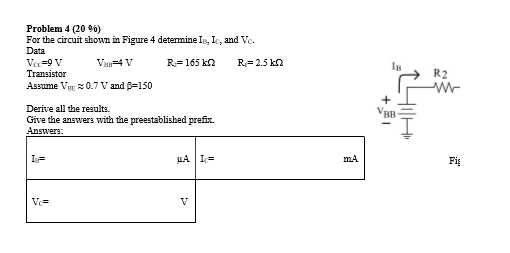
FAVOR DIBUJAR LOS CIRCUITOS
Homework Answers

Add Answer to:
Problem 4 (20 %) For the circuit shown in Figure 4 determine IB,
IC, and VC....
4. Determine the terminal voltages of each transistor with respect to ground for each circuit in ...
 4. Determine the terminal voltages of each transistor with respect to ground for each circuit in the Figure shown. Also determine VcE. VBe, and VcB- Ans: Vc=-12 V Vy--4V VBE =-0.7 V ½ =-3.3 V Va. =-8.7 V 4 V RE 2.2 kΩ CE
4. Determine the terminal voltages of each transistor with respect to ground for each circuit in the Figure shown. Also determine VcE. VBe, and VcB- Ans: Vc=-12 V Vy--4V VBE =-0.7 V ½ =-3.3 V Va....
4. Determine the terminal voltages of each transistor with respect to ground for each circuit in the Figure shown. Also determine VcE. VBe, and VcB- Ans: Vc=-12 V Vy--4V VBE =-0.7 V ½ =-3.3 V Va. =-8.7 V 4 V RE 2.2 kΩ CE
4. Determine the terminal voltages of each transistor with respect to ground for each circuit in the Figure shown. Also determine VcE. VBe, and VcB- Ans: Vc=-12 V Vy--4V VBE =-0.7 V ½ =-3.3 V Va....
Vcc 10 V #2. Calculate the values of VBE, VCE, IB, Ic, and IE assuming B...
 Vcc 10 V #2. Calculate the values of VBE, VCE, IB, Ic, and IE assuming B = 150 for the Transistor Biasing Circuit in Figure 5 - 5. Simulate the circuit in Figure 5 - 5. Include the procedure and results of calculation / simulation in related section. 370k SR2 2370K BROD 2N3904 ŽR3 330 Figure 5 -5: Transistor Biasing
Problem 5 Given the following circuit, assume the following parameters VBB IV, RB 220 k, RC...
 Problem 5 Given the following circuit, assume the following parameters VBB IV, RB 220 k, RC = 2 k, VCC= 10 V, VBE(on)-0.7 V, and B 200 a) Calculate the base, collector, and emitter currents and the C-E voltage, also, calculate the transistor power dissipation b) What transistor configuration does the circuit resemble? Vcc=10V RC=2k Rg=220 kQ VCE VBB= 1V o + VRE IB
5 نقاط For the circuit shown, If there is an added 1 K. Ohm resistor at...
 5 نقاط For the circuit shown, If there is an added 1 K. Ohm resistor at the emitter terminal connected between Emitter and Ground, then calculate IB, IC, VCE, VB, and VC knowing that Vcc = 12 Volts, RB = 220 K. Ohm, RC = 4 K. Ohm, VBE = 0.7 volts, and Beta of transistor = 50 VCC Fig. 1 Rc im Ic RB ac HE output signal C2 IB + ac VCE input I signal G B +...
Design a transistor biasing circuit as shown below. Assume ß = 100, Ice = 10 mA,...
 Design a transistor biasing circuit as shown below. Assume ß = 100, Ice = 10 mA, VE = Vcc/3, VCEQ = Vcc/3 and VBE = 0.7 V. RTH = 0.1 (1 + BRE. Also find the power rating of all resistors. +15V R2 Rc V 10 R1 RE
Q. 3. Design a transistor biasing circuit as shown below. Assume B = 100, Ica =...
 Q. 3. Design a transistor biasing circuit as shown below. Assume B = 100, Ica = 10 mA, VE = Vcc/3, VceQ = Vcc /3 and VBE = 0.7 V. RTH = 0.1 (1 + B)RE . Also find the power rating of all resistors. (25) > +15V R2 Rc Vio R1 RE
Q. 3. Design a transistor biasing circuit as shown below. Assume ß = 100, lco =...
 Q. 3. Design a transistor biasing circuit as shown below. Assume ß = 100, lco = 10 mA, VE = Vcc/3, VCEQ = Vcc/3 and VBE = 0.7 V. RTH = 0.1 (1 + B)RE . Also find the power rating of all resistors. +15V R2 Rc V10 R1 RE
Please only use PSpice as stated in the directions. Any other software will not be accepted....
 Please only use PSpice as stated in the directions. Any other
software will not be accepted. Thanks
No multisim or LTSpice.
Part I: Transistor Output Characteristic Procedure: 1. Build the circuit model in PSpice as shown in Fig. 1 with Vbb = 10V, R2 = 330 k92 and R3 = 0.22 k22. R3 0.22 Vec vbь R2 Q1 10V 330k or 147k Figure 1. Circuit configuration for Transistor output characteristic testing 2. Use Ohm's Law to calculate Ib. You may...
Please only use PSpice as stated in the directions. Any other
software will not be accepted. Thanks
No multisim or LTSpice.
Part I: Transistor Output Characteristic Procedure: 1. Build the circuit model in PSpice as shown in Fig. 1 with Vbb = 10V, R2 = 330 k92 and R3 = 0.22 k22. R3 0.22 Vec vbь R2 Q1 10V 330k or 147k Figure 1. Circuit configuration for Transistor output characteristic testing 2. Use Ohm's Law to calculate Ib. You may...
Need help with all A-H 4. Refer to the following circuit (Qi is a generic transistor),...
 Need help with all A-H
4. Refer to the following circuit (Qi is a generic transistor), assuming B = 200 when the transistor is in the active region. R1 47kg R3 33.3ko 12V Vcc Q1 R2 12k R4 1.0kΩ (a) If R, is open, calculate VB, VE, Vc. (b) If R is short, calculate 1b, IE and Vc. (c) If R2 is short, calculate IE and Vc. (d) If R3 is short, calculate VB, Ic, and Ib. (e) If both...
Need help with all A-H
4. Refer to the following circuit (Qi is a generic transistor), assuming B = 200 when the transistor is in the active region. R1 47kg R3 33.3ko 12V Vcc Q1 R2 12k R4 1.0kΩ (a) If R, is open, calculate VB, VE, Vc. (b) If R is short, calculate 1b, IE and Vc. (c) If R2 is short, calculate IE and Vc. (d) If R3 is short, calculate VB, Ic, and Ib. (e) If both...
4. Lab VIII: Experiment VII The Bipolar Junction Transistor (BJT) Characteristics The bipolar junction transistor (BJT)...
 4. Lab VIII: Experiment VII The Bipolar Junction Transistor (BJT) Characteristics The bipolar junction transistor (BJT) is a three-terminal solid state device widely used as an amplifier (or switching) device. It consists of two n-type materials sandwiched by p-type material (npn) or two p-type and n-type. The terminals (sections) are known as emitter E, base B and collector C. Two currents and two voltages uniquely describe the behavior of the device. The third current/voltage can be determined through KCL/KVL. See...
 4. Determine the terminal voltages of each transistor with respect to ground for each circuit in the Figure shown. Also determine VcE. VBe, and VcB- Ans: Vc=-12 V Vy--4V VBE =-0.7 V ½ =-3.3 V Va. =-8.7 V 4 V RE 2.2 kΩ CE
4. Determine the terminal voltages of each transistor with respect to ground for each circuit in the Figure shown. Also determine VcE. VBe, and VcB- Ans: Vc=-12 V Vy--4V VBE =-0.7 V ½ =-3.3 V Va....
4. Determine the terminal voltages of each transistor with respect to ground for each circuit in the Figure shown. Also determine VcE. VBe, and VcB- Ans: Vc=-12 V Vy--4V VBE =-0.7 V ½ =-3.3 V Va. =-8.7 V 4 V RE 2.2 kΩ CE
4. Determine the terminal voltages of each transistor with respect to ground for each circuit in the Figure shown. Also determine VcE. VBe, and VcB- Ans: Vc=-12 V Vy--4V VBE =-0.7 V ½ =-3.3 V Va....
 Vcc 10 V #2. Calculate the values of VBE, VCE, IB, Ic, and IE assuming B = 150 for the Transistor Biasing Circuit in Figure 5 - 5. Simulate the circuit in Figure 5 - 5. Include the procedure and results of calculation / simulation in related section. 370k SR2 2370K BROD 2N3904 ŽR3 330 Figure 5 -5: Transistor Biasing
 Problem 5 Given the following circuit, assume the following parameters VBB IV, RB 220 k, RC = 2 k, VCC= 10 V, VBE(on)-0.7 V, and B 200 a) Calculate the base, collector, and emitter currents and the C-E voltage, also, calculate the transistor power dissipation b) What transistor configuration does the circuit resemble? Vcc=10V RC=2k Rg=220 kQ VCE VBB= 1V o + VRE IB
 5 نقاط For the circuit shown, If there is an added 1 K. Ohm resistor at the emitter terminal connected between Emitter and Ground, then calculate IB, IC, VCE, VB, and VC knowing that Vcc = 12 Volts, RB = 220 K. Ohm, RC = 4 K. Ohm, VBE = 0.7 volts, and Beta of transistor = 50 VCC Fig. 1 Rc im Ic RB ac HE output signal C2 IB + ac VCE input I signal G B +...
 Design a transistor biasing circuit as shown below. Assume ß = 100, Ice = 10 mA, VE = Vcc/3, VCEQ = Vcc/3 and VBE = 0.7 V. RTH = 0.1 (1 + BRE. Also find the power rating of all resistors. +15V R2 Rc V 10 R1 RE
 Q. 3. Design a transistor biasing circuit as shown below. Assume B = 100, Ica = 10 mA, VE = Vcc/3, VceQ = Vcc /3 and VBE = 0.7 V. RTH = 0.1 (1 + B)RE . Also find the power rating of all resistors. (25) > +15V R2 Rc Vio R1 RE
 Q. 3. Design a transistor biasing circuit as shown below. Assume ß = 100, lco = 10 mA, VE = Vcc/3, VCEQ = Vcc/3 and VBE = 0.7 V. RTH = 0.1 (1 + B)RE . Also find the power rating of all resistors. +15V R2 Rc V10 R1 RE
 Please only use PSpice as stated in the directions. Any other
software will not be accepted. Thanks
No multisim or LTSpice.
Part I: Transistor Output Characteristic Procedure: 1. Build the circuit model in PSpice as shown in Fig. 1 with Vbb = 10V, R2 = 330 k92 and R3 = 0.22 k22. R3 0.22 Vec vbь R2 Q1 10V 330k or 147k Figure 1. Circuit configuration for Transistor output characteristic testing 2. Use Ohm's Law to calculate Ib. You may...
Please only use PSpice as stated in the directions. Any other
software will not be accepted. Thanks
No multisim or LTSpice.
Part I: Transistor Output Characteristic Procedure: 1. Build the circuit model in PSpice as shown in Fig. 1 with Vbb = 10V, R2 = 330 k92 and R3 = 0.22 k22. R3 0.22 Vec vbь R2 Q1 10V 330k or 147k Figure 1. Circuit configuration for Transistor output characteristic testing 2. Use Ohm's Law to calculate Ib. You may...
 Need help with all A-H
4. Refer to the following circuit (Qi is a generic transistor), assuming B = 200 when the transistor is in the active region. R1 47kg R3 33.3ko 12V Vcc Q1 R2 12k R4 1.0kΩ (a) If R, is open, calculate VB, VE, Vc. (b) If R is short, calculate 1b, IE and Vc. (c) If R2 is short, calculate IE and Vc. (d) If R3 is short, calculate VB, Ic, and Ib. (e) If both...
Need help with all A-H
4. Refer to the following circuit (Qi is a generic transistor), assuming B = 200 when the transistor is in the active region. R1 47kg R3 33.3ko 12V Vcc Q1 R2 12k R4 1.0kΩ (a) If R, is open, calculate VB, VE, Vc. (b) If R is short, calculate 1b, IE and Vc. (c) If R2 is short, calculate IE and Vc. (d) If R3 is short, calculate VB, Ic, and Ib. (e) If both...
 4. Lab VIII: Experiment VII The Bipolar Junction Transistor (BJT) Characteristics The bipolar junction transistor (BJT) is a three-terminal solid state device widely used as an amplifier (or switching) device. It consists of two n-type materials sandwiched by p-type material (npn) or two p-type and n-type. The terminals (sections) are known as emitter E, base B and collector C. Two currents and two voltages uniquely describe the behavior of the device. The third current/voltage can be determined through KCL/KVL. See...
Most questions answered within 3 hours.
-
Where is the error in this code sequence?
String s1 = "Hello";
String s2 = "ello";...
asked 10 months ago -
Financial data for Joel de Paris, Inc., for last year
follow:
Joel de Paris, Inc.
Balance...
asked 10 months ago -
Consider this reaction:
Al2(SO4)3 (aq)+ BaCl3
(aq) Al2Cl6 (aq)- +
3BaSO4(s) . What is the...
asked 10 months ago -
Suppose that Savneet is considering increasing her
recent random sample from 20 car rentals to 40...
asked 10 months ago -
Trucks arrive at an unloading terminal at an average rate of 120
per hour.
Trucks arrive...
asked 10 months ago -
Why are methanol and ethanol completely soluble in water while
octanol is not very little soluble....
asked 10 months ago -
A facilities manager at a university reads in a research report
that the mean amount of...
asked 10 months ago -
When the CuSO4 is rehydrated by adding water to the anhydrous
compound, is this an endothermic...
asked 10 months ago -
A ray of sunlight is passing from diamond into crown glass; the
angle of incidence is...
asked 10 months ago -
A block of mass 0.249 kg is placed on top of a light, vertical
spring of...
asked 10 months ago -
how do the kidneys compensate in the presences of acidosis
a) trigger hyperventilate
b) reserve acid...
asked 10 months ago -
Question 501 pts
The rental rate of capital to the firm increases. Which of the
following...
asked 10 months ago