at what temperature does the anneal step of pcr occur?
Homework Answers
Request Answer!
We need at least 10 more requests to produce the answer.
0 / 10 have requested this problem solution
The more requests, the faster the answer.
5) p points) Temperature regulation is critical while preforming PCR. What could resuit IT the PCR...
 5) p points) Temperature regulation is critical while preforming PCR. What could resuit IT the PCR reaction is not cooled to 42°C -65°C before the extension step? Why would this occur (2 points) If you start with one copy of a single gene of interest and perform PCR on that sequence, how many copies of the gene would you have after 10 cycles? Explain your reasoning.
The direct role of the DNA denaturation step in a PCR reaction is to Group of...
The direct role of the DNA denaturation step in a PCR reaction is to Group of answer choices provide the optimal temperature for the DNA polymerase used separate the two DNA strands of the template allow the primers to anneal to the DNA 2. Which of the following would be useful/necessary for an expression vector BUT not for a cloning vector? Group of answer choices origin of replication regulatory sequences antibiotic resistance gene high copy number
A researcher is doing a PCR-based experiment using the following temperature profile: • Melt for 1...
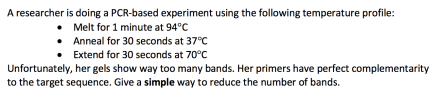 A researcher is doing a PCR-based experiment using the following temperature profile: • Melt for 1 minute at 94°C • Anneal for 30 seconds at 37°C Extend for 30 seconds at 70°C Unfortunately, her gels show way too many bands. Her primers have perfect complementarity to the target sequence. Give a simple way to reduce the number of bands.
This PCR step is called annealing. The annealing step follows the denaturation step: it is usually...
 This PCR step is called annealing. The annealing step follows the denaturation step: it is usually the lowest temperature in the PCR. The temperature of this step varies with each PCR reaction because each primer has its own sequence and may not be an identical match to the DNA template strand. GC or CG have three hydrogen bonds and AT or TA have two hydrogen bonds. Higher annealing temperatures are more stringent and require a better match between primer and...
1) What does PCR stand for and what does it do? a. Polymerase Chain Reaction; PCR...
1) What does PCR stand for and what does it do? a. Polymerase Chain Reaction; PCR deletes DNA b. Polymerase Copying Repeats; PCR amplifies DNA c. Polymerase Copying Releats; PCR deletes DNA d. Polymerase Chain Reaction; PCR amplifies DNA 2) During gel electrophoresis, the DNA fragments are separated by ____ a. charge b. DNA fragments cannot be separated c. color d. size 3) Primers are a. double stranded DNA oligonucleotide (fragment) b. double stranded RNA oligonucleotide (fragment) c. single stranded...
At what temperature, in K, does X(l) → X(g) occur spontaneously?
At what temperature, in K, does X(l) → X(g) occur spontaneously?
Which of the following is NOT a reason that each PCR Primer requires a different PCR...
Which of the following is NOT a reason that each PCR Primer requires a different PCR settings? -because the complimentary strands of the DNA may be composed of more G-C pairs which would require less energy to denature than a strand with more A-T pairs due to the amounts of hydrogen bonds to break in each. -because the PCR products are different lengths which may require different amounts of time to denature, elongate , and extend the PCR...
Problem.1: What does a PCR optimization means? Problem.2: You are working on a gradient PCR to...
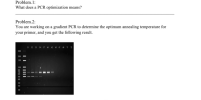 Problem.1: What does a PCR optimization means? Problem.2: You are working on a gradient PCR to determine the optimum annealing temperature for your primer, and you get the following result. Problem.5: Your target is to amplify a promoter region of TRF2 gene. You design the following primer pair: Forward: 5'- CAGCGCTGCCTGAAACTC-3: Tm: 58.6°C, length: 18 bp, GC%: 61.11% Reverse: 5'- GTCCTGCCCCTTCACCTT-3' Tm: 59°C, length: 18 bp, GC%: 61.11% Product size: 200 bp -You get the following result: Marker CC CCC...
check all that apply What are some differences between the PCR that occurs in the Sherlock...
 check all that apply
What are some differences between the PCR that occurs in the Sherlock protocol and the PCR that occurs in RT-PCR test? O PCR in Sherlock protocol can amplify more than one gene at the same time O Dyes are added to RT-PCR PCR in RT-PCR is faster PCR in Sherlock protocol is isothermic (all the steps occur at the same temperature).
check all that apply
What are some differences between the PCR that occurs in the Sherlock protocol and the PCR that occurs in RT-PCR test? O PCR in Sherlock protocol can amplify more than one gene at the same time O Dyes are added to RT-PCR PCR in RT-PCR is faster PCR in Sherlock protocol is isothermic (all the steps occur at the same temperature).
8. PCR is used to. A Diagnose genetic disease 8 Solve cnmes C Sudy gene unction...
 8. PCR is used to. A Diagnose genetic disease 8 Solve cnmes C Sudy gene unction D. All of th C ONA as a template to form RINA D All of the above 7. PCR technique does not need A. Tag polymerase B Restriion encymes C Olgoucletide prmers C. A fragment of skin D. All of the above 9 PCR can be used in A Cloning B.Sequening C.Medical dagnosis&foric mine 0.PCR can make mullple copies ot A. DNA B RNA...
 5) p points) Temperature regulation is critical while preforming PCR. What could resuit IT the PCR reaction is not cooled to 42°C -65°C before the extension step? Why would this occur (2 points) If you start with one copy of a single gene of interest and perform PCR on that sequence, how many copies of the gene would you have after 10 cycles? Explain your reasoning.
 A researcher is doing a PCR-based experiment using the following temperature profile: • Melt for 1 minute at 94°C • Anneal for 30 seconds at 37°C Extend for 30 seconds at 70°C Unfortunately, her gels show way too many bands. Her primers have perfect complementarity to the target sequence. Give a simple way to reduce the number of bands.
 This PCR step is called annealing. The annealing step follows the denaturation step: it is usually the lowest temperature in the PCR. The temperature of this step varies with each PCR reaction because each primer has its own sequence and may not be an identical match to the DNA template strand. GC or CG have three hydrogen bonds and AT or TA have two hydrogen bonds. Higher annealing temperatures are more stringent and require a better match between primer and...
 Problem.1: What does a PCR optimization means? Problem.2: You are working on a gradient PCR to determine the optimum annealing temperature for your primer, and you get the following result. Problem.5: Your target is to amplify a promoter region of TRF2 gene. You design the following primer pair: Forward: 5'- CAGCGCTGCCTGAAACTC-3: Tm: 58.6°C, length: 18 bp, GC%: 61.11% Reverse: 5'- GTCCTGCCCCTTCACCTT-3' Tm: 59°C, length: 18 bp, GC%: 61.11% Product size: 200 bp -You get the following result: Marker CC CCC...
 check all that apply
What are some differences between the PCR that occurs in the Sherlock protocol and the PCR that occurs in RT-PCR test? O PCR in Sherlock protocol can amplify more than one gene at the same time O Dyes are added to RT-PCR PCR in RT-PCR is faster PCR in Sherlock protocol is isothermic (all the steps occur at the same temperature).
check all that apply
What are some differences between the PCR that occurs in the Sherlock protocol and the PCR that occurs in RT-PCR test? O PCR in Sherlock protocol can amplify more than one gene at the same time O Dyes are added to RT-PCR PCR in RT-PCR is faster PCR in Sherlock protocol is isothermic (all the steps occur at the same temperature).
 8. PCR is used to. A Diagnose genetic disease 8 Solve cnmes C Sudy gene unction D. All of th C ONA as a template to form RINA D All of the above 7. PCR technique does not need A. Tag polymerase B Restriion encymes C Olgoucletide prmers C. A fragment of skin D. All of the above 9 PCR can be used in A Cloning B.Sequening C.Medical dagnosis&foric mine 0.PCR can make mullple copies ot A. DNA B RNA...
Most questions answered within 3 hours.
-
Where is the error in this code sequence?
String s1 = "Hello";
String s2 = "ello";...
asked 11 months ago -
Financial data for Joel de Paris, Inc., for last year
follow:
Joel de Paris, Inc.
Balance...
asked 11 months ago -
Consider this reaction:
Al2(SO4)3 (aq)+ BaCl3
(aq) Al2Cl6 (aq)- +
3BaSO4(s) . What is the...
asked 11 months ago -
Suppose that Savneet is considering increasing her
recent random sample from 20 car rentals to 40...
asked 11 months ago -
Trucks arrive at an unloading terminal at an average rate of 120
per hour.
Trucks arrive...
asked 11 months ago -
Why are methanol and ethanol completely soluble in water while
octanol is not very little soluble....
asked 11 months ago -
A facilities manager at a university reads in a research report
that the mean amount of...
asked 11 months ago -
When the CuSO4 is rehydrated by adding water to the anhydrous
compound, is this an endothermic...
asked 11 months ago -
A ray of sunlight is passing from diamond into crown glass; the
angle of incidence is...
asked 11 months ago -
A block of mass 0.249 kg is placed on top of a light, vertical
spring of...
asked 11 months ago -
how do the kidneys compensate in the presences of acidosis
a) trigger hyperventilate
b) reserve acid...
asked 11 months ago -
Question 501 pts
The rental rate of capital to the firm increases. Which of the
following...
asked 11 months ago