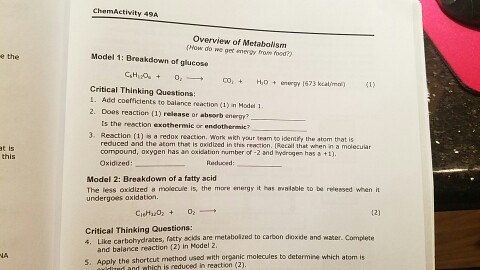
C6H12O6 + O2 > CO2 + H2O + energy (673 kcal/mol) (1)
1. Add coefficient to balance reaction (1) in model 1.
2. Does reaction (1) release or absorb energy? Is the reaction
exothermic or exothermic?
3. Reason (1) is a redox reaction. Work with your team to identify
the atom that is reduced and the atom that is oxidized in the
reaction. (Recall that when in a molecular compound, oxygen has an
oxidation number of -2 and hydrogen had a +1).
Oxidized:
Reduced:
The less oxidized a molecule is, the more energy it has availible
to be released even it undergoes oxidation.
C16H32O2 + O2 >
4. Like carbohydrates, fatty acids are metabolized to carbon
dioxide and water. Complete and balance reaction (2) in Model
(2).
5. apply the shortcut method used with organic molecules to
determine which item is oxidized and which is reduced in the
reaction (2).
Oxidized: Reduced:
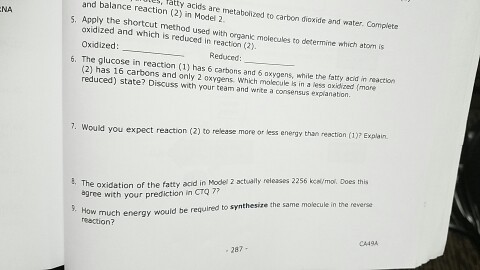
6. The glucose reaction (1) has 6 protons and 6
oxygens, while the fatty acid in reaction (2) has 16 carbons and
only 2 oxygens. Which molecule is in a less oxidized (more reduced)
state?
7. Would you expect reaction (2) to release more or less energy
than reaction (1)? Explain.
8. The oxidation of the fatty acid in module 2 actually releases
2256 kcal/mol.
9. How much energy would be required to synthesize the same
molecule in the reverse reaction?
Homework Answers

Add Answer to:
C6H12O6 + O2 > CO2 + H2O + energy (673 kcal/mol) (1)
1. Add coefficient to...
Ignore question 4. 1. Calculate the number of ATP produced per carbon atom for a molecule...
 Ignore question 4.
1. Calculate the number of ATP produced per carbon atom for a molecule of glucose under oxidative phosphorylation (remember we use as a rule of thumb 2.5ATP per NADH and 1.5ATP per FADH2 based on the number of protons pumped in the ETC). 2. Calculate the number of ATP produced per carbon atom for a saturated fatty acid between 12 and 18 carbons long (make sure you clearly indicate the length of fatty acid you choose, e.g...
Ignore question 4.
1. Calculate the number of ATP produced per carbon atom for a molecule of glucose under oxidative phosphorylation (remember we use as a rule of thumb 2.5ATP per NADH and 1.5ATP per FADH2 based on the number of protons pumped in the ETC). 2. Calculate the number of ATP produced per carbon atom for a saturated fatty acid between 12 and 18 carbons long (make sure you clearly indicate the length of fatty acid you choose, e.g...
1. When ONE molecule of glucose is totally oxidized to CO2 and H2O, how many net...
1. When ONE molecule of glucose is totally oxidized to CO2 and H2O, how many net ATP molecules (or GTP equivalents) are made by oxidative phosphorylation, relative to the maximum yield?A. 30 out of 30 B. 12 out of 24 C. 26 out of 30 D. 4 out of 24 E. 4 out of 30 would the answer be E or C 2. The SEQUENCE OF THREE REACTIONS ( oxidation, hydration, and oxidation) occurs in which one(s)of the following pathways?...
4. (20 points) The reaction of pyruvate to acetyl-CoA and CO2 is the bridge reaction between...
 4. (20 points) The reaction of pyruvate to acetyl-CoA and CO2 is the bridge reaction between glycolysis and the citric acid cycle. The carbon atoms in pyruvate are numbered and where they end up in the products are indicated CO0Θ 2 C=O + HS-CoA 3 CH3 Pyruvate S-COA 2C=O 3 CH3 Acetyl CoA Pyruvate dehydrogenase +1 CO2 a) Is C atom 1 in CO2 in a more reduced state or more oxidized state compared to its state in pyruvate? Why?...
1. Potassium nitrate has a lattice energy of -163.8 kcal/mol and a heat of hydration of...
1. Potassium nitrate has a lattice energy of -163.8 kcal/mol and a heat of hydration of -155.5 kcal/mol. How much potassium nitrate has to dissolve in water to absorb 112 kJof heat? 2. Calculate the mass of nitrogen dissolved at room temperature in an 97.0 Lhome aquarium. Assume a total pressure of 1.0 atmand a mole fraction for nitrogen of 0.78. 3. Use Henry's law to determine the molar solubility of helium at a pressure of 2.0 atmand 25 ∘C....
1. The distance between chlorine and sodium in Naal is 2.82 A, but their atomic radi...
 1. The distance between chlorine and sodium in Naal is 2.82 A, but their atomic radi are 0.99 and 1.54 A, respectively Explain the discrepancy between the sum of the radi and the distance. 2. The element Setonium, St, is the next, undiscovered noble gas in the periodic table based on the Pauli's principle that a maximum of 3 electrons can occupy an orbital. Give the electronic configuration of the valence shell of St. 3. Oxidation can be defined as...
Fatty Acid Metabolism. The reactions of the fatty acid spiral are shown below. Use the description...
 Fatty Acid Metabolism. The reactions of the fatty acid spiral are shown below. Use the description on the left side of the page to classify the reactions and fill in the boxes on the right side of the page Activation Step. The activation of the fatty acid begins by the addition of CoA which will carry the fatty acid from the cytosol into the mitochondria. The product, which is a fatty acid with a CoA attached, is known as a...
Model 1 - Potential Energy Diagrams 1) The energy (enthalpy) change of a reaction can be...
 Model 1 - Potential Energy Diagrams 1) The energy (enthalpy) change of a reaction can be determined by the following expression: Activated Complex Transition State AH = Energy products - Energy reactants Activation Energy, E Reactants Consider the energy change for the reaction in Model 1 (the graph to the left). Potential Energy (kJ/mol) Energy change (AH) Products a) The energy change shown is (positive/negative). b) This reaction is (endothermic / exothermic). c) These (reactants / transition state) has more...
Question 1 9 pts Below is a partial data table with the hypothetical amounts of reagents...
 Question 1 9 pts Below is a partial data table with the hypothetical amounts of reagents you used for the oxidation of borneol, plus the hypothetic final yield of product you obtained. reagent MW conc(M) d/g/mL) vol(mL) mass (mg) borneol 154.25 118.3 NaCl 1 0.15 Oxone 307.37 232.1 EtOAC 0.897 0.4 camphor 152.24 yield camphor (mg) 99.2 Using these amounts, calculate the following values. Answers should be reported to the correct level of significant figures. Note: equivalents are usually based...
1(a) The complete metabolic oxidation of glucose to CO2 and O2 yields 38 ATPs. What is...
1(a) The complete metabolic oxidation of glucose to CO2 and O2 yields 38 ATPs. What is the yield of ATP from Glc if it is first added to a glycogen polymer before being converted to CO2 and O2? What is the FRACTIONAL energetic cost in terms of ATP (eg., 1%, 2%, 10%, etc.) of storing glucose as glycogen and later metabolizing the glycogen rather than directly metabolizing the glucose? Be sure to show your work and state any assumptions being...
(91 fatty Acid Metabolism. The reactions of the fatty acid spiral are shown below. Use the...
 (91 fatty Acid Metabolism. The reactions of the fatty acid spiral are shown below. Use the description on the left side of the page to classify the reactions and fil in the boxes on the right side of the page Aetivation Step. The activation of the fatty acid begins by the addition of CoA which will carry the fatty acid from the cytosol into the mitochondria. The product, which is a fatty acid with a CoA attached, is known as...
 Ignore question 4.
1. Calculate the number of ATP produced per carbon atom for a molecule of glucose under oxidative phosphorylation (remember we use as a rule of thumb 2.5ATP per NADH and 1.5ATP per FADH2 based on the number of protons pumped in the ETC). 2. Calculate the number of ATP produced per carbon atom for a saturated fatty acid between 12 and 18 carbons long (make sure you clearly indicate the length of fatty acid you choose, e.g...
Ignore question 4.
1. Calculate the number of ATP produced per carbon atom for a molecule of glucose under oxidative phosphorylation (remember we use as a rule of thumb 2.5ATP per NADH and 1.5ATP per FADH2 based on the number of protons pumped in the ETC). 2. Calculate the number of ATP produced per carbon atom for a saturated fatty acid between 12 and 18 carbons long (make sure you clearly indicate the length of fatty acid you choose, e.g...
 4. (20 points) The reaction of pyruvate to acetyl-CoA and CO2 is the bridge reaction between glycolysis and the citric acid cycle. The carbon atoms in pyruvate are numbered and where they end up in the products are indicated CO0Θ 2 C=O + HS-CoA 3 CH3 Pyruvate S-COA 2C=O 3 CH3 Acetyl CoA Pyruvate dehydrogenase +1 CO2 a) Is C atom 1 in CO2 in a more reduced state or more oxidized state compared to its state in pyruvate? Why?...
 1. The distance between chlorine and sodium in Naal is 2.82 A, but their atomic radi are 0.99 and 1.54 A, respectively Explain the discrepancy between the sum of the radi and the distance. 2. The element Setonium, St, is the next, undiscovered noble gas in the periodic table based on the Pauli's principle that a maximum of 3 electrons can occupy an orbital. Give the electronic configuration of the valence shell of St. 3. Oxidation can be defined as...
 Fatty Acid Metabolism. The reactions of the fatty acid spiral are shown below. Use the description on the left side of the page to classify the reactions and fill in the boxes on the right side of the page Activation Step. The activation of the fatty acid begins by the addition of CoA which will carry the fatty acid from the cytosol into the mitochondria. The product, which is a fatty acid with a CoA attached, is known as a...
 Model 1 - Potential Energy Diagrams 1) The energy (enthalpy) change of a reaction can be determined by the following expression: Activated Complex Transition State AH = Energy products - Energy reactants Activation Energy, E Reactants Consider the energy change for the reaction in Model 1 (the graph to the left). Potential Energy (kJ/mol) Energy change (AH) Products a) The energy change shown is (positive/negative). b) This reaction is (endothermic / exothermic). c) These (reactants / transition state) has more...
 Question 1 9 pts Below is a partial data table with the hypothetical amounts of reagents you used for the oxidation of borneol, plus the hypothetic final yield of product you obtained. reagent MW conc(M) d/g/mL) vol(mL) mass (mg) borneol 154.25 118.3 NaCl 1 0.15 Oxone 307.37 232.1 EtOAC 0.897 0.4 camphor 152.24 yield camphor (mg) 99.2 Using these amounts, calculate the following values. Answers should be reported to the correct level of significant figures. Note: equivalents are usually based...
 (91 fatty Acid Metabolism. The reactions of the fatty acid spiral are shown below. Use the description on the left side of the page to classify the reactions and fil in the boxes on the right side of the page Aetivation Step. The activation of the fatty acid begins by the addition of CoA which will carry the fatty acid from the cytosol into the mitochondria. The product, which is a fatty acid with a CoA attached, is known as...
Most questions answered within 3 hours.
-
Where is the error in this code sequence?
String s1 = "Hello";
String s2 = "ello";...
asked 11 months ago -
Financial data for Joel de Paris, Inc., for last year
follow:
Joel de Paris, Inc.
Balance...
asked 11 months ago -
Consider this reaction:
Al2(SO4)3 (aq)+ BaCl3
(aq) Al2Cl6 (aq)- +
3BaSO4(s) . What is the...
asked 11 months ago -
Suppose that Savneet is considering increasing her
recent random sample from 20 car rentals to 40...
asked 11 months ago -
Trucks arrive at an unloading terminal at an average rate of 120
per hour.
Trucks arrive...
asked 11 months ago -
Why are methanol and ethanol completely soluble in water while
octanol is not very little soluble....
asked 11 months ago -
A facilities manager at a university reads in a research report
that the mean amount of...
asked 11 months ago -
When the CuSO4 is rehydrated by adding water to the anhydrous
compound, is this an endothermic...
asked 11 months ago -
A ray of sunlight is passing from diamond into crown glass; the
angle of incidence is...
asked 11 months ago -
A block of mass 0.249 kg is placed on top of a light, vertical
spring of...
asked 11 months ago -
how do the kidneys compensate in the presences of acidosis
a) trigger hyperventilate
b) reserve acid...
asked 11 months ago -
Question 501 pts
The rental rate of capital to the firm increases. Which of the
following...
asked 11 months ago