

Homework Answers
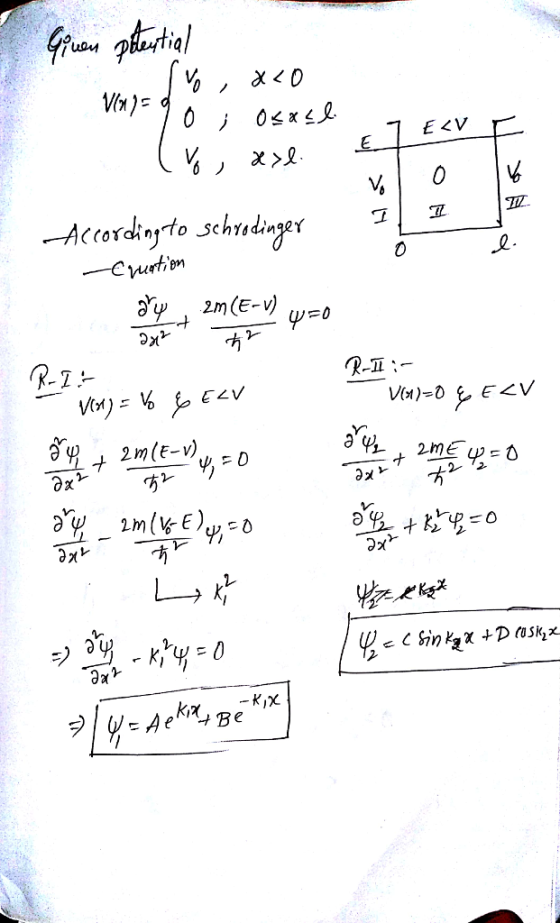
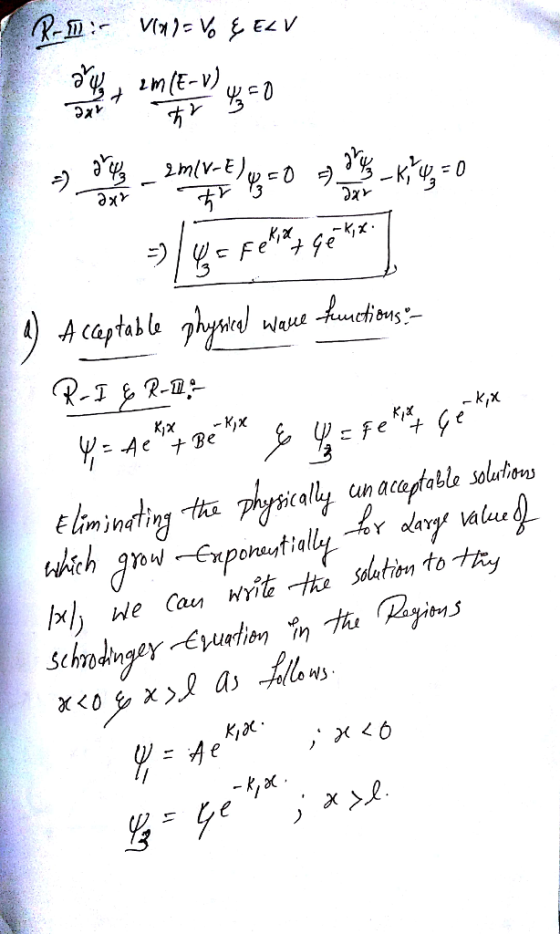
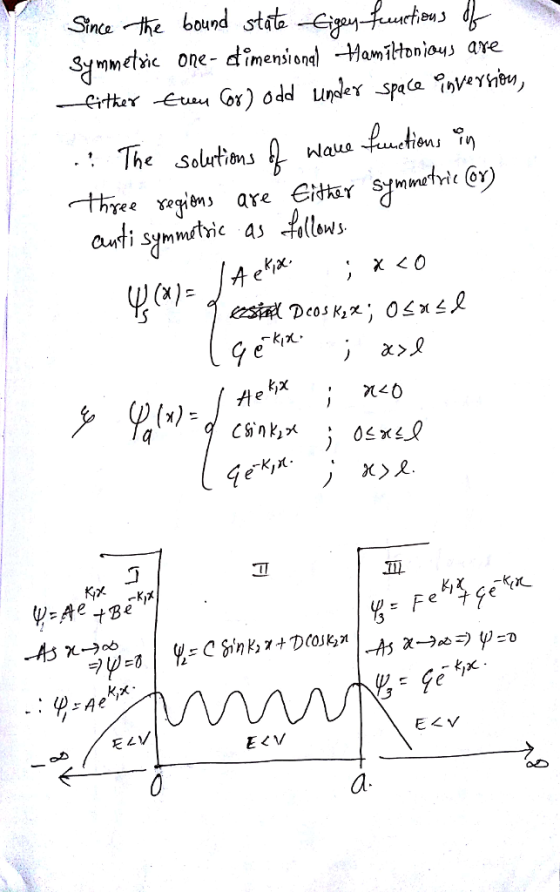
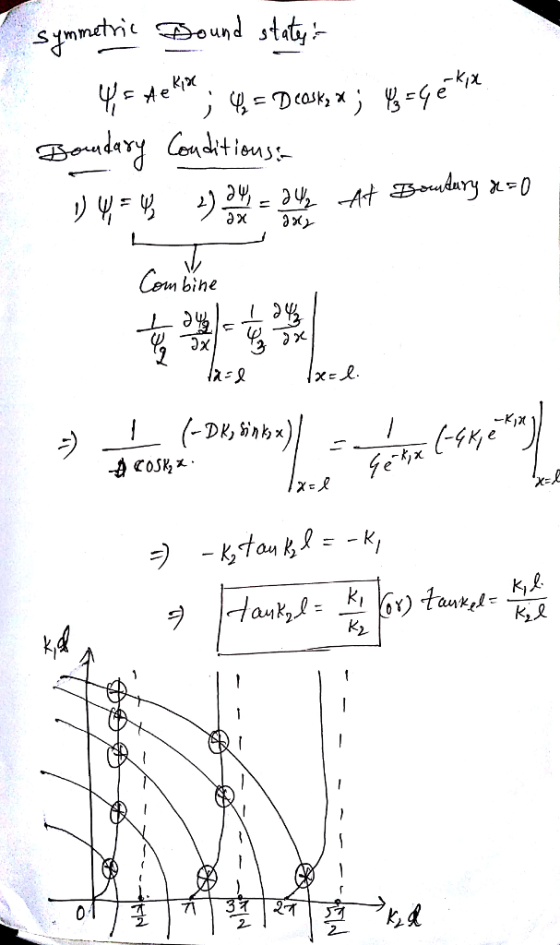
[Finite potential well] Consider a symmetric square well potential of a finite depth, i.e., V(x) =...
 [Finite potential well] Consider a symmetric square well potential of a finite depth, i.e., V(x) = 0 inside the well, V(x) = V outside the well. NOTE: for a general discontinuous potential the boundary conditions are the continuity of both the wave function and its first derivative at the point(s) of the discontinuity of the potential y (x_)=y(x),y'(x_)=y'(x4) (i) What are the functional forms of the solutions for y(x) inside and outside the well? (ii) What are the explicit continuity...
A finite potential well has depth U0=5.5 eV. In the well, there is an electron with...
A finite potential well has depth U0=5.5 eV. In the well, there is an electron with energy of 4.0 eV. a. What is the penetration distance of such electron? b. At what distance into the wall has the amplitude of the wave function decreased to 60% of the value at the edge of the potential well? c. If the depth of the well and the energy of the electron both increase by 0.5 eV, will the results for the question...
1. In a finite potential well, a.) the particle's wave function is an exponential throughout. b.)...
1. In a finite potential well, a.) the particle's wave function is an exponential throughout. b.) the allowed particle energies are higher than in an infinite potential well. c.) the number of possible bound states is infinite. d.) the particle may be found in a region where it violates energy conservation. 2. A tunneling particle a.) will tunnel through any barrier with equal probability. b.) loses some energy after tunneling. c.) temporarily violates energy conservation. d.) always uses a shovel....
5. One-Dimensional Potential Energy (20 points) A particle of mass m oscillates in a potential well...
 5. One-Dimensional Potential Energy (20 points) A particle of mass m oscillates in a potential well created by a one-dimensional force where a and b are known positive constants. Assume the particle is trapped in the well on the positive side of the y-axis. a) Find and expression for the potential energy U(x) for this force. (10 points) NOTE: There will be one undetermined constant. b) Set Umin, the minimum value for this potential energy function, equal to zero. Solve...
(a) Find the uncertainty in the position of an electron in an infinite square-well potential if...
(a) Find the uncertainty in the position of an electron in an infinite square-well potential if the electron is in the n=5 state and the box is 0.10nm wide. (b) Find the uncertainty in the momentum of an electron in an infinite square-well potential if the electron is in the n=5 state and the box is 0.10nm wide.
Part A A three-dimensional potential well has potential Uo = 0 in the region 0 <...
 Part A A three-dimensional potential well has potential Uo = 0 in the region 0 < x <L, 0<y<L, and 0 <z<2L and infinite potential otherwise. The ground state energy of a particle in the well is E. What is the energy of the first excited state, and what is the degeneracy of that state? 3Eo, triple degeneracy 2Eo, single degeneracy 2Eo, double degeneracy (7/3)Eo, double degeneracy (4/3)Eo, single degeneracy Submit Request Answer
Write the potential sn2 and sn1 reaction as well as the potential the sn2 and sn1...
 Write
the potential sn2 and sn1 reaction as well as the potential the sn2
and sn1 mechanism. Then state which reaction(s) will occur if any,
and why?
with naI/acetone and with AgNO3/ethanol
F) chlorobenzene G) 1-bromobutane H) 2-bromobutane
Write
the potential sn2 and sn1 reaction as well as the potential the sn2
and sn1 mechanism. Then state which reaction(s) will occur if any,
and why?
with naI/acetone and with AgNO3/ethanol
F) chlorobenzene G) 1-bromobutane H) 2-bromobutane
Quantum Mechanics question about an infinite square well. A particle in an infinite square well potential...
 Quantum Mechanics question about an infinite square
well.
A particle in an infinite square well potential has an initial state vector 14() = E1) - %|E2) where E) is the n'th eigenfunctions of the Hamiltonian operator. (a) Find the time evolution of the state vector. (b) Find the expectation value of the position as a function of time.
Quantum Mechanics question about an infinite square
well.
A particle in an infinite square well potential has an initial state vector 14() = E1) - %|E2) where E) is the n'th eigenfunctions of the Hamiltonian operator. (a) Find the time evolution of the state vector. (b) Find the expectation value of the position as a function of time.
Write the potential sn2 and sn1 reaction as well as the potential the sn2 and sn1...
 Write
the potential sn2 and sn1 reaction as well as the potential the sn2
and sn1 mechanism. Then state which reaction(s) will occur if any,
and why?
with NaI/acetone and AgNO3/ethanol
1) t-butyl bromide J) benzyl bromide K) bromobenzene
Write
the potential sn2 and sn1 reaction as well as the potential the sn2
and sn1 mechanism. Then state which reaction(s) will occur if any,
and why?
with NaI/acetone and AgNO3/ethanol
1) t-butyl bromide J) benzyl bromide K) bromobenzene
Write the potential sn2 and sn1 reaction as well as the potential the sn2 and sn1...
 Write the potential sn2 and sn1 reaction as well as the potential
the sn2 and sn1 mechanism. Then state which reaction(s) will occur
if any, and why?
with NaI/acetone and AgNO3 and ethanol
C) 2-iodobutane D) t-butyl chloride E) benzyl chloride
Write the potential sn2 and sn1 reaction as well as the potential
the sn2 and sn1 mechanism. Then state which reaction(s) will occur
if any, and why?
with NaI/acetone and AgNO3 and ethanol
C) 2-iodobutane D) t-butyl chloride E) benzyl chloride
 [Finite potential well] Consider a symmetric square well potential of a finite depth, i.e., V(x) = 0 inside the well, V(x) = V outside the well. NOTE: for a general discontinuous potential the boundary conditions are the continuity of both the wave function and its first derivative at the point(s) of the discontinuity of the potential y (x_)=y(x),y'(x_)=y'(x4) (i) What are the functional forms of the solutions for y(x) inside and outside the well? (ii) What are the explicit continuity...
 5. One-Dimensional Potential Energy (20 points) A particle of mass m oscillates in a potential well created by a one-dimensional force where a and b are known positive constants. Assume the particle is trapped in the well on the positive side of the y-axis. a) Find and expression for the potential energy U(x) for this force. (10 points) NOTE: There will be one undetermined constant. b) Set Umin, the minimum value for this potential energy function, equal to zero. Solve...
 Part A A three-dimensional potential well has potential Uo = 0 in the region 0 < x <L, 0<y<L, and 0 <z<2L and infinite potential otherwise. The ground state energy of a particle in the well is E. What is the energy of the first excited state, and what is the degeneracy of that state? 3Eo, triple degeneracy 2Eo, single degeneracy 2Eo, double degeneracy (7/3)Eo, double degeneracy (4/3)Eo, single degeneracy Submit Request Answer
 Write
the potential sn2 and sn1 reaction as well as the potential the sn2
and sn1 mechanism. Then state which reaction(s) will occur if any,
and why?
with naI/acetone and with AgNO3/ethanol
F) chlorobenzene G) 1-bromobutane H) 2-bromobutane
Write
the potential sn2 and sn1 reaction as well as the potential the sn2
and sn1 mechanism. Then state which reaction(s) will occur if any,
and why?
with naI/acetone and with AgNO3/ethanol
F) chlorobenzene G) 1-bromobutane H) 2-bromobutane
 Quantum Mechanics question about an infinite square
well.
A particle in an infinite square well potential has an initial state vector 14() = E1) - %|E2) where E) is the n'th eigenfunctions of the Hamiltonian operator. (a) Find the time evolution of the state vector. (b) Find the expectation value of the position as a function of time.
Quantum Mechanics question about an infinite square
well.
A particle in an infinite square well potential has an initial state vector 14() = E1) - %|E2) where E) is the n'th eigenfunctions of the Hamiltonian operator. (a) Find the time evolution of the state vector. (b) Find the expectation value of the position as a function of time.
 Write
the potential sn2 and sn1 reaction as well as the potential the sn2
and sn1 mechanism. Then state which reaction(s) will occur if any,
and why?
with NaI/acetone and AgNO3/ethanol
1) t-butyl bromide J) benzyl bromide K) bromobenzene
Write
the potential sn2 and sn1 reaction as well as the potential the sn2
and sn1 mechanism. Then state which reaction(s) will occur if any,
and why?
with NaI/acetone and AgNO3/ethanol
1) t-butyl bromide J) benzyl bromide K) bromobenzene
 Write the potential sn2 and sn1 reaction as well as the potential
the sn2 and sn1 mechanism. Then state which reaction(s) will occur
if any, and why?
with NaI/acetone and AgNO3 and ethanol
C) 2-iodobutane D) t-butyl chloride E) benzyl chloride
Write the potential sn2 and sn1 reaction as well as the potential
the sn2 and sn1 mechanism. Then state which reaction(s) will occur
if any, and why?
with NaI/acetone and AgNO3 and ethanol
C) 2-iodobutane D) t-butyl chloride E) benzyl chloride
Most questions answered within 3 hours.
-
Where is the error in this code sequence?
String s1 = "Hello";
String s2 = "ello";...
asked 10 months ago -
Financial data for Joel de Paris, Inc., for last year
follow:
Joel de Paris, Inc.
Balance...
asked 10 months ago -
Consider this reaction:
Al2(SO4)3 (aq)+ BaCl3
(aq) Al2Cl6 (aq)- +
3BaSO4(s) . What is the...
asked 10 months ago -
Suppose that Savneet is considering increasing her
recent random sample from 20 car rentals to 40...
asked 10 months ago -
Trucks arrive at an unloading terminal at an average rate of 120
per hour.
Trucks arrive...
asked 10 months ago -
Why are methanol and ethanol completely soluble in water while
octanol is not very little soluble....
asked 10 months ago -
A facilities manager at a university reads in a research report
that the mean amount of...
asked 10 months ago -
When the CuSO4 is rehydrated by adding water to the anhydrous
compound, is this an endothermic...
asked 10 months ago -
A ray of sunlight is passing from diamond into crown glass; the
angle of incidence is...
asked 10 months ago -
A block of mass 0.249 kg is placed on top of a light, vertical
spring of...
asked 10 months ago -
how do the kidneys compensate in the presences of acidosis
a) trigger hyperventilate
b) reserve acid...
asked 10 months ago -
Question 501 pts
The rental rate of capital to the firm increases. Which of the
following...
asked 10 months ago