If the distance between two slits is 1.5 µm and the distance to a screen is...
If the distance between two slits is 1.5 µm and the distance to a screen is 1.5 m, find the angular spacing between the first-order bright fringes for light of 632 nm and 659 nm wavelength.
Homework Answers
Angular position of first order bright fringe is given by

where m = 1 for first order bright fringe


here for first wavelength i.e. 632 nm
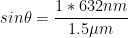


Now for another wavelength i.e. 659 nm
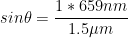


Now angular seperation between them is given by

Add Answer to:
If the distance between two slits is 1.5 µm and the distance to
a screen is...
In a Young's double slit experiment a screen is placed 85.0 cm from two slits that...
 In a Young's double slit experiment a screen is placed 85.0 cm from two slits that have a spacing of 0.300 mm. The slits are illuminated with coherent light with a wavelength of 540 nm. (a) What is the distance between the first and third-order dark fringes? (b) What is the distance between the first-order bright fringe and the second order dark fringe?
In a Young's double slit experiment, if the separation between the two slits is 0.050 mm...
In a Young's double slit experiment, if the separation between the two slits is 0.050 mm and the distance from the slits to a screen is 2.5 m, find the spacing between the first-order and second-order bright fringes for light with wavelength of 600 nm. Correct answer is 3cm but I'm not sure how. Can somebody show all work to get this step? Thank you so much.
In a double-slit experiment the distance between slits is 5.8 mm and the slits are 2.0...
In a double-slit experiment the distance between slits is 5.8 mm and the slits are 2.0 m from the screen. Two interference patterns can be seen on the screen: one due to light with wavelength 490 nm, and the other due to light with wavelength 565 nm. What is the separation on the screen between the third-order (m = 3) bright fringes of the two interference patterns? ________________m
A new experiment is created with the screen at a distance of 1.9 m from the...
A new experiment is created with the screen at a distance of 1.9 m from the slits (with spacing 0.1 mm). What is the distance between the second order bright fringe of light with l = 690 nm and the third order bright fringe of light with l = 420 nm? (Give the absolute value of the smallest possible distance between these two fringes: the distance between bright fringes on the same side of the central bright fringe.)
Monochromatic light (? = 440 nm) passes through two slits and onto a screen 3.0 m...
Monochromatic light (? = 440 nm) passes through two slits and onto a screen 3.0 m away. (a) If two nearby bright fringes are separated by 10 mm, what is the slit spacing? (b) If the slit spacing is reduced by a factor of four, what is the new distance between bright fringes? m
Monochromatic light (λ 470 nm) passes through two slits and onto a screen 3.0 m away....
 Monochromatic light (λ 470 nm) passes through two slits and onto a screen 3.0 m away. (a) If two nearby bright fringes are separated by 16 mm, what is the slit spacing? (b) If the slit spacing is reduced by a factor of two, what is the new distance between bright fringes?
A screen is seperated from a double-slit source by 1.20 m. The distance between the two...
A screen is seperated from a double-slit source by 1.20 m. The distance between the two slits is 0.05 mm. The fifth-order bright fringe is measured to be 9.0 cm from the centerline. Find a) the wavelength of light b) the distance between adjacent bright fringes
In a two-slit experiment using laser light, the distance between the slits and the screen is...
In a two-slit experiment using laser light, the distance between the slits and the screen is 1.10 m, and the distance between the slits is 0.040 mm. If the second order (m=2) bright fringe is measured to be 4.20 cm from the centerline on the screen, what is the wavelength of light?
Questions 1. In a single slit experiment, the distance between two dark fringes of the second...
 Questions 1. In a single slit experiment, the distance between two dark fringes of the second order is 10 cm on a screen which is 1.5 m away. If the wavelength of the light is 650 nm, find the width of the slit A laser light of A- 633nm shines on a wire and diffraction pattern is found on a screen 1 m away. The distance between the first two bright fringes is 8 cm. Find the diameter on the...
In a double-slit experiment the distance between slits is d = 4 mm and the distance...
In a double-slit experiment the distance between slits is d = 4 mm and the distance to the screen is 1.4 m. There are two interference patterns on the screen: one due to light with λ1=470 nm and another due light with λ2=610 nm. What is the separation between third order (m = 3) bright fringes of the two patterns?
 In a Young's double slit experiment a screen is placed 85.0 cm from two slits that have a spacing of 0.300 mm. The slits are illuminated with coherent light with a wavelength of 540 nm. (a) What is the distance between the first and third-order dark fringes? (b) What is the distance between the first-order bright fringe and the second order dark fringe?
 Monochromatic light (λ 470 nm) passes through two slits and onto a screen 3.0 m away. (a) If two nearby bright fringes are separated by 16 mm, what is the slit spacing? (b) If the slit spacing is reduced by a factor of two, what is the new distance between bright fringes?
 Questions 1. In a single slit experiment, the distance between two dark fringes of the second order is 10 cm on a screen which is 1.5 m away. If the wavelength of the light is 650 nm, find the width of the slit A laser light of A- 633nm shines on a wire and diffraction pattern is found on a screen 1 m away. The distance between the first two bright fringes is 8 cm. Find the diameter on the...
Most questions answered within 3 hours.
-
Where is the error in this code sequence?
String s1 = "Hello";
String s2 = "ello";...
asked 10 months ago -
Financial data for Joel de Paris, Inc., for last year
follow:
Joel de Paris, Inc.
Balance...
asked 10 months ago -
Consider this reaction:
Al2(SO4)3 (aq)+ BaCl3
(aq) Al2Cl6 (aq)- +
3BaSO4(s) . What is the...
asked 10 months ago -
Suppose that Savneet is considering increasing her
recent random sample from 20 car rentals to 40...
asked 10 months ago -
Trucks arrive at an unloading terminal at an average rate of 120
per hour.
Trucks arrive...
asked 10 months ago -
Why are methanol and ethanol completely soluble in water while
octanol is not very little soluble....
asked 10 months ago -
A facilities manager at a university reads in a research report
that the mean amount of...
asked 10 months ago -
When the CuSO4 is rehydrated by adding water to the anhydrous
compound, is this an endothermic...
asked 10 months ago -
A ray of sunlight is passing from diamond into crown glass; the
angle of incidence is...
asked 10 months ago -
A block of mass 0.249 kg is placed on top of a light, vertical
spring of...
asked 10 months ago -
how do the kidneys compensate in the presences of acidosis
a) trigger hyperventilate
b) reserve acid...
asked 10 months ago -
Question 501 pts
The rental rate of capital to the firm increases. Which of the
following...
asked 10 months ago