
Homework Answers
| Activity | ES | EF | LS | LF | Slack |
| A | 0 | 2 | 0 | 2 | 0 |
| B | 2 | 5 | 4 | 7 | 2 |
| C | 2 | 6 | 2 | 6 | 0 |
| D | 2 | 4 | 6 | 8 | 4 |
| E | 5 | 10 | 7 | 12 | 2 |
| F | 6 | 9 | 9 | 12 | 3 |
| G | 4 | 7 | 8 | 11 | 4 |
| H | 10 | 12 | 12 | 14 | 2 |
| I | 6 | 11 | 6 | 11 | 0 |
| J | 11 | 13 | 14 | 16 | 3 |
| K | 11 | 15 | 11 | 15 | 0 |
| L | 12 | 15 | 14 | 17 | 2 |
| M | 13 | 14 | 16 | 17 | 3 |
| N | 15 | 17 | 15 | 17 | 0 |
Critical path is the path joining the activites with zero slack i.e. ACIKN. Activity duration is 17 days,
Add Answer to:
6. Find the critical path, early expected time, and latest start time from the given activity...
9. Given the following information in the table, construct an activity on the node diagram. Label the critical path as well as the early and late start/finish times and the slack for each activit...
 9. Given the following information in the table, construct an activity on the node diagram. Label the critical path as well as the early and late start/finish times and the slack for each activity. (20 points) Predecessor Duration (Days) Activity A, B C, D F,G
9. Given the following information in the table, construct an activity on the node diagram. Label the critical path as well as the early and late start/finish times and the slack for each activity. (20...
9. Given the following information in the table, construct an activity on the node diagram. Label the critical path as well as the early and late start/finish times and the slack for each activity. (20 points) Predecessor Duration (Days) Activity A, B C, D F,G
9. Given the following information in the table, construct an activity on the node diagram. Label the critical path as well as the early and late start/finish times and the slack for each activity. (20...
Lecture Exercise #12 Critical Path Method . Determine the early start, early finish, late start, late...
 Lecture Exercise #12 Critical Path Method . Determine the early start, early finish, late start, late finish times for each activity Identify the critical path Activity Time (days) Predecessor(s) . A 6 None B 7 None с 3 A D 2 A E 4 B F 6 B G 10 C, E D, F H 7 ))
(3) Determine the critical path and critical time of the network shown below. Use the critical...
 (3) Determine the critical path and critical time of the network
shown below. Use the critical path method (the table of ES, EF,
etc.).
(3) Determine the critical path and critical time of the network shown below. Use the critical path method (the table of ES, EF, etc.). po Problem . Example a 100 For all starting activities, ES is taken as 0. Activities 1-2, 1-3 gets ES of O. Find EF-ES +time. Activity Time ES E F LS L...
(3) Determine the critical path and critical time of the network
shown below. Use the critical path method (the table of ES, EF,
etc.).
(3) Determine the critical path and critical time of the network shown below. Use the critical path method (the table of ES, EF, etc.). po Problem . Example a 100 For all starting activities, ES is taken as 0. Activities 1-2, 1-3 gets ES of O. Find EF-ES +time. Activity Time ES E F LS L...
8.6: From the following network data, determine the critical path, early start, early finish, late start,...
 8.6: From the following network data, determine the critical path, early start, early finish, late start, late finish, total float, and free float for each activity. Highlight the critical path. E B 3 С F A 2 K N o G 2
11 The following activity times are given: Determine the following a) Earliest start time b) Earliest...
11 The following activity times are given: Determine the following a) Earliest start time b) Earliest finish time c) Latest Start Time d) Latest finish time e) Critical Path Activity Completion time( in months) 1-2 5 1-3 6 1-4 2 2-5 3 2-6 1 3-5 3 4-5 0 4-7 2 5-8 9 5-7 5 7-8 4 6-9 7 8-9 3
Problem 9-14 Given the following activity times in months, determine the items listed below: Time Estimates...
 Problem 9-14 Given the following activity times in months, determine the items listed below: Time Estimates (months) Activity Activity Predecessor а т 4 12 A B 6 10 15 С 2 10 14 1 D A 4 13 E A 3 F В 3 6 18 G 2 8 12 Н С.Е.F С.Е.F 15 22 I 5 12 21 J D 20 25 K G.I 5 12 L Н.К 3 20 Expected activity times b. Variance times а. c. Earliest...
11. In CPM/PERT, an activity that is on the critical path A. has equal values for...
11. In CPM/PERT, an activity that is on the critical path A. has equal values for "Latest Start" and "Earliest Start" ( LS = ES ) B. has equal values for "Latest Finish" and "Earliest Finish" ( LF = EF ) C. is used in calculating total project duration D. has slack equal to zero E. all of the above 12. In CPM/PERT, the critical path through the network A. will require the most time of any path B. will...
Consider the following project activities: Calculate the expected time (te) for each activity. Draw an Activity...
 Consider the following project activities:
Calculate the expected time (te) for each
activity.
Draw an Activity on Node (AON) diagram to reflect the flow of
these activities.
Calculate the Early Start (ES), Early Finish (EF), Late Start
(LS), and Late Finish (LF) for each activity.
Calculate the slack for each activity.
Identify all activities on the Critical Path.
Use the data to calculate the probability the project will
finish in 20 weeks (Hint: z-score).
Activity A 8 с D E...
Consider the following project activities:
Calculate the expected time (te) for each
activity.
Draw an Activity on Node (AON) diagram to reflect the flow of
these activities.
Calculate the Early Start (ES), Early Finish (EF), Late Start
(LS), and Late Finish (LF) for each activity.
Calculate the slack for each activity.
Identify all activities on the Critical Path.
Use the data to calculate the probability the project will
finish in 20 weeks (Hint: z-score).
Activity A 8 с D E...
Also find the total float activity of E ... Number of the critical path is ......
 Also find the total float activity of E ...
Number of the critical path is ...
The late finish of activity F is...
thank you,
Project ALPHA has 6 Activities from A to F as follows: Activity Duration Preceded By A 5 B А С 7 A D 6 B 7 c E F E The number of non-critical activities is Select one! 1 all activities are non-critical 0 2 None of the given answers Skip this question to avoid...
Also find the total float activity of E ...
Number of the critical path is ...
The late finish of activity F is...
thank you,
Project ALPHA has 6 Activities from A to F as follows: Activity Duration Preceded By A 5 B А С 7 A D 6 B 7 c E F E The number of non-critical activities is Select one! 1 all activities are non-critical 0 2 None of the given answers Skip this question to avoid...
Question 14 Assume that activity F has the following times: Early start time (ES) = 7...
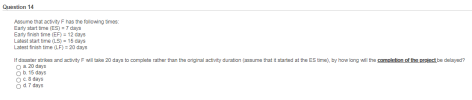 Question 14 Assume that activity F has the following times: Early start time (ES) = 7 days Early finish time (EF) = 12 days Latest start time (LS) = 15 days Latest finish time (LF) = 20 days If disaster strikes and activity F will take 20 days to complete rather than the original activity duration (assume that it started at the ES time), by how long will the completion of the project be delayed? O a. 20 days b....
 9. Given the following information in the table, construct an activity on the node diagram. Label the critical path as well as the early and late start/finish times and the slack for each activity. (20 points) Predecessor Duration (Days) Activity A, B C, D F,G
9. Given the following information in the table, construct an activity on the node diagram. Label the critical path as well as the early and late start/finish times and the slack for each activity. (20...
9. Given the following information in the table, construct an activity on the node diagram. Label the critical path as well as the early and late start/finish times and the slack for each activity. (20 points) Predecessor Duration (Days) Activity A, B C, D F,G
9. Given the following information in the table, construct an activity on the node diagram. Label the critical path as well as the early and late start/finish times and the slack for each activity. (20...
 Lecture Exercise #12 Critical Path Method . Determine the early start, early finish, late start, late finish times for each activity Identify the critical path Activity Time (days) Predecessor(s) . A 6 None B 7 None с 3 A D 2 A E 4 B F 6 B G 10 C, E D, F H 7 ))
 (3) Determine the critical path and critical time of the network
shown below. Use the critical path method (the table of ES, EF,
etc.).
(3) Determine the critical path and critical time of the network shown below. Use the critical path method (the table of ES, EF, etc.). po Problem . Example a 100 For all starting activities, ES is taken as 0. Activities 1-2, 1-3 gets ES of O. Find EF-ES +time. Activity Time ES E F LS L...
(3) Determine the critical path and critical time of the network
shown below. Use the critical path method (the table of ES, EF,
etc.).
(3) Determine the critical path and critical time of the network shown below. Use the critical path method (the table of ES, EF, etc.). po Problem . Example a 100 For all starting activities, ES is taken as 0. Activities 1-2, 1-3 gets ES of O. Find EF-ES +time. Activity Time ES E F LS L...
 8.6: From the following network data, determine the critical path, early start, early finish, late start, late finish, total float, and free float for each activity. Highlight the critical path. E B 3 С F A 2 K N o G 2
 Problem 9-14 Given the following activity times in months, determine the items listed below: Time Estimates (months) Activity Activity Predecessor а т 4 12 A B 6 10 15 С 2 10 14 1 D A 4 13 E A 3 F В 3 6 18 G 2 8 12 Н С.Е.F С.Е.F 15 22 I 5 12 21 J D 20 25 K G.I 5 12 L Н.К 3 20 Expected activity times b. Variance times а. c. Earliest...
 Consider the following project activities:
Calculate the expected time (te) for each
activity.
Draw an Activity on Node (AON) diagram to reflect the flow of
these activities.
Calculate the Early Start (ES), Early Finish (EF), Late Start
(LS), and Late Finish (LF) for each activity.
Calculate the slack for each activity.
Identify all activities on the Critical Path.
Use the data to calculate the probability the project will
finish in 20 weeks (Hint: z-score).
Activity A 8 с D E...
Consider the following project activities:
Calculate the expected time (te) for each
activity.
Draw an Activity on Node (AON) diagram to reflect the flow of
these activities.
Calculate the Early Start (ES), Early Finish (EF), Late Start
(LS), and Late Finish (LF) for each activity.
Calculate the slack for each activity.
Identify all activities on the Critical Path.
Use the data to calculate the probability the project will
finish in 20 weeks (Hint: z-score).
Activity A 8 с D E...
 Also find the total float activity of E ...
Number of the critical path is ...
The late finish of activity F is...
thank you,
Project ALPHA has 6 Activities from A to F as follows: Activity Duration Preceded By A 5 B А С 7 A D 6 B 7 c E F E The number of non-critical activities is Select one! 1 all activities are non-critical 0 2 None of the given answers Skip this question to avoid...
Also find the total float activity of E ...
Number of the critical path is ...
The late finish of activity F is...
thank you,
Project ALPHA has 6 Activities from A to F as follows: Activity Duration Preceded By A 5 B А С 7 A D 6 B 7 c E F E The number of non-critical activities is Select one! 1 all activities are non-critical 0 2 None of the given answers Skip this question to avoid...
 Question 14 Assume that activity F has the following times: Early start time (ES) = 7 days Early finish time (EF) = 12 days Latest start time (LS) = 15 days Latest finish time (LF) = 20 days If disaster strikes and activity F will take 20 days to complete rather than the original activity duration (assume that it started at the ES time), by how long will the completion of the project be delayed? O a. 20 days b....
Most questions answered within 3 hours.
-
Where is the error in this code sequence?
String s1 = "Hello";
String s2 = "ello";...
asked 10 months ago -
Financial data for Joel de Paris, Inc., for last year
follow:
Joel de Paris, Inc.
Balance...
asked 10 months ago -
Consider this reaction:
Al2(SO4)3 (aq)+ BaCl3
(aq) Al2Cl6 (aq)- +
3BaSO4(s) . What is the...
asked 10 months ago -
Suppose that Savneet is considering increasing her
recent random sample from 20 car rentals to 40...
asked 10 months ago -
Trucks arrive at an unloading terminal at an average rate of 120
per hour.
Trucks arrive...
asked 10 months ago -
Why are methanol and ethanol completely soluble in water while
octanol is not very little soluble....
asked 10 months ago -
A facilities manager at a university reads in a research report
that the mean amount of...
asked 10 months ago -
When the CuSO4 is rehydrated by adding water to the anhydrous
compound, is this an endothermic...
asked 10 months ago -
A ray of sunlight is passing from diamond into crown glass; the
angle of incidence is...
asked 10 months ago -
A block of mass 0.249 kg is placed on top of a light, vertical
spring of...
asked 10 months ago -
how do the kidneys compensate in the presences of acidosis
a) trigger hyperventilate
b) reserve acid...
asked 10 months ago -
Question 501 pts
The rental rate of capital to the firm increases. Which of the
following...
asked 10 months ago